Surgery: the only book you need to pass final year
Bailey & Love and S Das, cut down to what you need to pass the MBBS final-year Surgery exam. 33 chapters, named as in Bailey & Love, each in the same three parts: the theory, how to examine the patient with a ready case sheet, and revision with exam answers and viva cards.
Full book, all 35 PDFs. Or any single chapter for ₹99. Price includes GST.
What is inside
- 33 chapters, about 1,516 A4 pages, from shock and transfusion to the testis, scrotum and penis.
- Part A, theory: each topic told as a short story first, key words in bold, tables and simple diagrams you can draw.
- Part B, clinical: how to examine, step by step, then the case sheet written out.
- Part C, revision: the questions examiners ask most in university papers, ready answers, viva cards and a one-page recap.
- Full book only: the Night-before edition (Part C of every chapter in one 315-page PDF) and Signs, Triads and Eponyms.
Every fact is checked against Bailey & Love (28th edition) and S Das. PDFs open on any phone, tablet or laptop and stay on your device. Every copy carries your name across each page and your name and number in the footer: it is for your own study, please do not share it.
Look inside
Carcinoma breast was asked 99 times in 591 final-year Surgery papers from 21 universities (2005–2026). We counted every question, so each chapter tells you what examiners ask most, with a ready answer for it.
Famous topics: what examiners ask most
Chapters
1,854 pages in all. Single chapters are ₹99 each; if you later buy the full book you pay ₹599 minus what you spent on chapters.
General principles
- Preoperative and Postoperative Care
Preview and contents
What you get (44 pages)- Consent is a conversation, not a signature
- Three checks: sign in, time out, sign out
- Fever after surgery: lung, urine, wound, drip, calf, belly
- Conversion to open is judgement, not failure
- Audit asks "are we doing it right?" and then asks again
- Most asked: laparoscopy (31×)
Asked most in previous papers31× Principles of laparoscopic and minimal access surgery17× Informed consent: steps, content, forms14× Day care (day case) surgeryPart A · TheoryThe story · Before the operation · Consent · Ethics and the law · Safety in theatre · Audit and research · Keyhole and robotic surgery · Day surgery · After the operation · Post-operative complications · Ryle's tube and drains · TransplantationPart B · ClinicalHow to examine after surgery · Case sheetPart C · RevisionWhat examiners ask · Exam answers · Viva cards · Night-before recap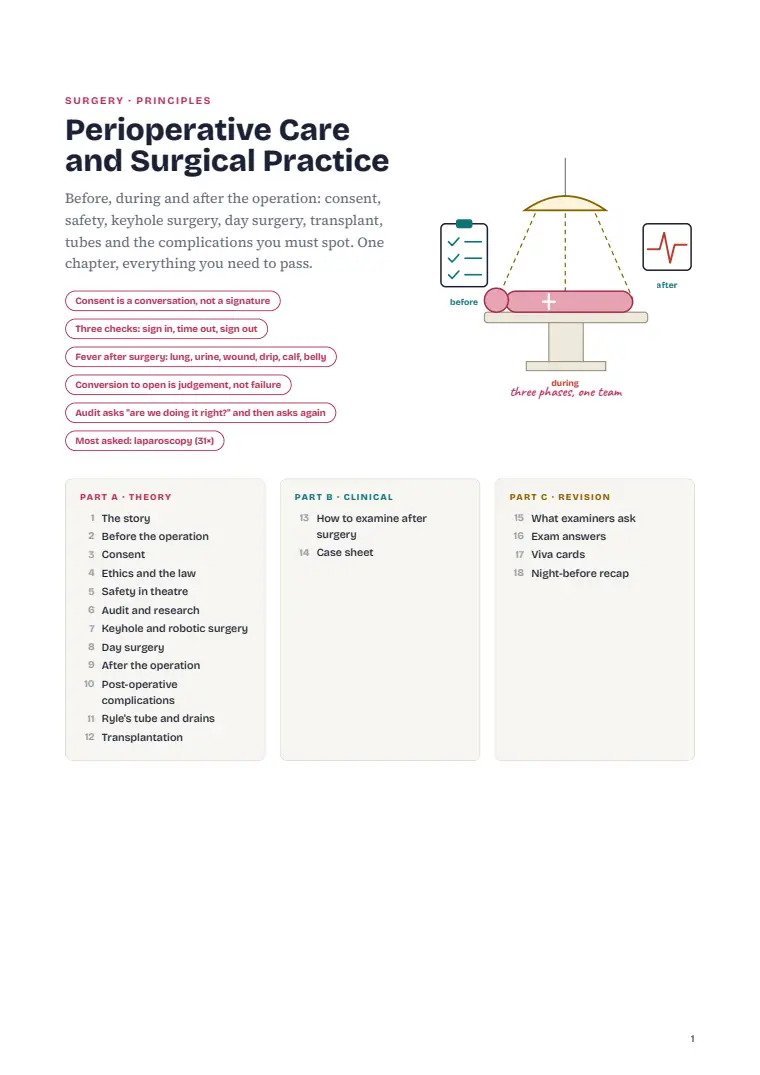
p. 1 · First page 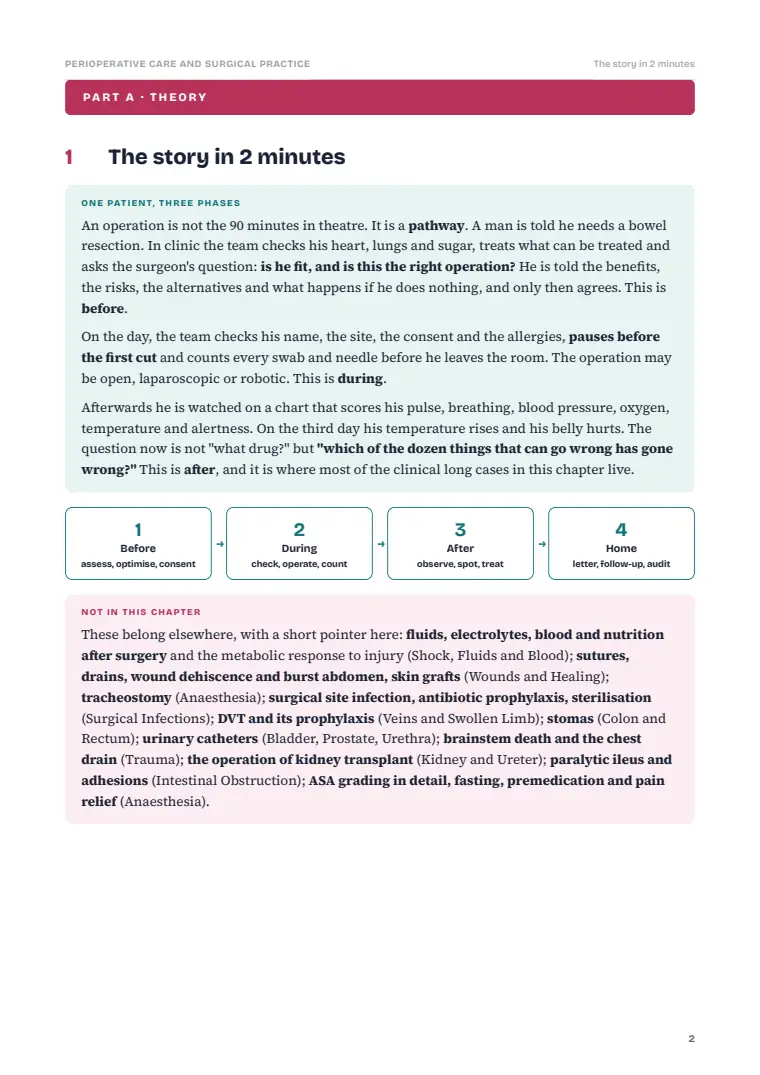
p. 2 · Inside the chapter 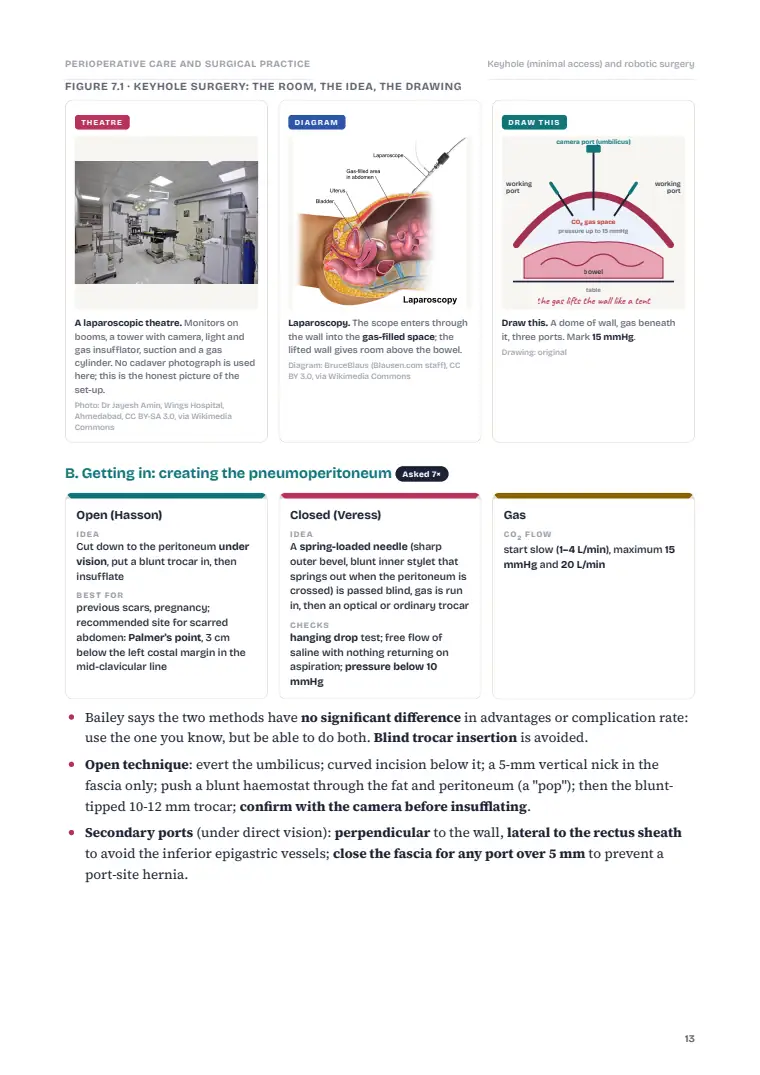
p. 13 · Inside the chapter 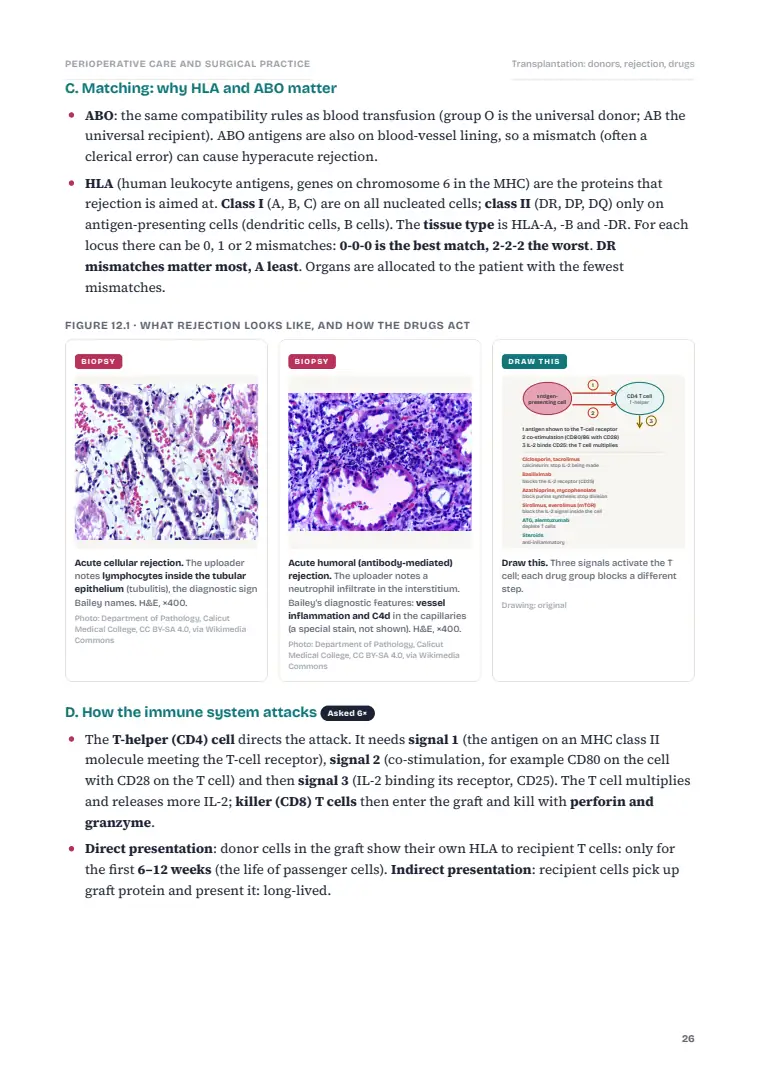
p. 26 · Inside the chapter 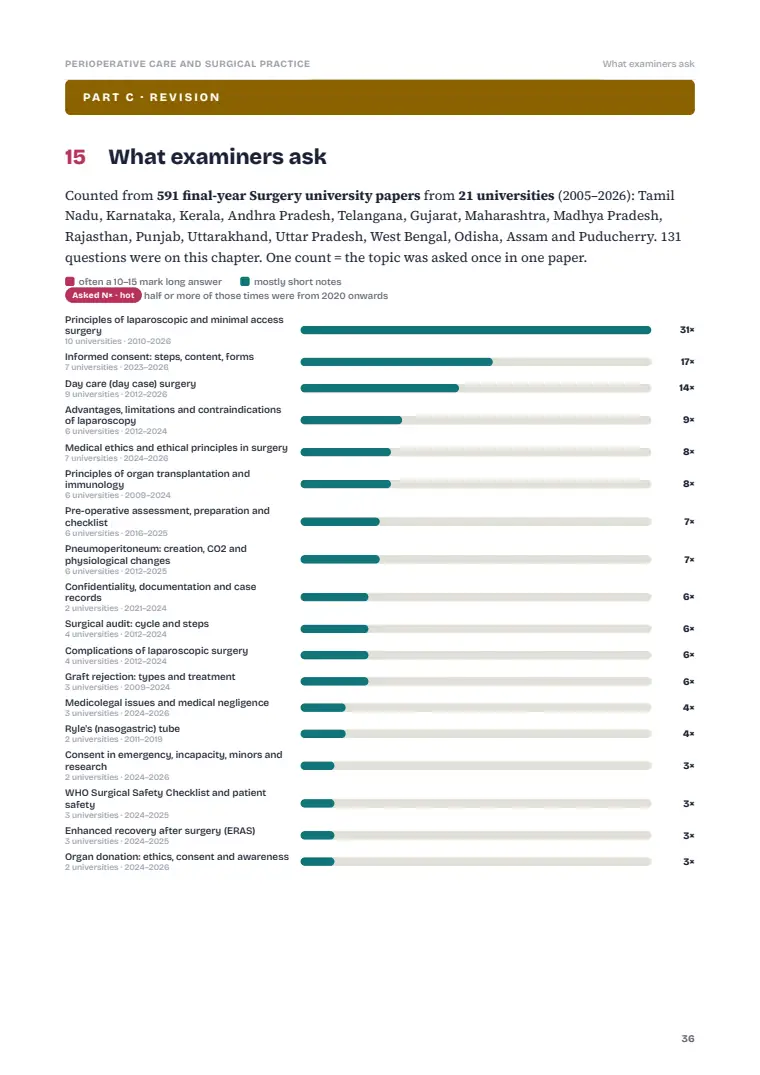
p. 36 · What examiners ask: previous years' questions - Wound Healing and Tissue Repair
Preview and contents
What you get (47 pages)- Four overlapping phases
- Close without tension
- Keloid crosses the wound edge
- A graft needs a bed; a flap brings its own blood
- Most asked: phases of wound healing (62×)
Asked most in previous papers62× Phases / stages of wound healing55× Factors affecting wound healing50× Keloid and hypertrophic scarPart A · TheoryThe story · The skin for the surgeon · Classifying wounds · The four phases of healing · Primary, secondary, delayed · Factors affecting healing · Scars, keloid, contracture · Chronic wounds, sinus · Wound care: debridement, dressings, NPWT · Sutures, needles, knots · Drains · Skin grafts and substitutes · Flaps · Dehiscence, incisional carePart B · ClinicalHow to examine · Case sheetPart C · RevisionWhat examiners ask · Exam answers · Viva cards · Night-before recap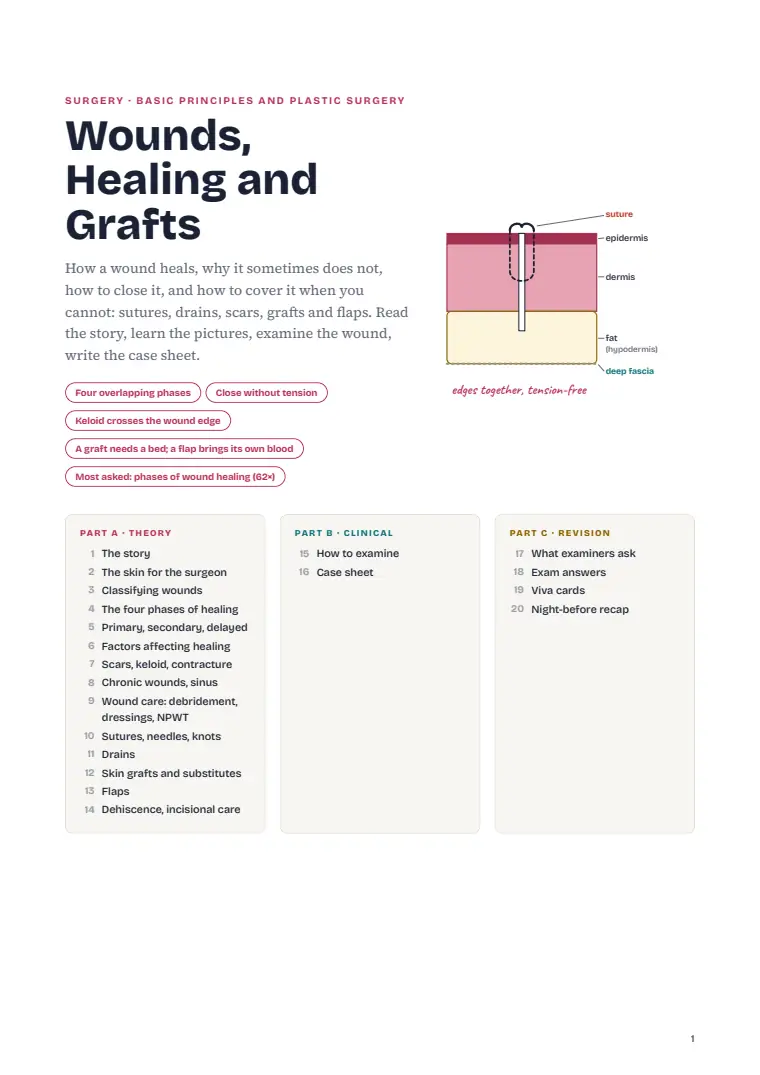
p. 1 · First page 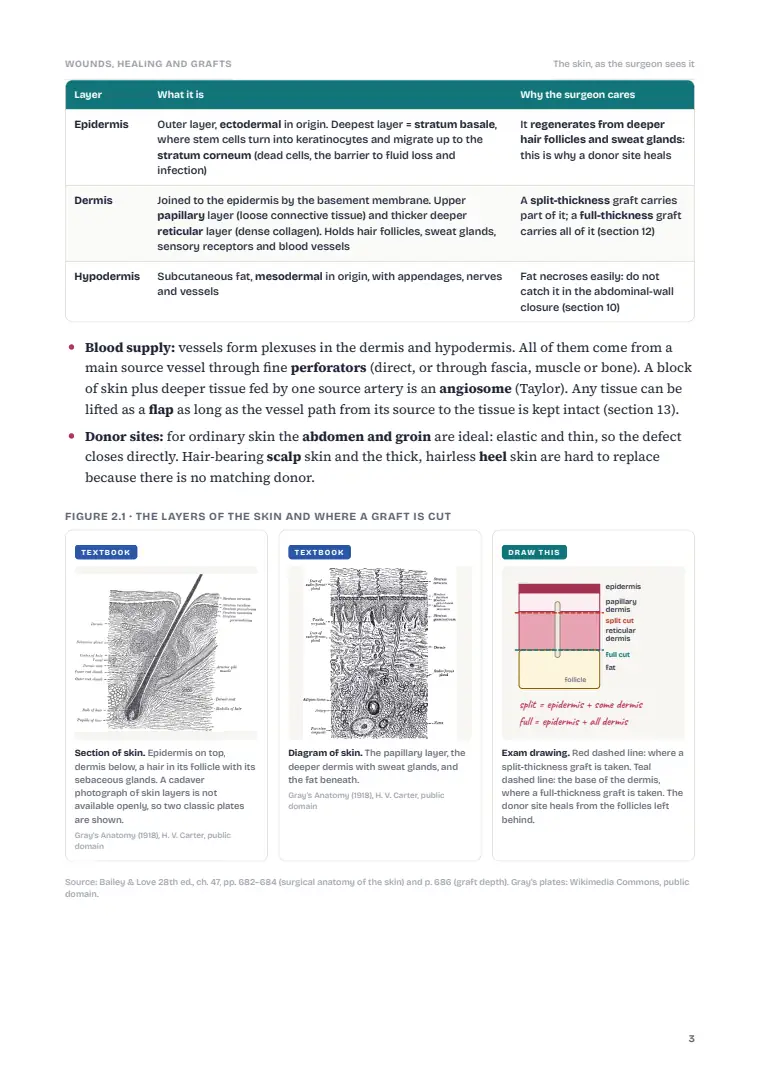
p. 3 · Inside the chapter 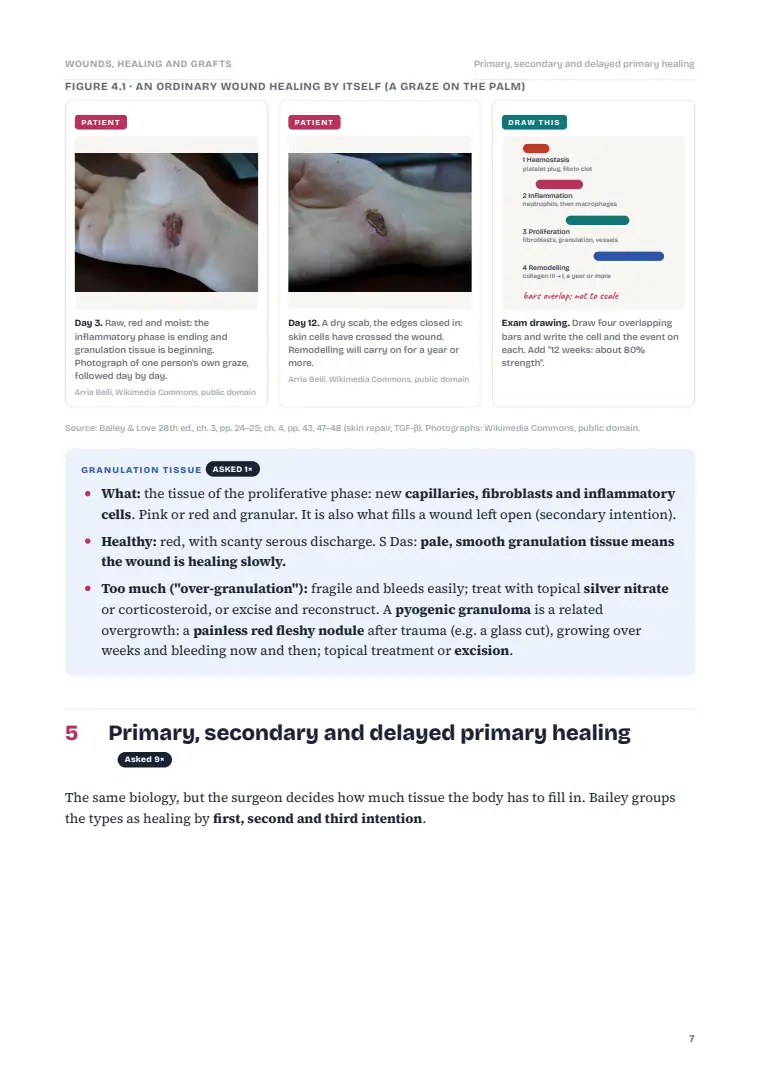
p. 7 · Inside the chapter 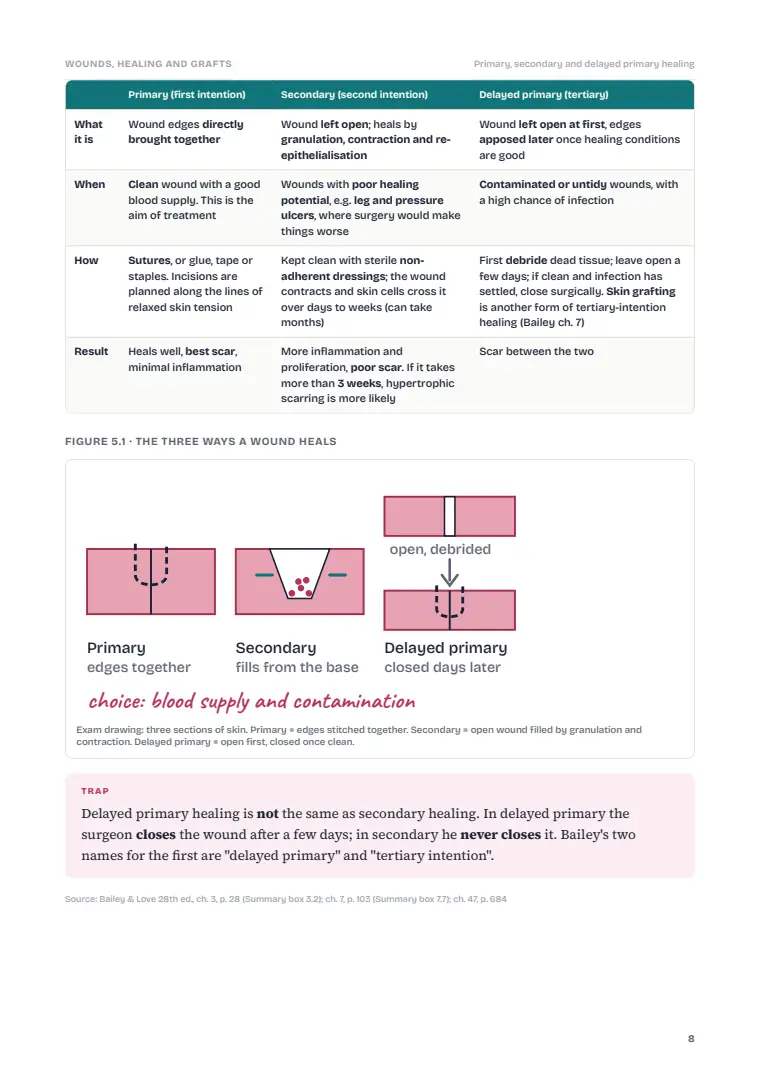
p. 8 · Inside the chapter 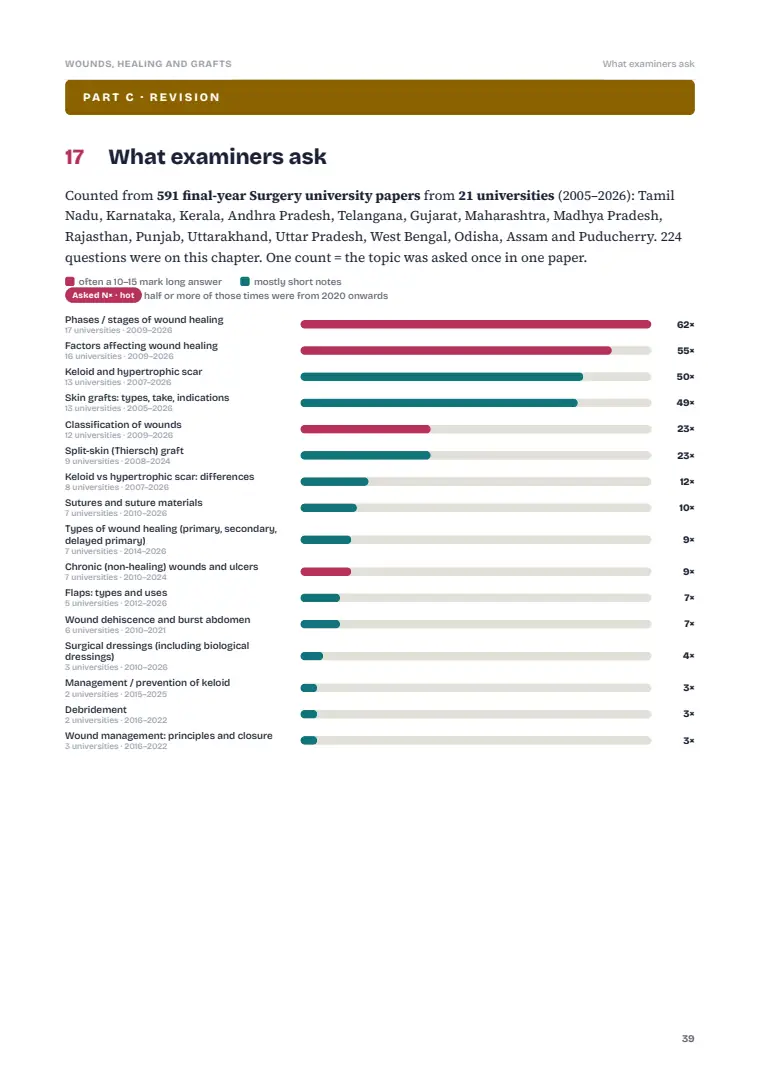
p. 39 · What examiners ask: previous years' questions - Surgical Infection
Preview and contents
What you get (46 pages)- Pus needs drainage
- Cellulitis: no edge, no pus
- Pain out of proportion: necrotising
- Gas and sweet smell: gas gangrene
- Toxoid plus ATG for dirty wounds
- Most asked: gas gangrene (42×)
Asked most in previous papers42× Gas gangrene: aetiology, clinical features, management42× Cold abscess and collar-stud abscess (neck, chest wall, psoas)33× Tuberculous cervical lymphadenitis: stages, features, treatmentPart A · TheoryThe story · Bugs, sources, defences · Abscess · Boil, carbuncle · Cellulitis, lymphangitis · Necrotising infection, Fournier · Gas gangrene · Tetanus · Tuberculosis in surgery · Actinomycosis, mycetoma, sinus · Sepsis, SIRS · Surgical site infection · Prevention, prophylaxis · Antibiotics · HIV, hepatitis, precautionsPart B · ClinicalHow to examine · Case sheetPart C · RevisionWhat examiners ask · Exam answers · Viva cards · Night-before recap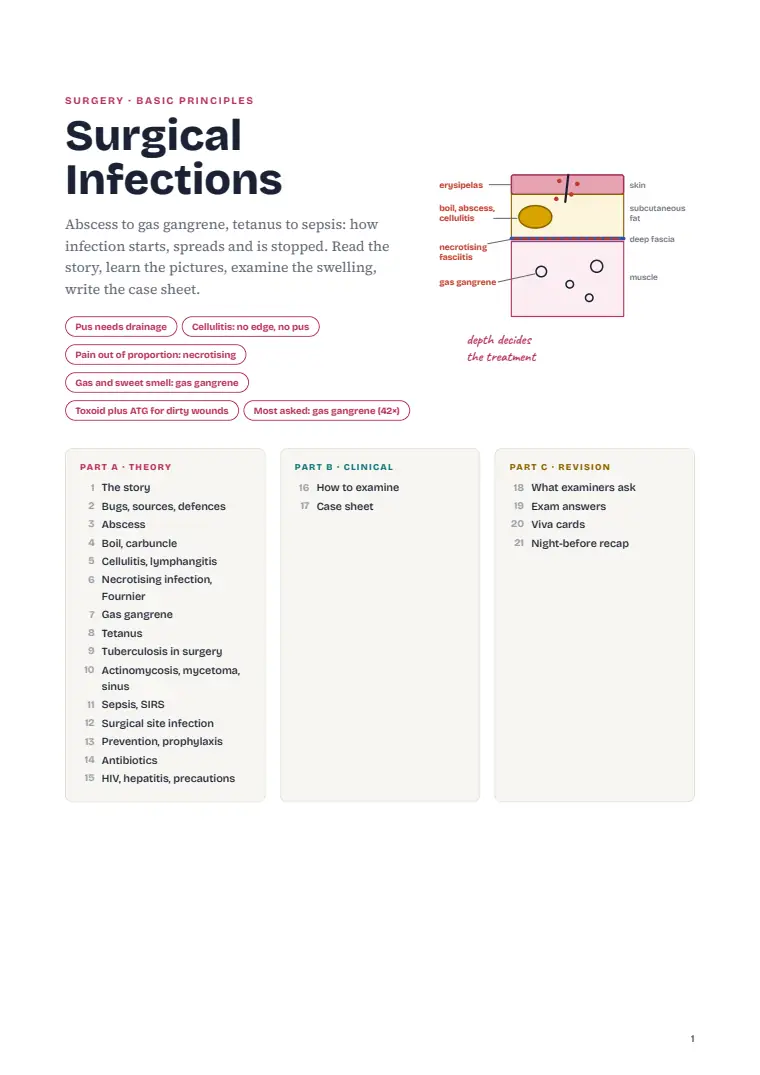
p. 1 · First page 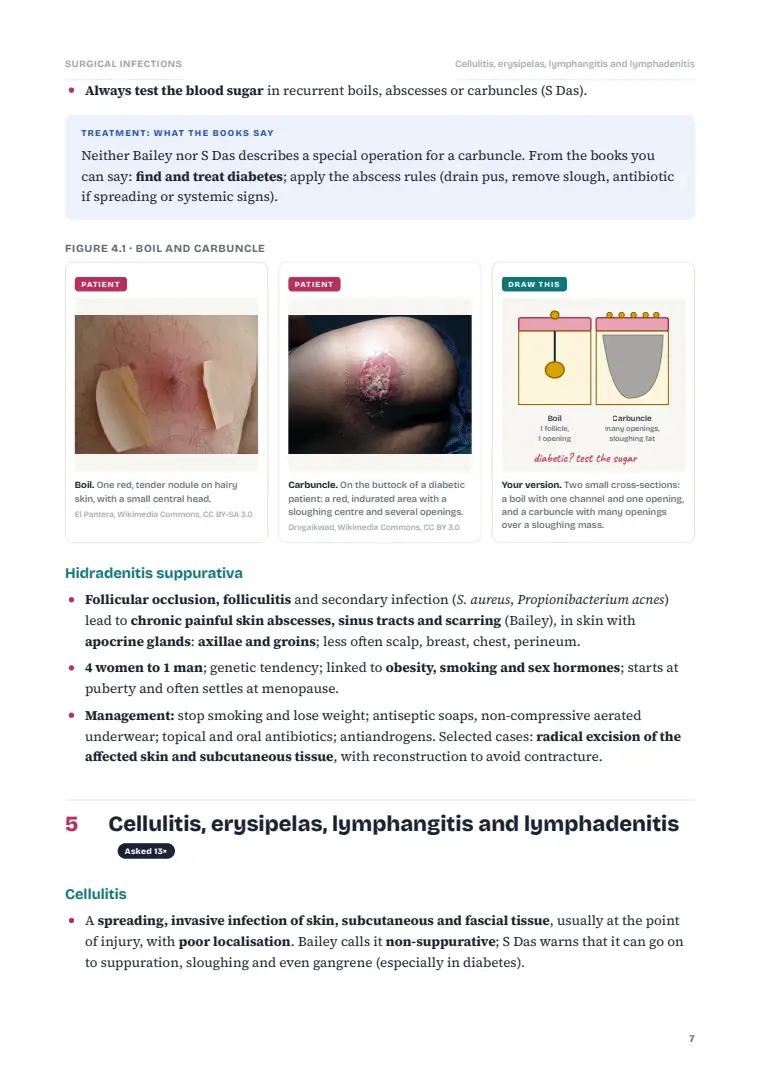
p. 7 · Inside the chapter 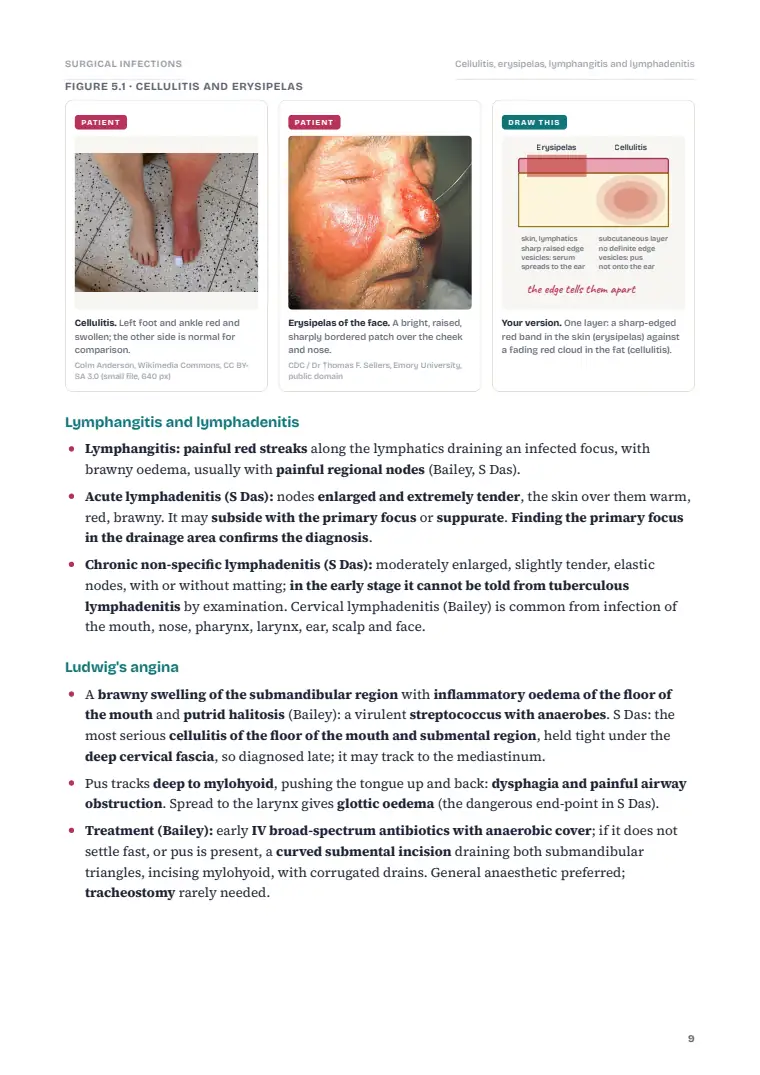
p. 9 · Inside the chapter 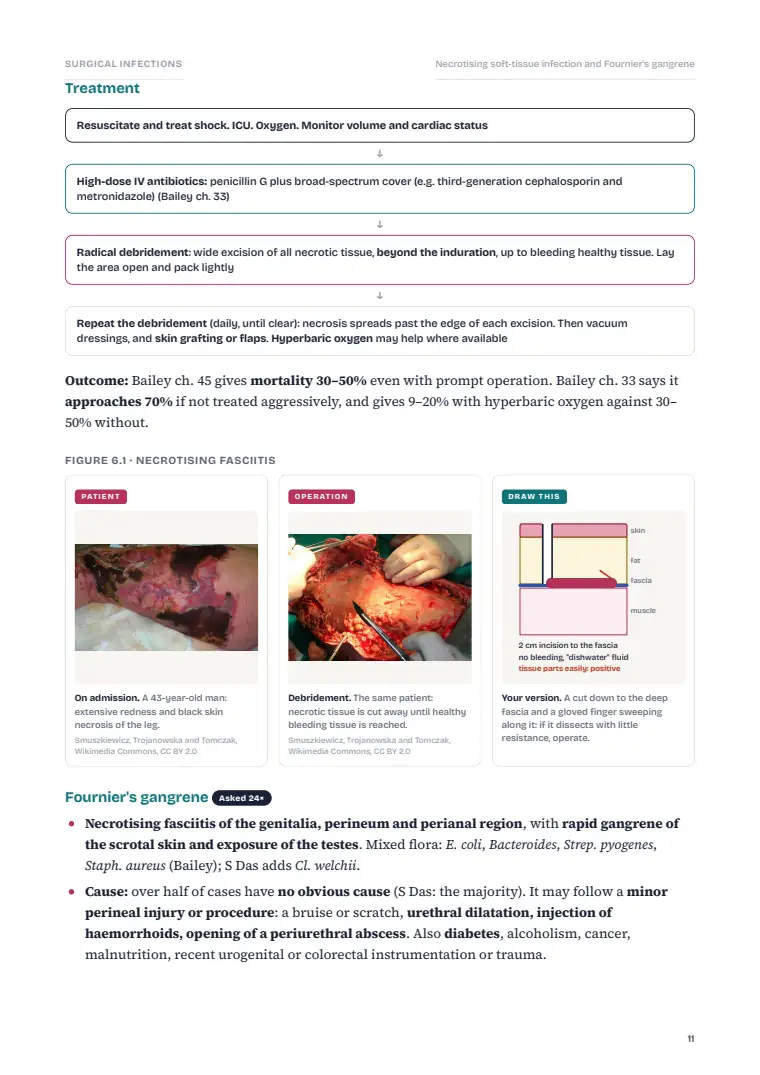
p. 11 · Inside the chapter 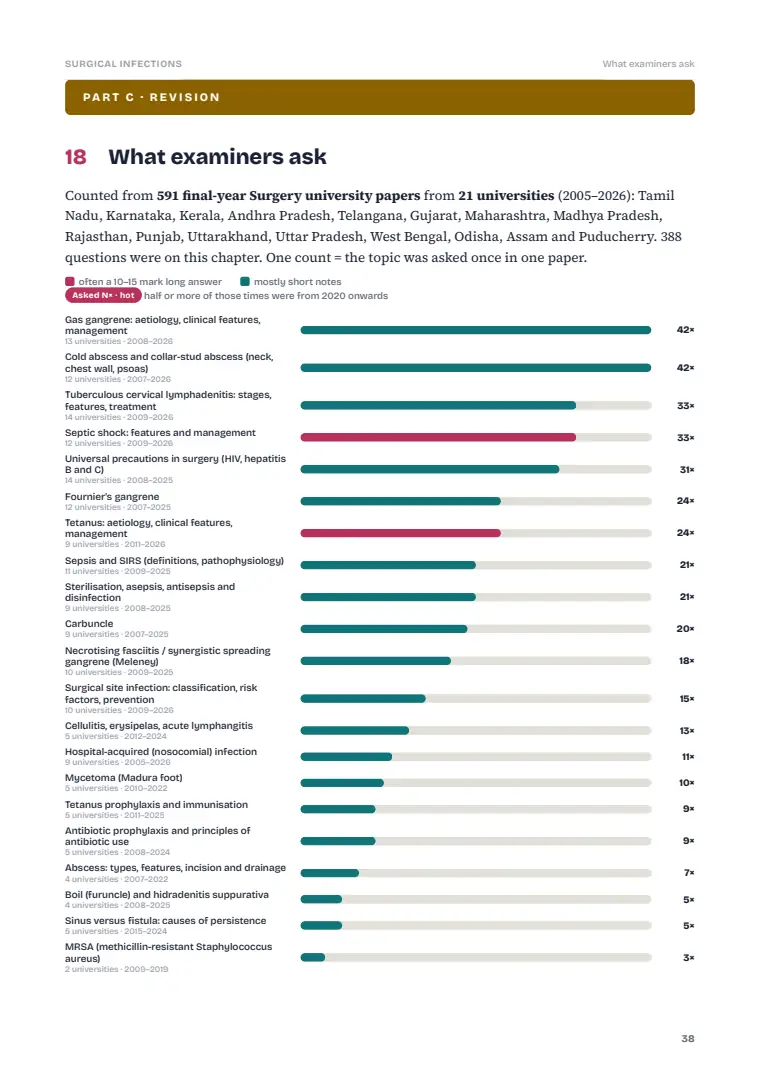
p. 38 · What examiners ask: previous years' questions - Shock, Haemorrhage and Transfusion
Preview and contents
What you get (48 pages)- Low BP is a late sign
- Bleeding: stop it first
- Lost blood: replace with blood
- Urine under 0.5 mL/kg/h: not enough
- Massive transfusion: clot, calcium, potassium, cold
- Most asked: transfusion complications (74×)
Asked most in previous papers74× Complications of blood transfusion66× Shock: definition, classification, pathophysiology, stages45× Hypovolaemic / haemorrhagic shock: features and managementPart A · TheoryThe story · What shock is · Kinds of shock · Haemorrhage · Resuscitation and monitoring · Septic shock · Body water, dehydration · IV fluids · Sodium and water · Potassium · Calcium, magnesium · Acid and base · Blood and its products · Transfusion risks · Clotting problems · Surgical nutrition · Response to injuryPart B · ClinicalHow to examine a shocked patient · Case sheetPart C · RevisionWhat examiners ask · Exam answers · Viva cards · Night-before recap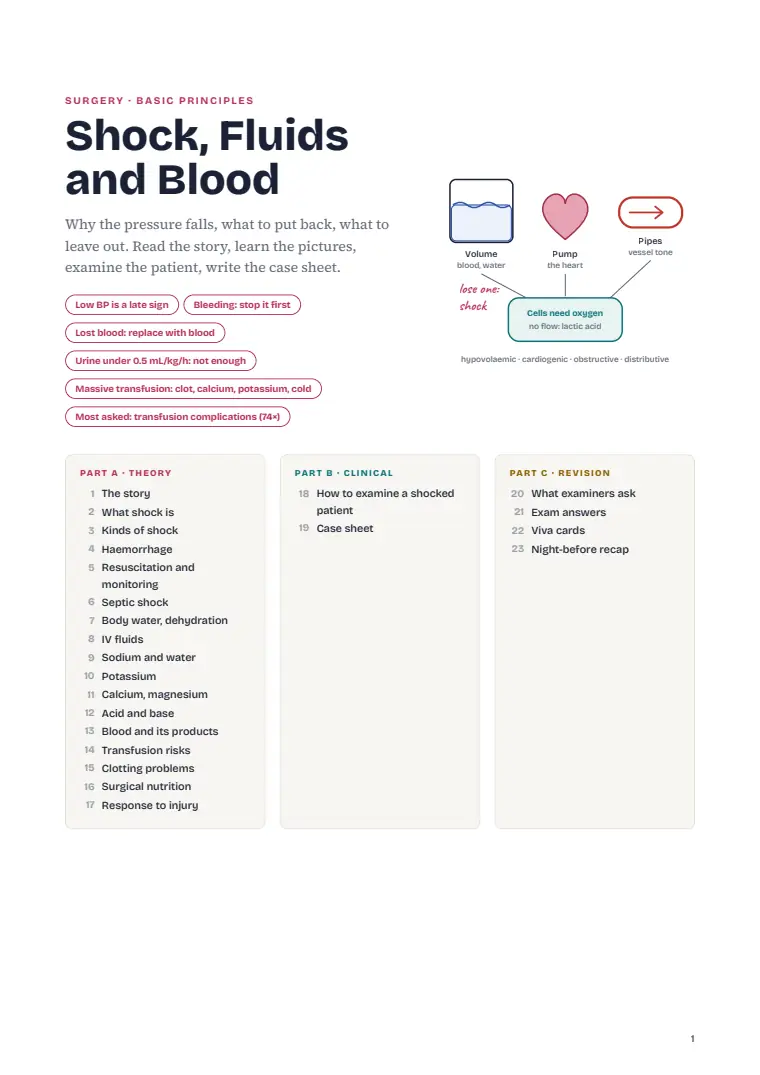
p. 1 · First page 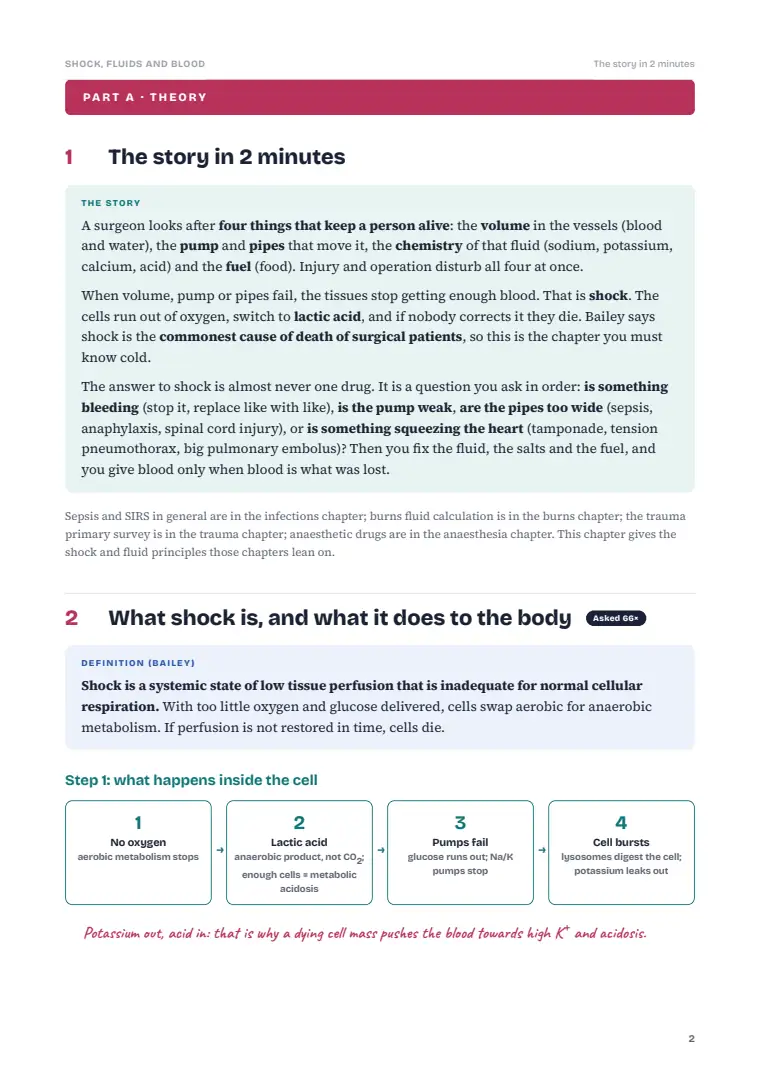
p. 2 · Inside the chapter 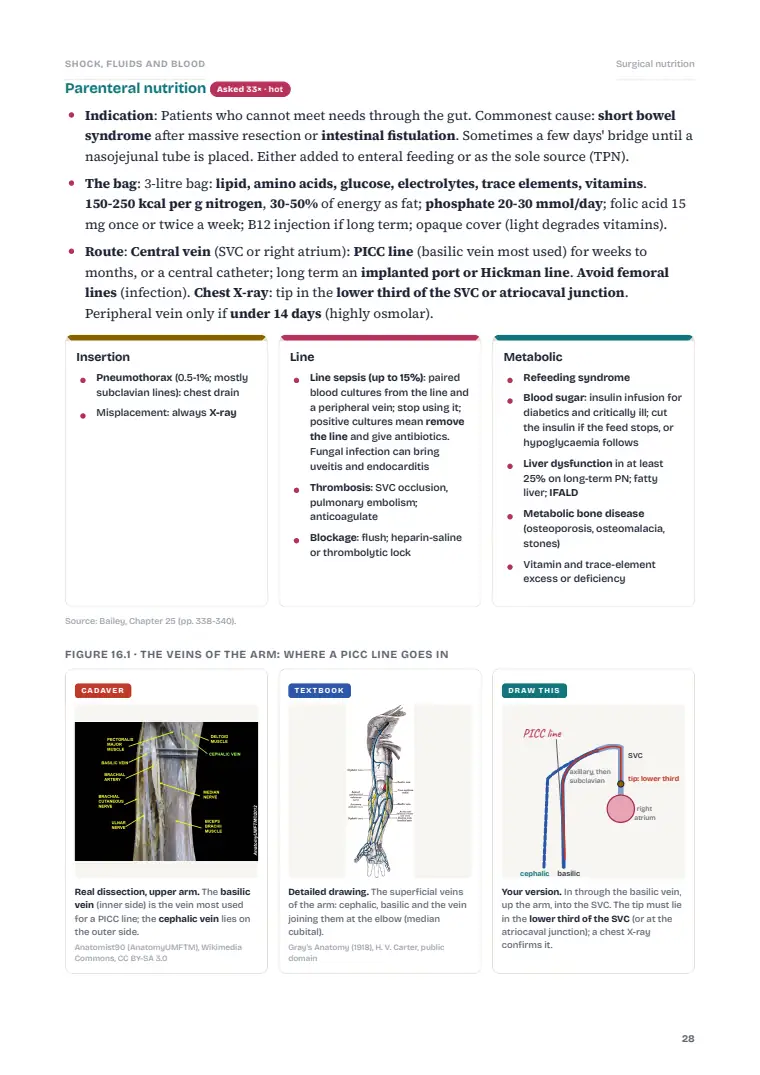
p. 28 · Inside the chapter 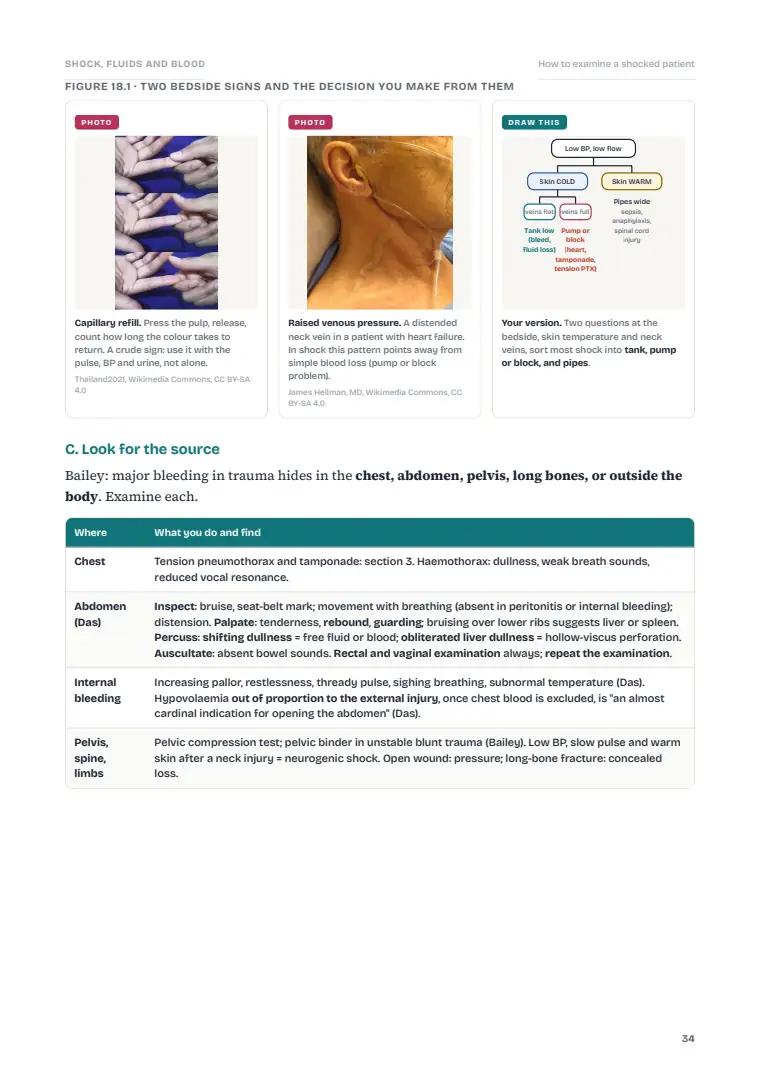
p. 34 · Inside the chapter 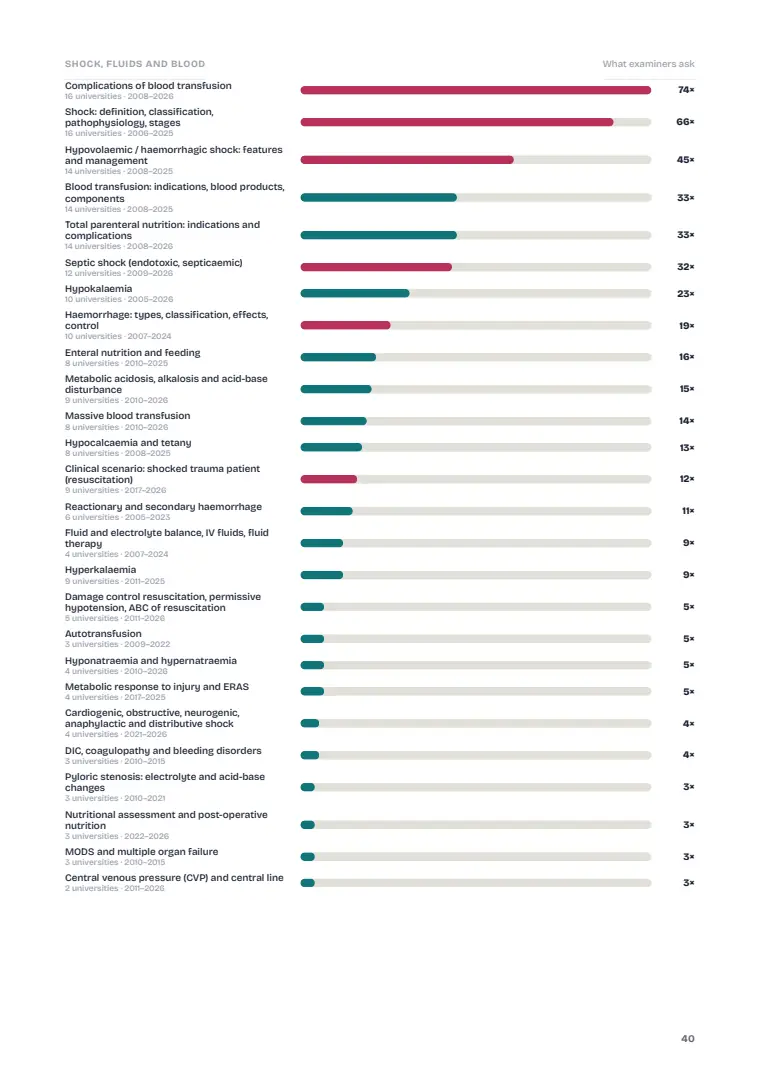
p. 40 · What examiners ask: previous years' questions - Burns
Preview and contents
What you get (46 pages)- Size, depth, airway, fluid
- Above 15% (adult): drip
- 4 × kg × % in 24 hours
- Half in 8 hours, counted from the burn
- Hoarse voice: secure the airway early
- Most asked: management of a burns case (64×)
- Then: classification (34×), rule of nines (33×), fluids (30×)
Asked most in previous papers64× Management of a major burn (a '% burns' case)34× Burns: classification (depth and cause) and types33× Assessing the size of a burn: rule of nines, Lund and BrowderPart A · TheoryThe story · The skin and what heat does to it · Classifying burns · What a big burn does to the body · Size and depth · First aid and the first hour · The burned airway, smoke, CO · Fluid resuscitation · Treating the burn wound · Pain, food, infection, nursing · Scars, contractures, reconstruction · Electrical, chemical, radiation, coldPart B · ClinicalHow to assess a burn patient · Case sheet: burns in an adultPart C · RevisionWhat examiners ask · Exam answers · Viva cards · Night-before recap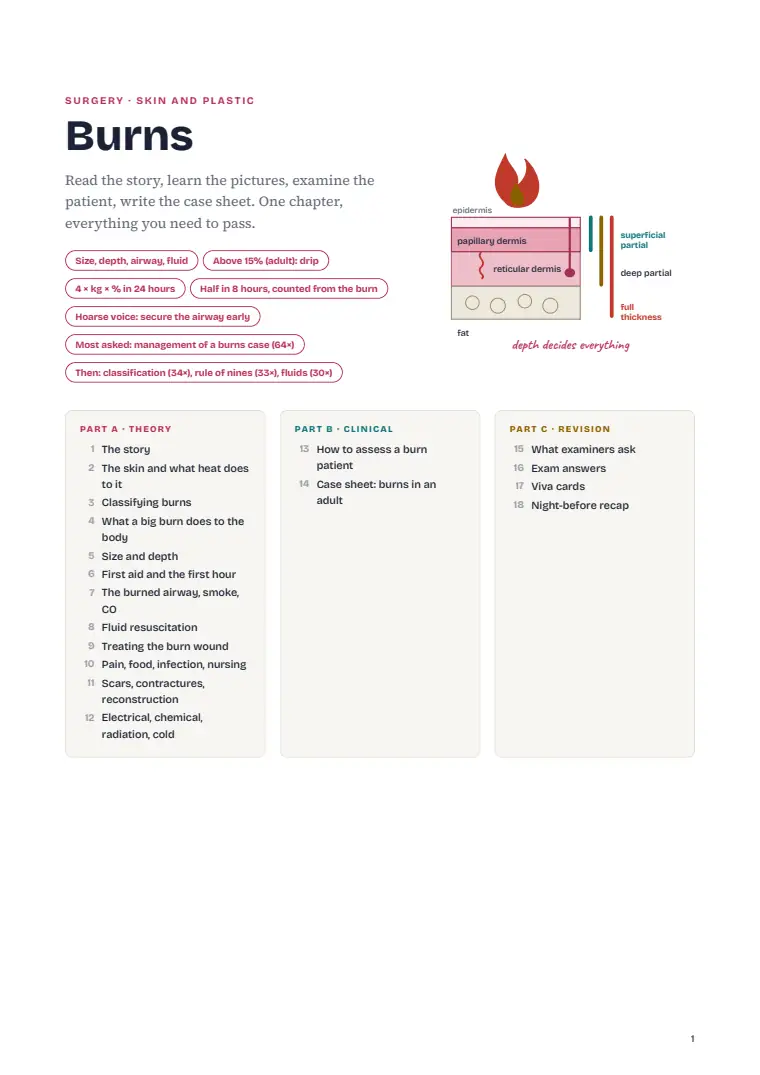
p. 1 · First page 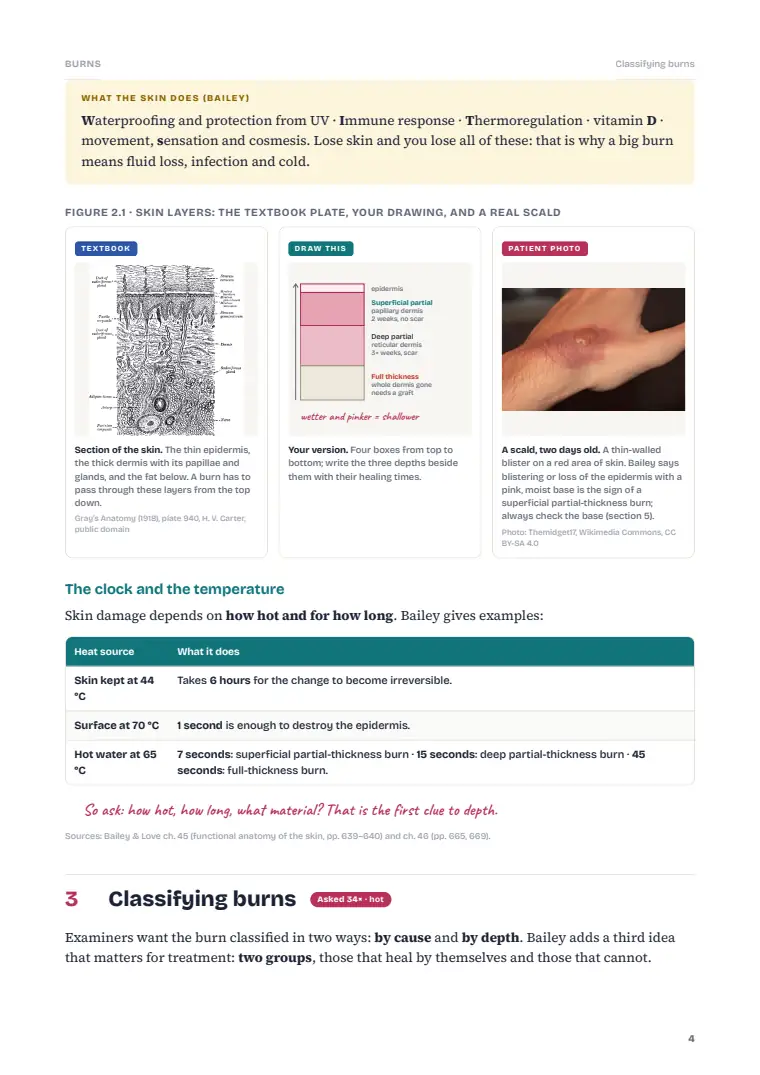
p. 4 · Inside the chapter 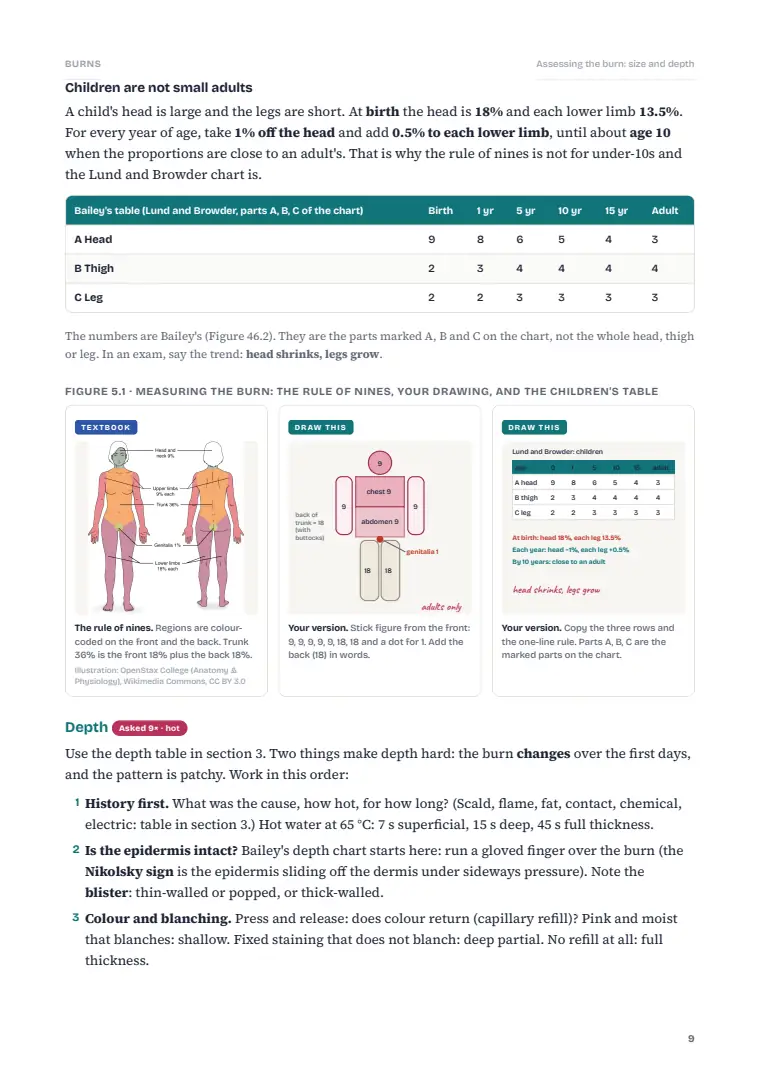
p. 9 · Inside the chapter 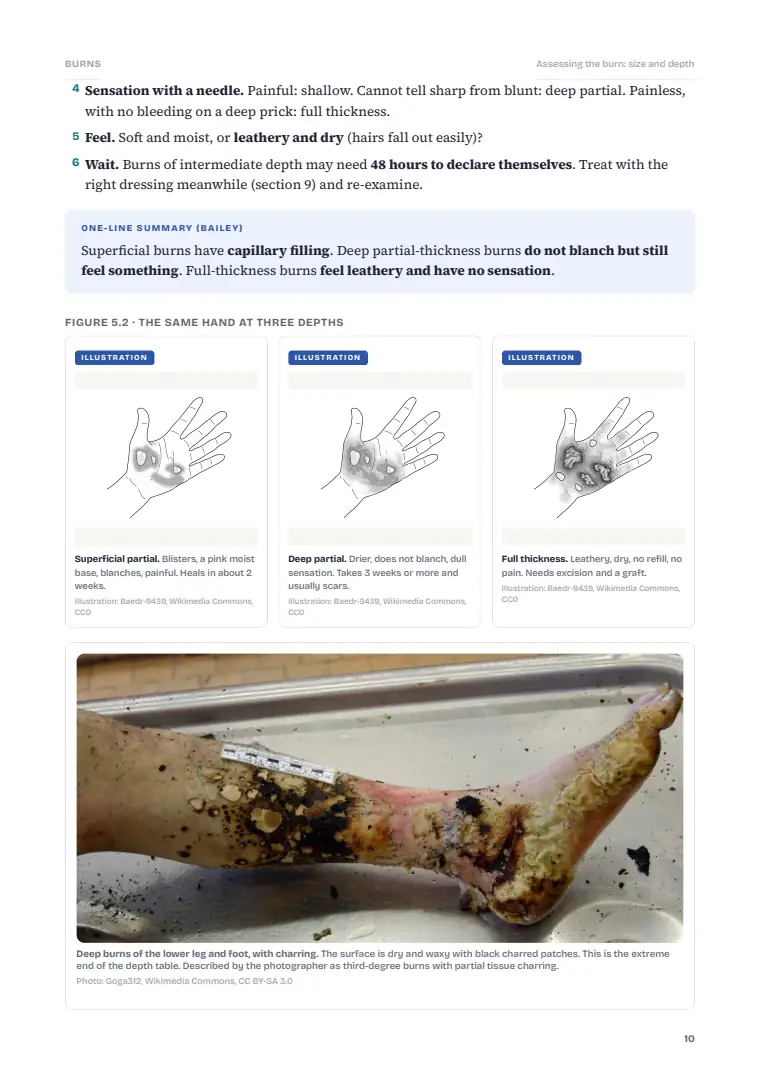
p. 10 · Inside the chapter 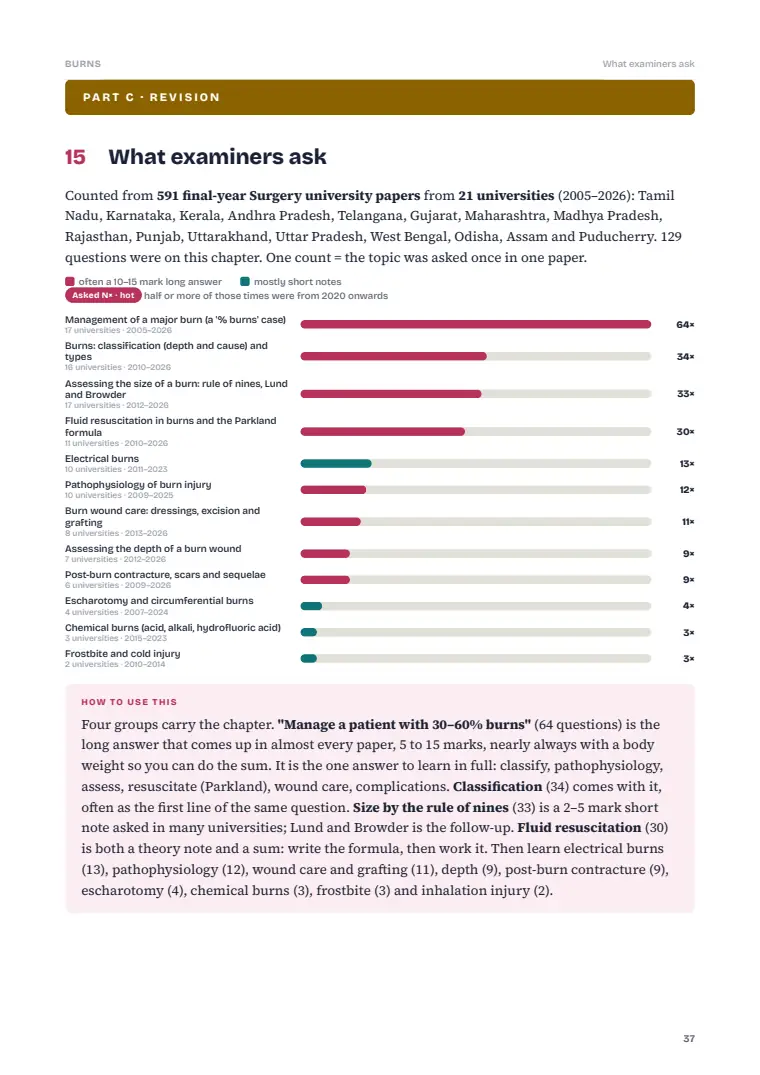
p. 37 · What examiners ask: previous years' questions - Trauma
Preview and contents
What you get (45 pages)- What kills first goes first: cABCDE
- Low BP after injury = bleeding until proved otherwise
- GCS: three numbers, never one
- Tension pneumothorax: treat, do not wait for an X-ray
- Lucid interval = extradural
- Most asked: extradural haematoma (67×)
Asked most in previous papers67× Extradural haematoma and the lucid interval66× Pneumothorax: types and management62× Flail chestPart A · TheoryThe story · How injury happens · Primary survey: cABCDE · Secondary survey and tests · Polytrauma, damage control · Triage, mass casualties · The brain in its box · GCS, pupils, vital signs · Scalp, skull, skull base · Extradural, subdural, others · Managing a head injury · Chest trauma: the deadly dozen · Pneumothorax and the chest drain · Haemothorax · Ribs and flail chest · Heart, aorta, lung, diaphragm · Abdominal trauma · Spleen and liver · Gut, pancreas, retroperitoneum · Pelvic injury · Neck, face, spine · Blast, bullet, crushPart B · ClinicalHow to examine an injured patient · Case sheetPart C · RevisionWhat examiners ask · Exam answers · Viva cards · Night-before recap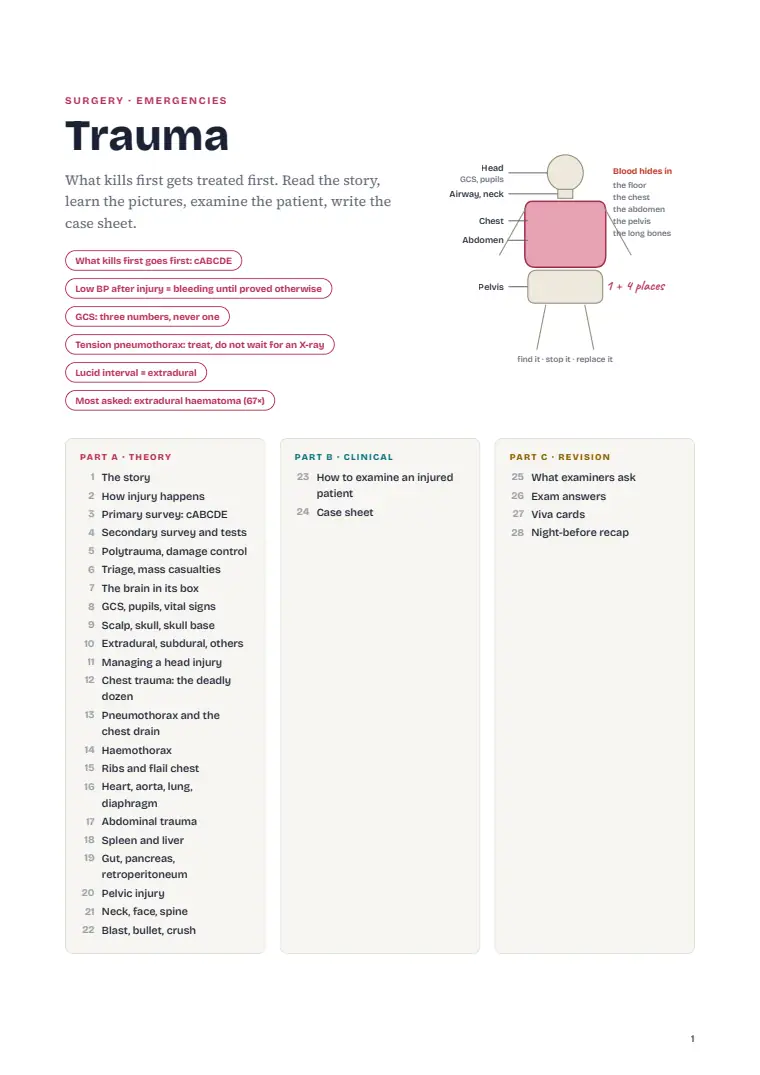
p. 1 · First page 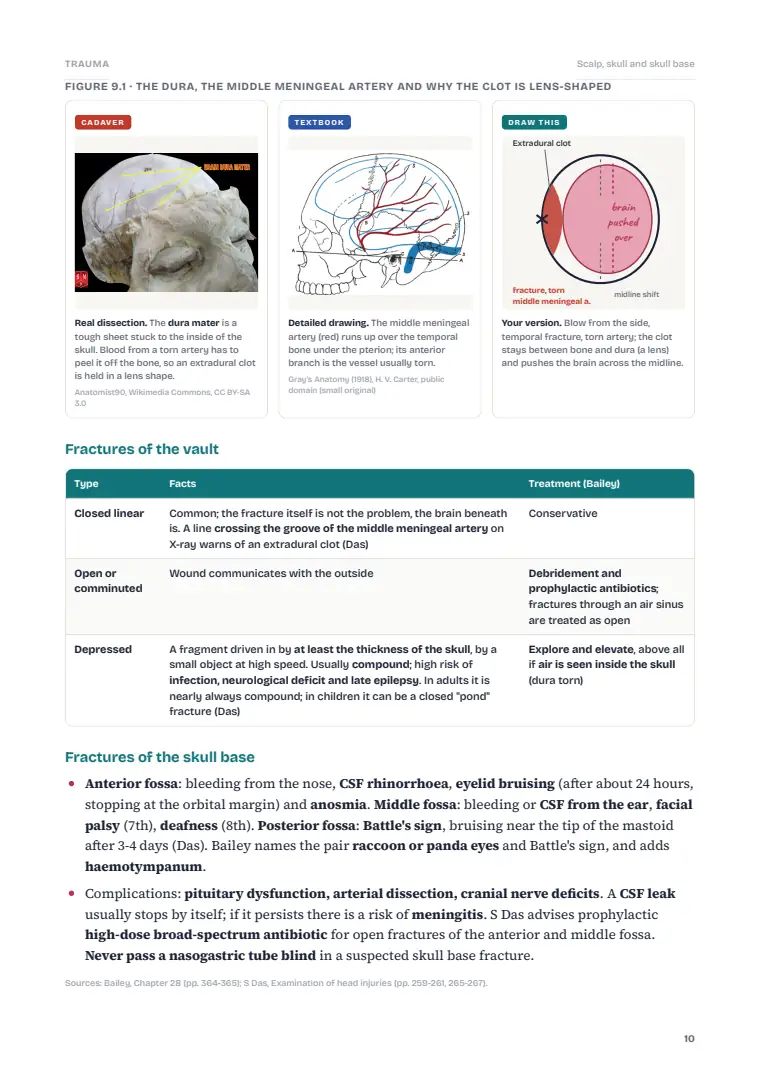
p. 10 · Inside the chapter 
p. 12 · Inside the chapter 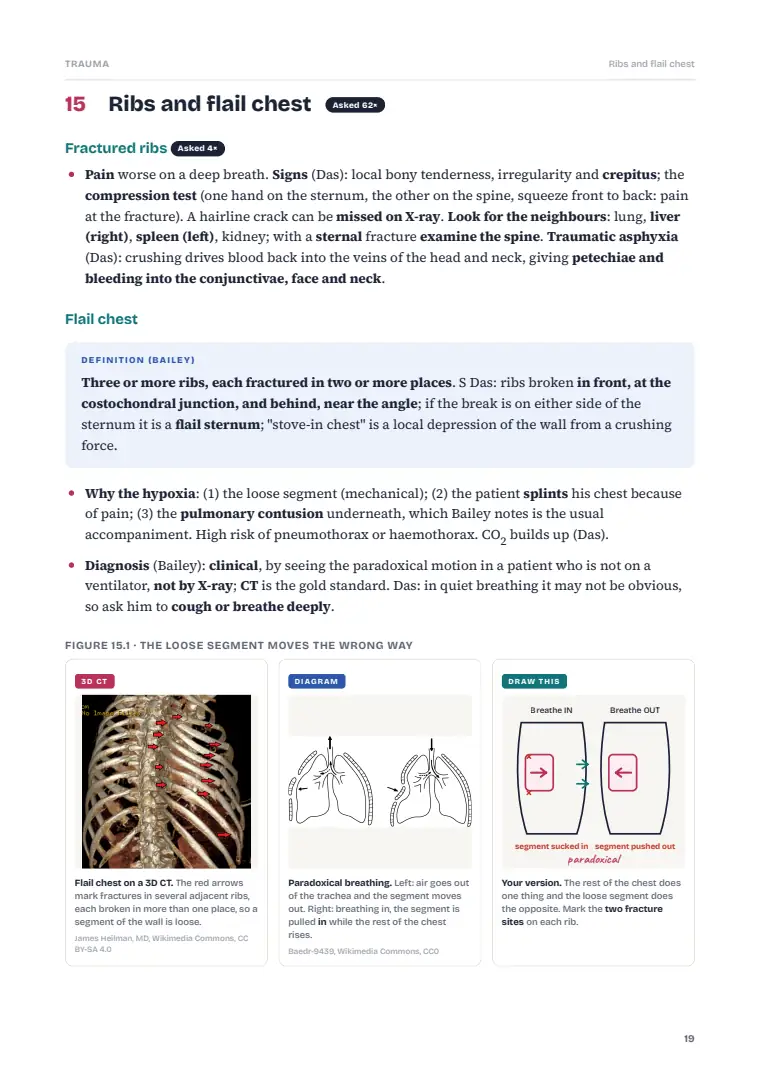
p. 19 · Inside the chapter 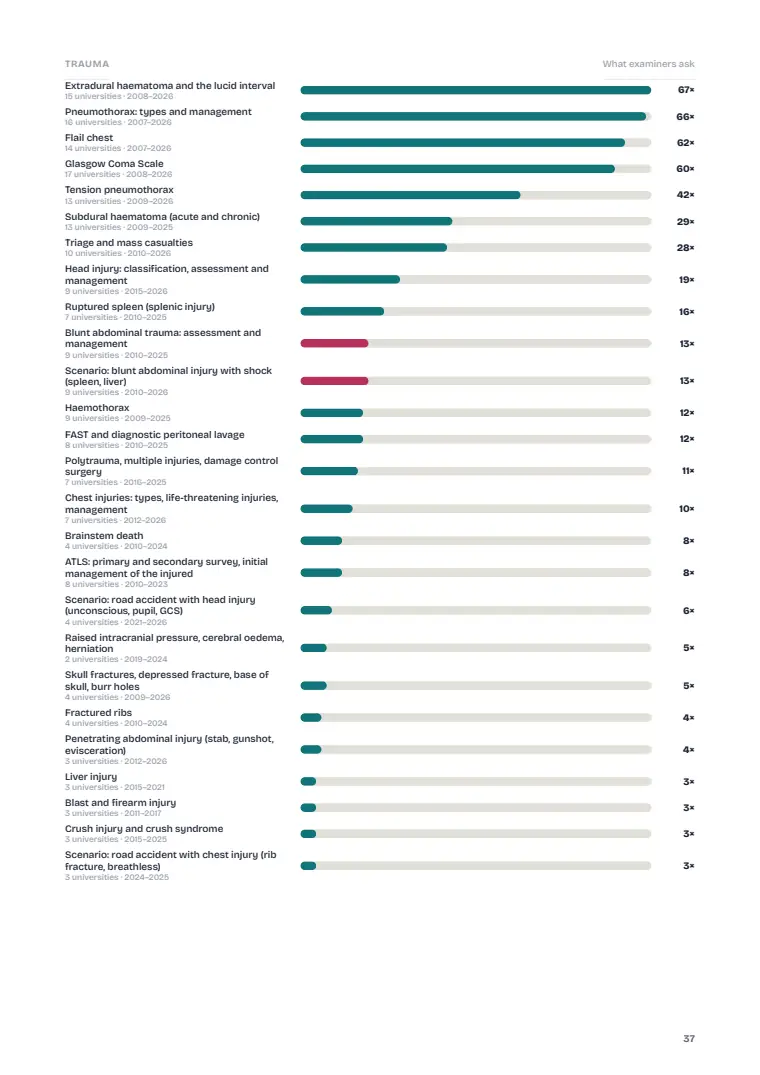
p. 37 · What examiners ask: previous years' questions - Anaesthesia and Pain Relief
Preview and contents
What you get (46 pages)- Triad: sleep, no pain, relaxed muscles
- Airway tests: 3 · 6.5 · 12.5 cm
- Fast 6 h solids, 2 h clear fluids
- Bupivacaine: never IV
- Most asked: spinal anaesthesia (63×)
- Then: epidural (41×) and regional blocks (26×)
Asked most in previous papers63× Spinal anaesthesia41× Epidural anaesthesia and analgesia26× Regional anaesthesia and nerve blocksPart A · TheoryThe story · Seeing the patient and the airway · Risk: ASA, high-risk, fitness · Tests before surgery · Getting the patient ready · General anaesthesia · Airway and intubation · Muscle relaxants, ventilation, monitoring · Local anaesthetics and nerve blocks · Spinal and epidural · Complications of anaesthesia · Pain relief · Recovery and critical care · Day-case surgery · TracheostomyPart B · ClinicalHow to do a pre-anaesthetic check · Case sheet: pre-anaesthetic checkPart C · RevisionWhat examiners ask · Exam answers · Viva cards · Night-before recap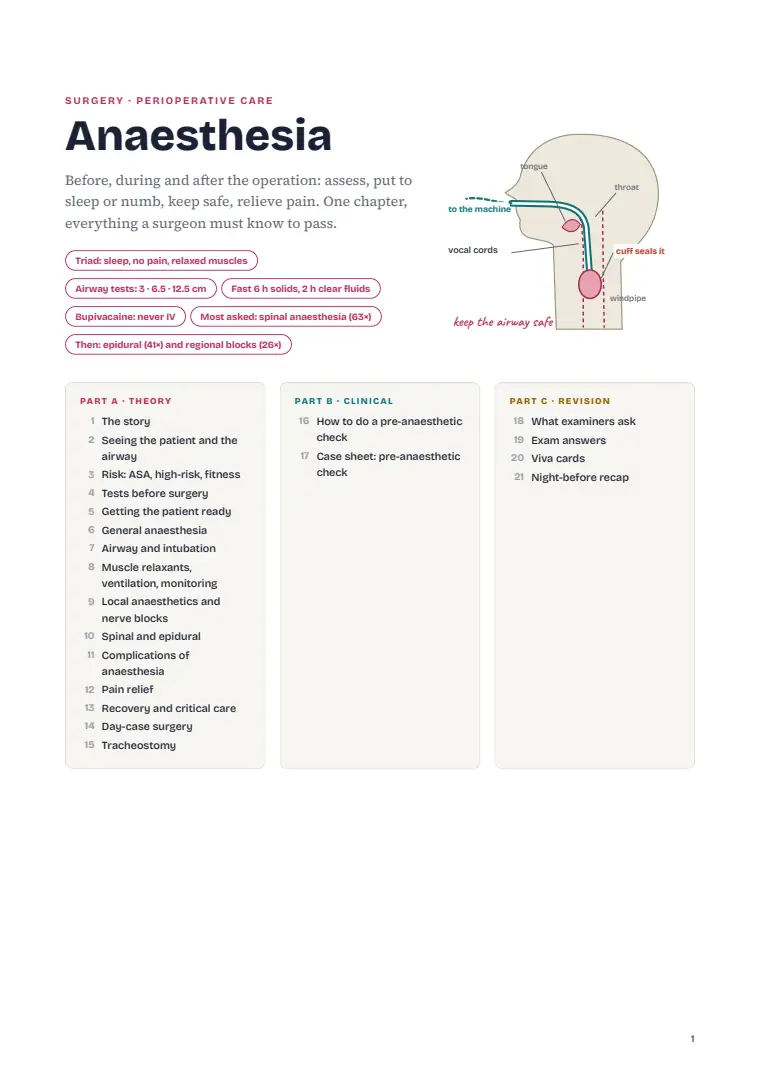
p. 1 · First page 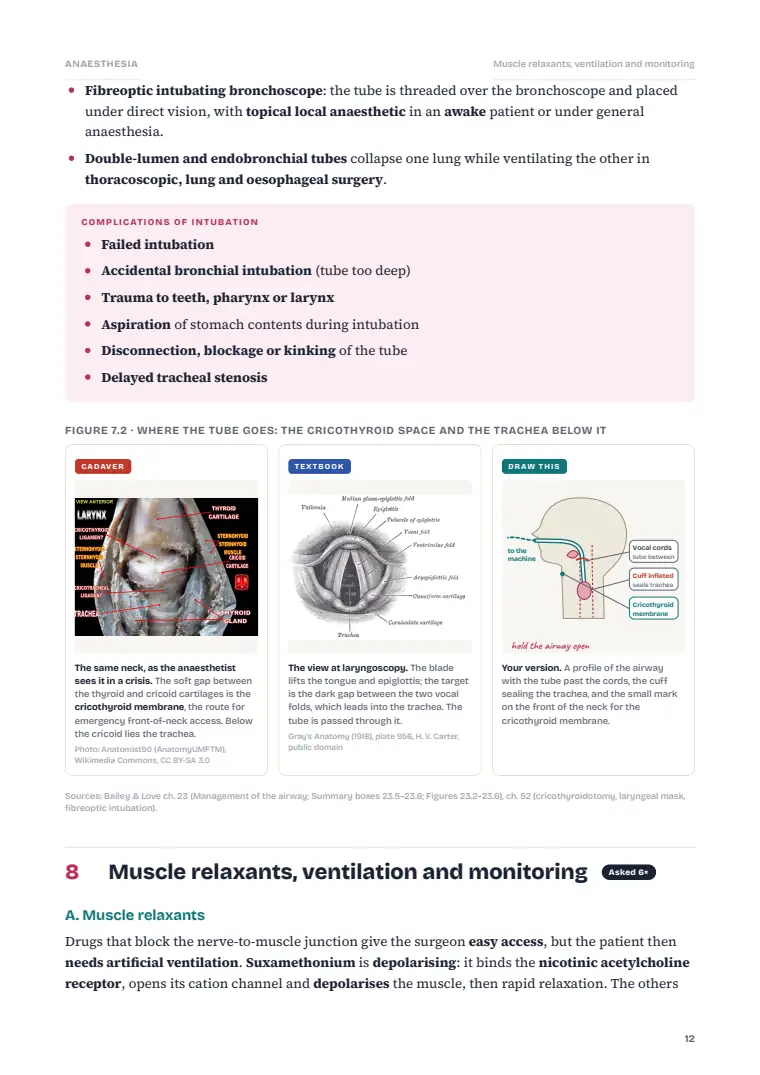
p. 12 · Inside the chapter 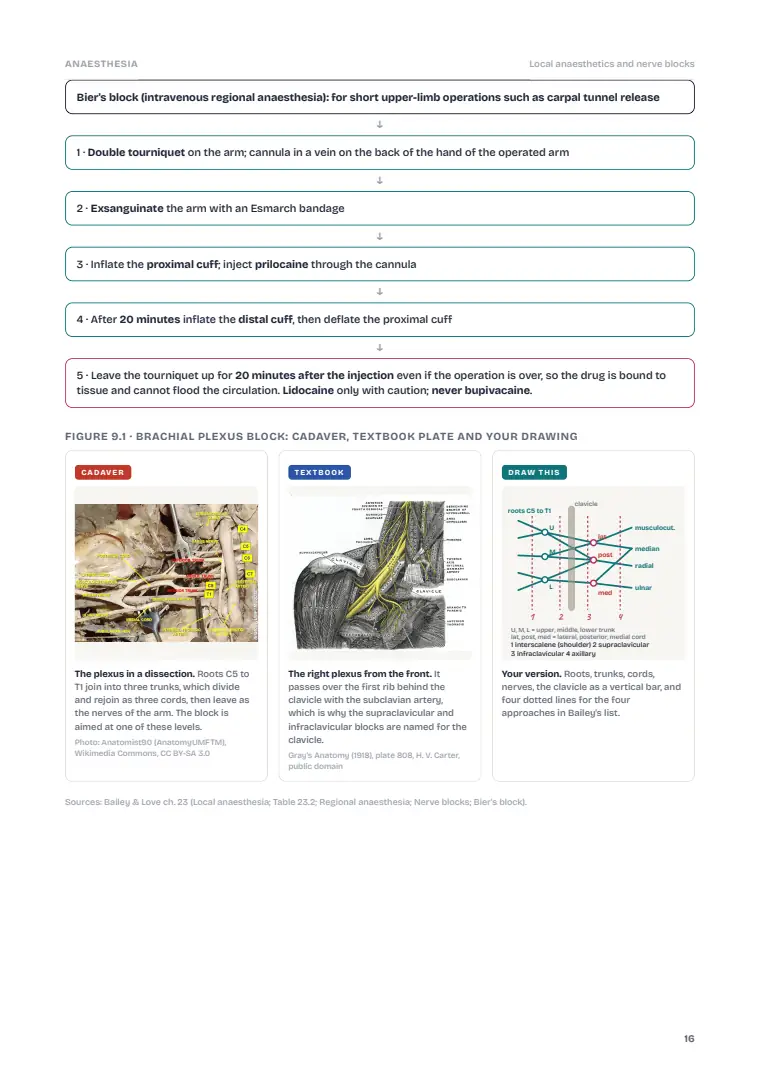
p. 16 · Inside the chapter 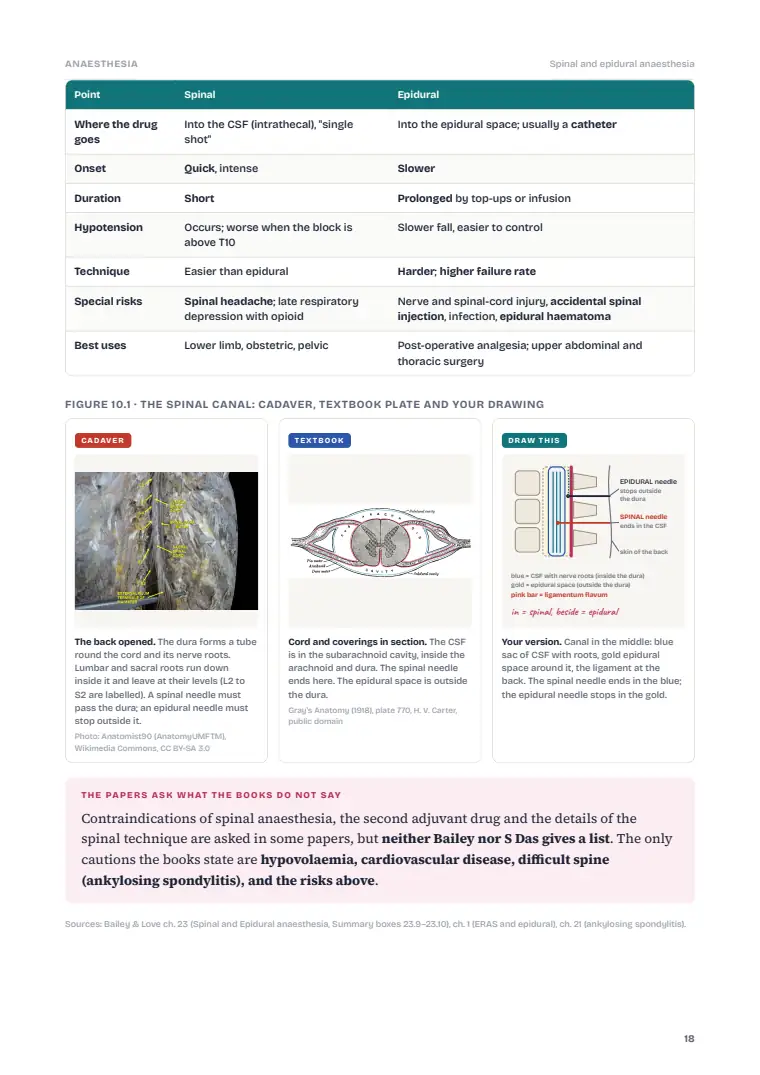
p. 18 · Inside the chapter 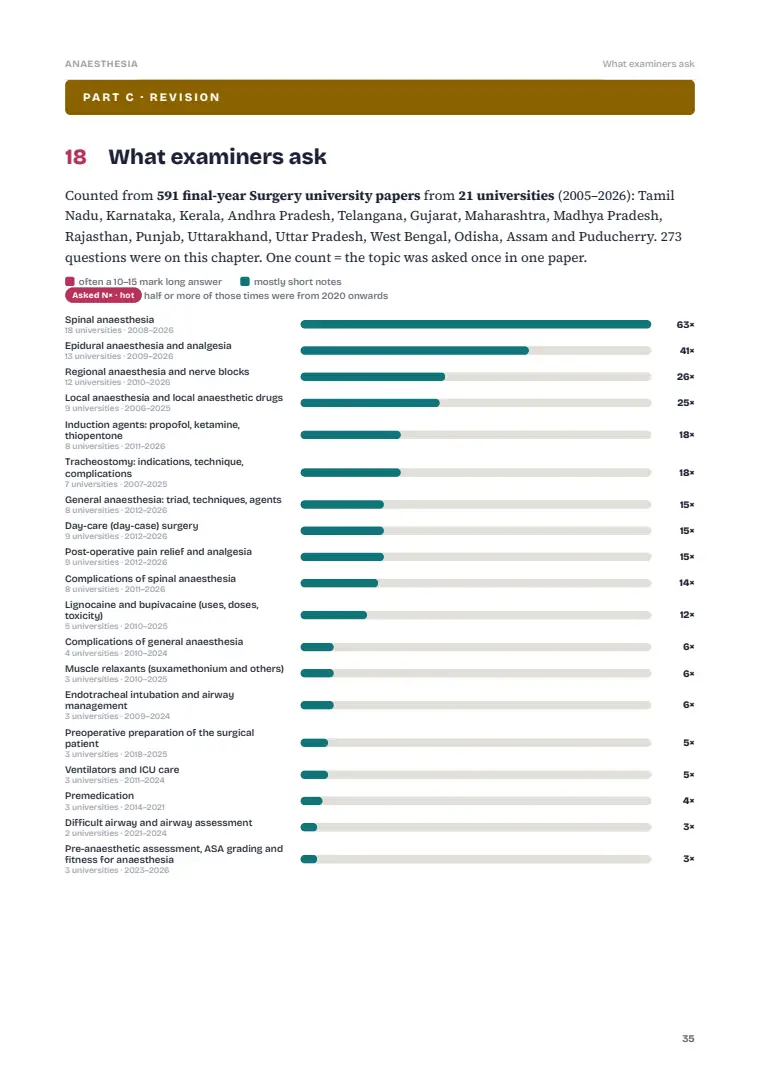
p. 35 · What examiners ask: previous years' questions - Principles of Oncology
Preview and contents
What you get (46 pages)- Tissue is the issue: no biopsy, no cancer
- Stage before you treat
- Name the aim: cure, prolong or palliate
- Four routes of spread: direct, lymph, blood, body cavity
- Most asked: tumour markers (17×) and MRI (17×)
- Then: PET and bone scan (16×) and brachytherapy (15×)
Asked most in previous papers17× Tumour markers17× MRI: principle, uses, advantages and limits16× PET scan and bone scan in cancerPart A · TheoryThe story · What is a tumour? Benign and malignant · How a cell turns cancerous · What causes cancer · How cancer spreads · Prevention and screening · Proving it: FNAC, biopsy, stains · Tumour markers · Grading and staging (TNM) · Which scan answers which question · Planning treatment: team, aims, fitness · Surgery for cancer · Radiotherapy · Chemotherapy, hormones, targeted drugs, immunotherapy · Emergencies, paraneoplastic syndromes, palliative care · Where each cancer lives in this bookPart B · ClinicalHow to examine: lump, nodes, sites of spread · Case sheet: suspected malignancyPart C · RevisionWhat examiners ask · Exam answers · Viva cards · Night-before recap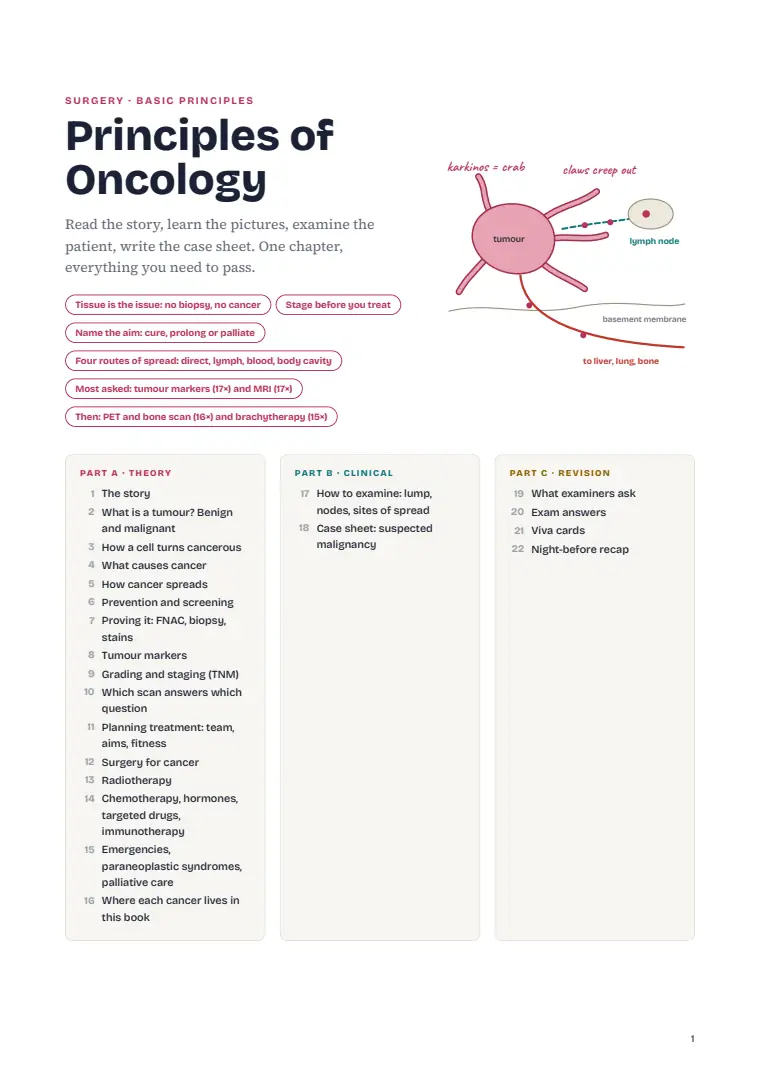
p. 1 · First page 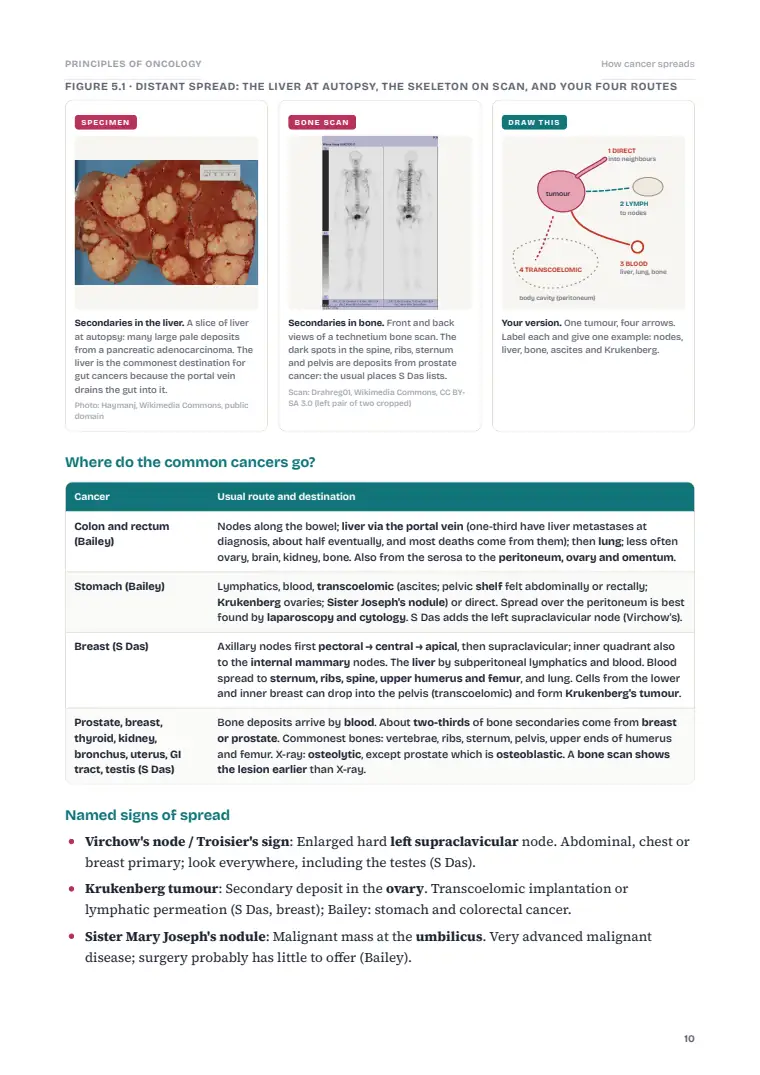
p. 10 · Inside the chapter 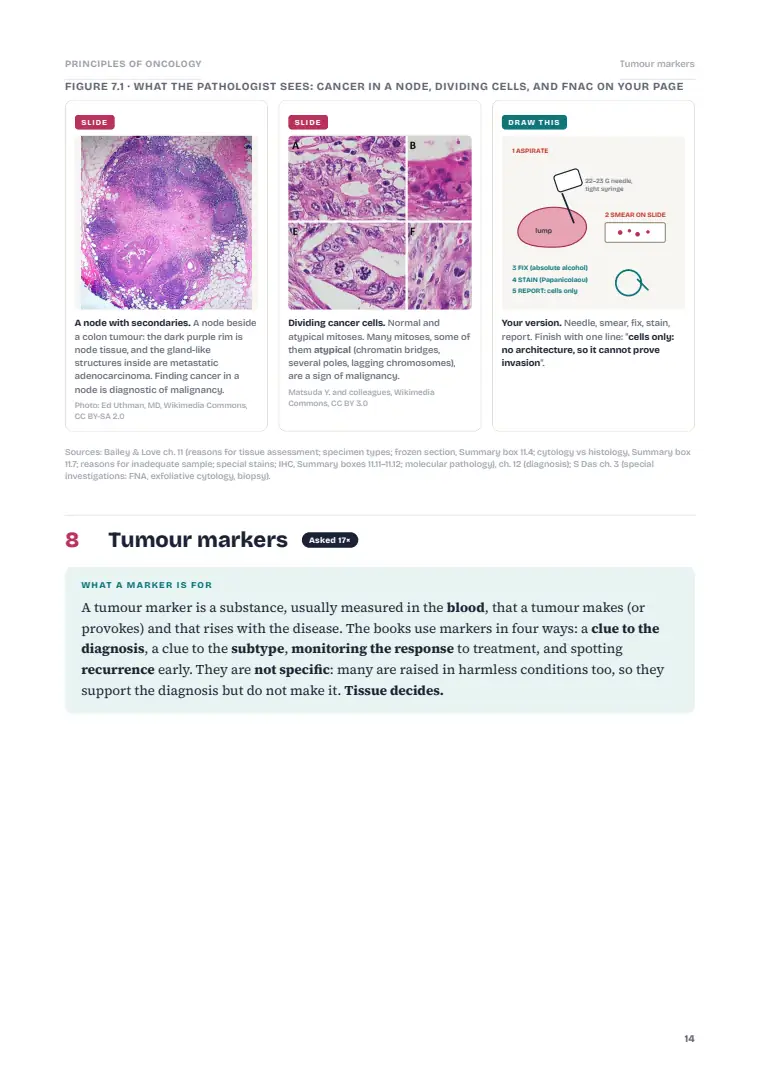
p. 14 · Inside the chapter 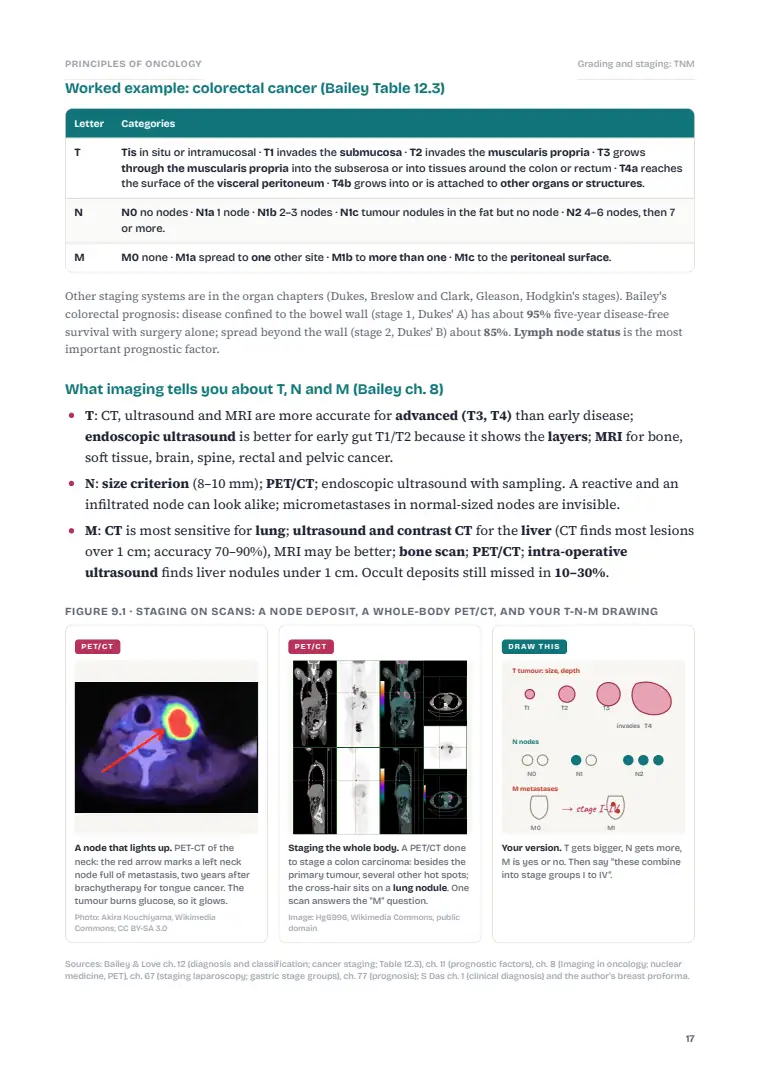
p. 17 · Inside the chapter 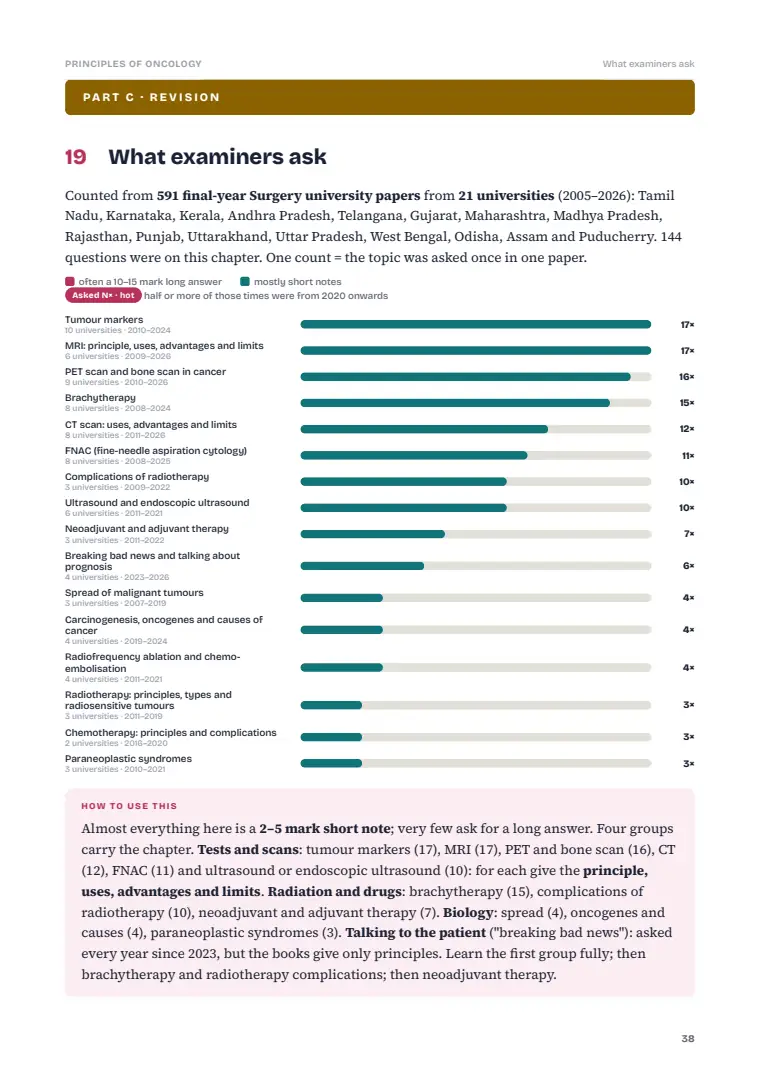
p. 38 · What examiners ask: previous years' questions
Skin, hand and plastics
- Skin and Subcutaneous Tissue
Preview and contents
What you get (49 pages)- Edge, floor, base: read the ulcer
- Biopsy the edge of a chronic ulcer
- A sinus fails to heal because something stays inside
- Rodent ulcer: no nodes, no metastases
- Breslow thickness rules melanoma
- Most asked: basal cell carcinoma (68×)
Asked most in previous papers68× Basal cell carcinoma (rodent ulcer)43× Lymphangioma and cystic hygroma35× Sebaceous (epidermal) cystPart A · TheoryThe story · The skin and where things arise · The ulcer: classification · Reading an ulcer · Types of ulcer · The non-healing leg ulcer · Marjolin's ulcer · Sinus and fistula · Pressure sores · Benign skin lesions · Premalignant lesions · Naevi (moles) · Basal cell carcinoma · Squamous cell carcinoma · Malignant melanoma · Cysts and ganglion · Lipoma, fibroma, desmoid · Neurofibroma · Haemangioma, lymphangioma · Soft-tissue sarcoma · BiopsyPart B · ClinicalHow to examine · Case sheetPart C · RevisionWhat examiners ask · Exam answers · Viva cards · Night-before recap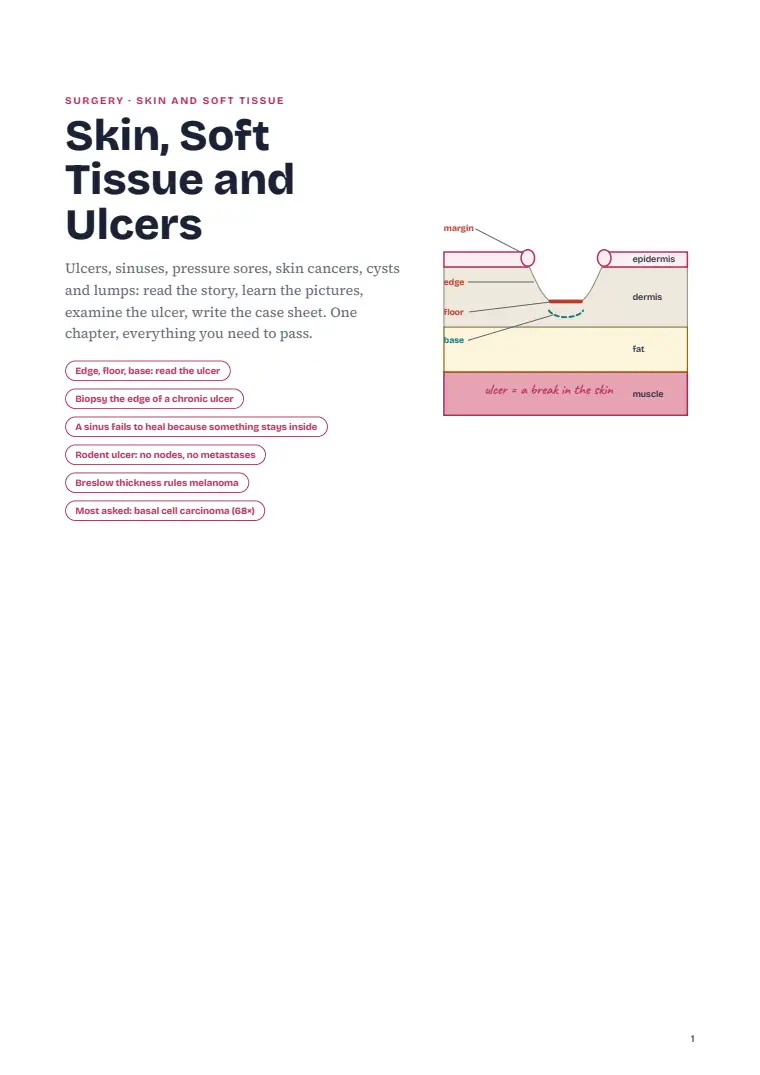
p. 1 · First page 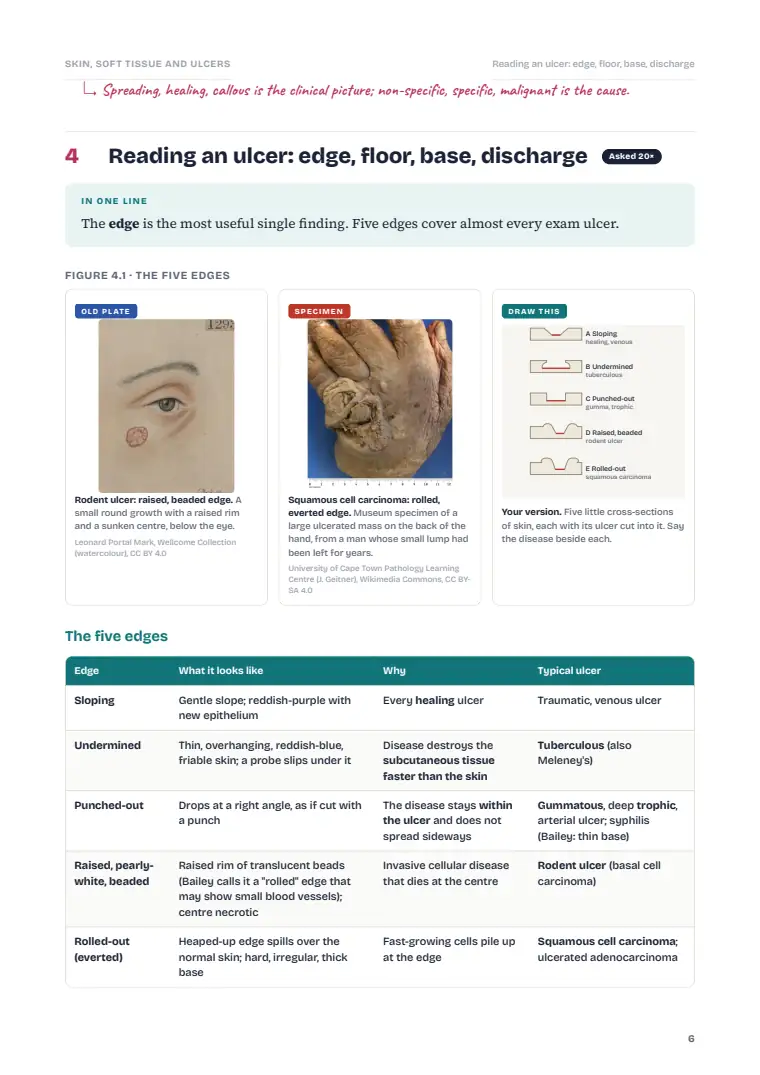
p. 6 · Inside the chapter 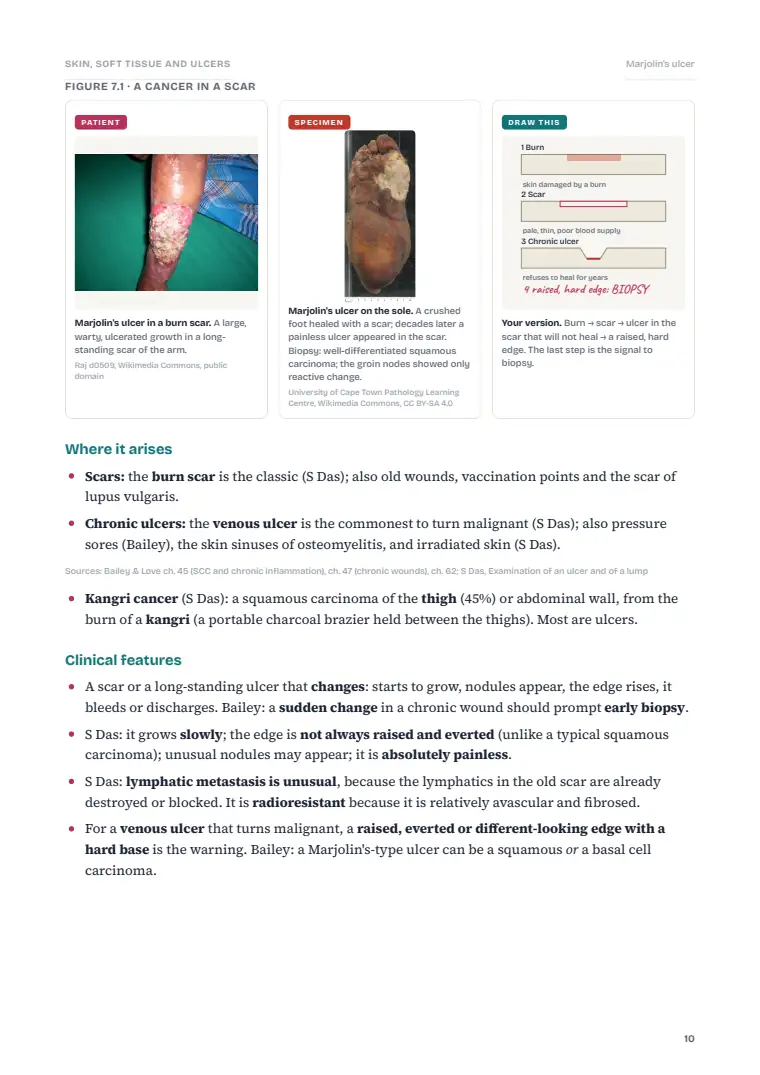
p. 10 · Inside the chapter 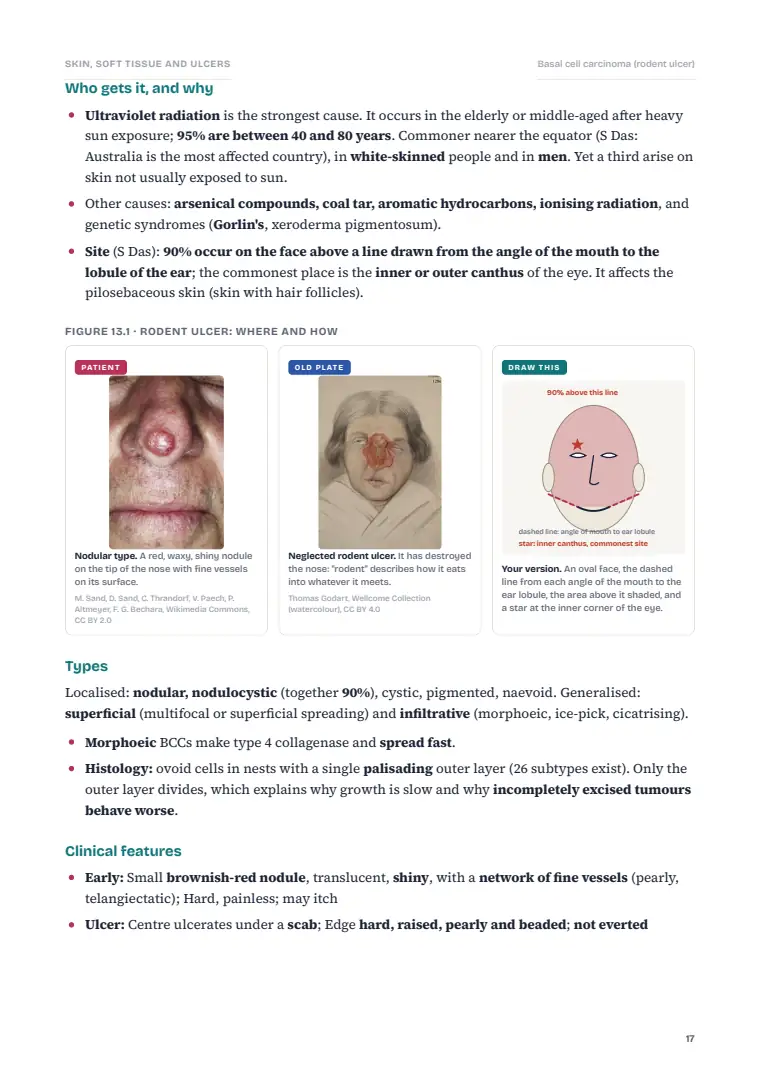
p. 17 · Inside the chapter 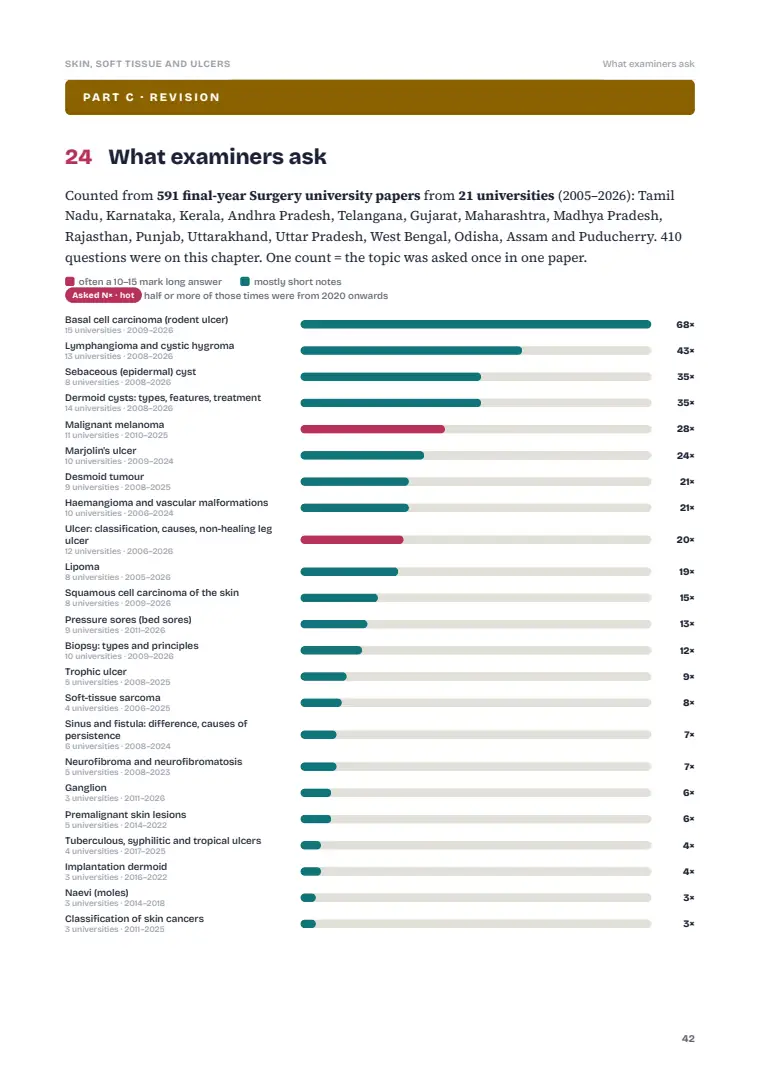
p. 42 · What examiners ask: previous years' questions - Plastic and Reconstructive Surgery and the Hand
Preview and contents
What you get (45 pages)- Four signs of a flexor sheath infection
- Pus in the pulp: let it out early
- Ring finger bent, cannot straighten: Dupuytren's
- Swell, then stiffen: raise, splint, move
- Most asked: acute paronychia (15×)
- Then: trigger finger (12×), de Quervain's (10×), ingrowing toenail (10×)
Asked most in previous papers15× Acute paronychia12× Trigger finger and trigger thumb10× De Quervain's tenosynovitisPart A · TheoryThe story · Sheaths, spaces, nerves · Hand infections: the big picture · Paronychia · Felon · Flexor sheath infection · Palmar spaces, web space · Other hand infections · Dupuytren's contracture · Trigger finger, de Quervain's, mallet finger · Nerves: carpal tunnel, claw hand · Lumps of the hand · Injury, stiffness, replantation · Congenital anomalies · Ingrowing toenail · Plastic surgery, facial palsyPart B · ClinicalHow to examine the hand · Case sheets: hand infection, Dupuytren'sPart C · RevisionWhat examiners ask · Exam answers · Viva cards · Night-before recap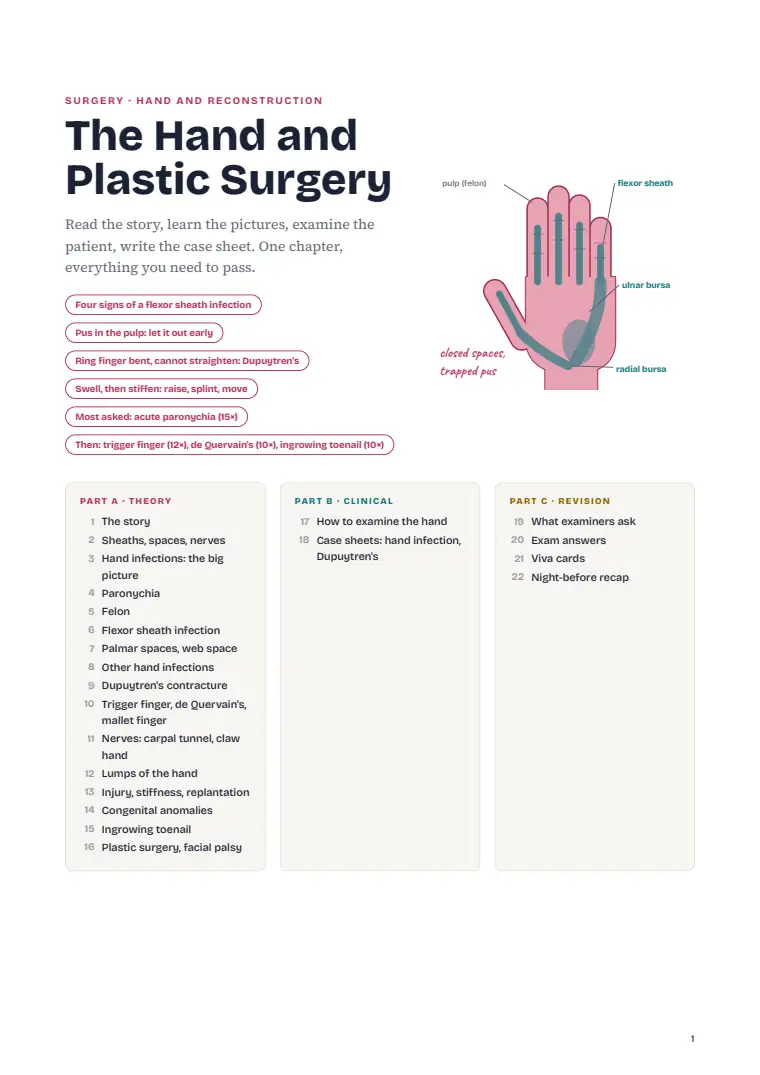
p. 1 · First page 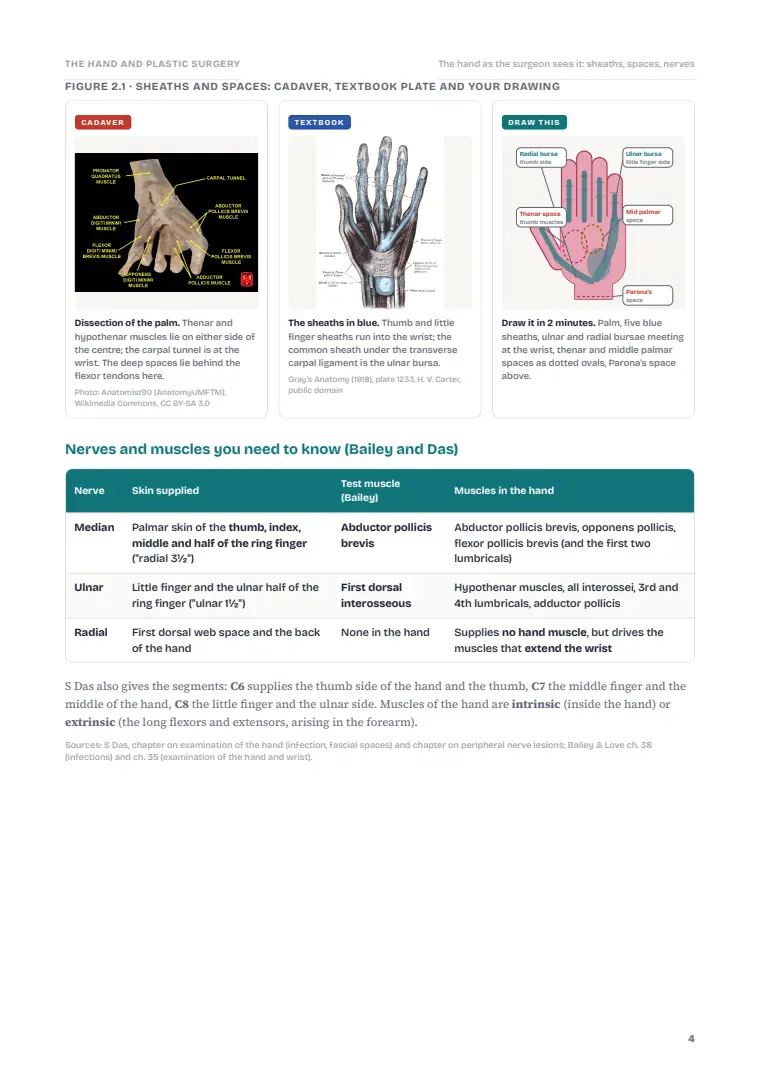
p. 4 · Inside the chapter 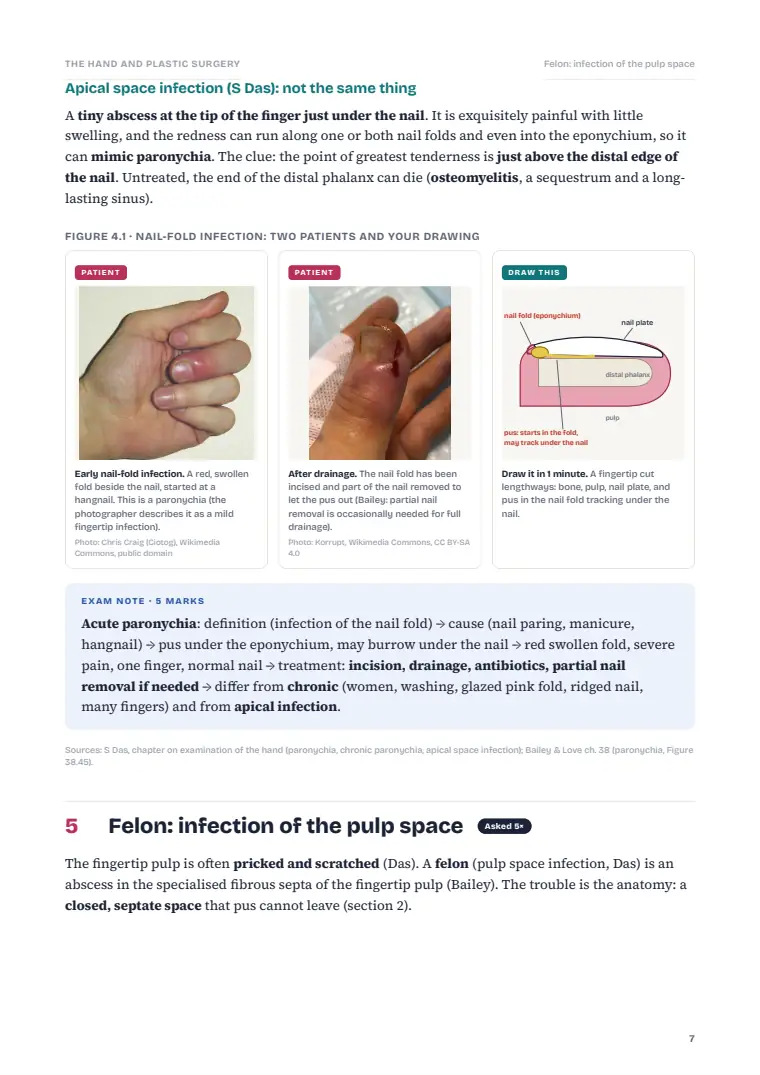
p. 7 · Inside the chapter 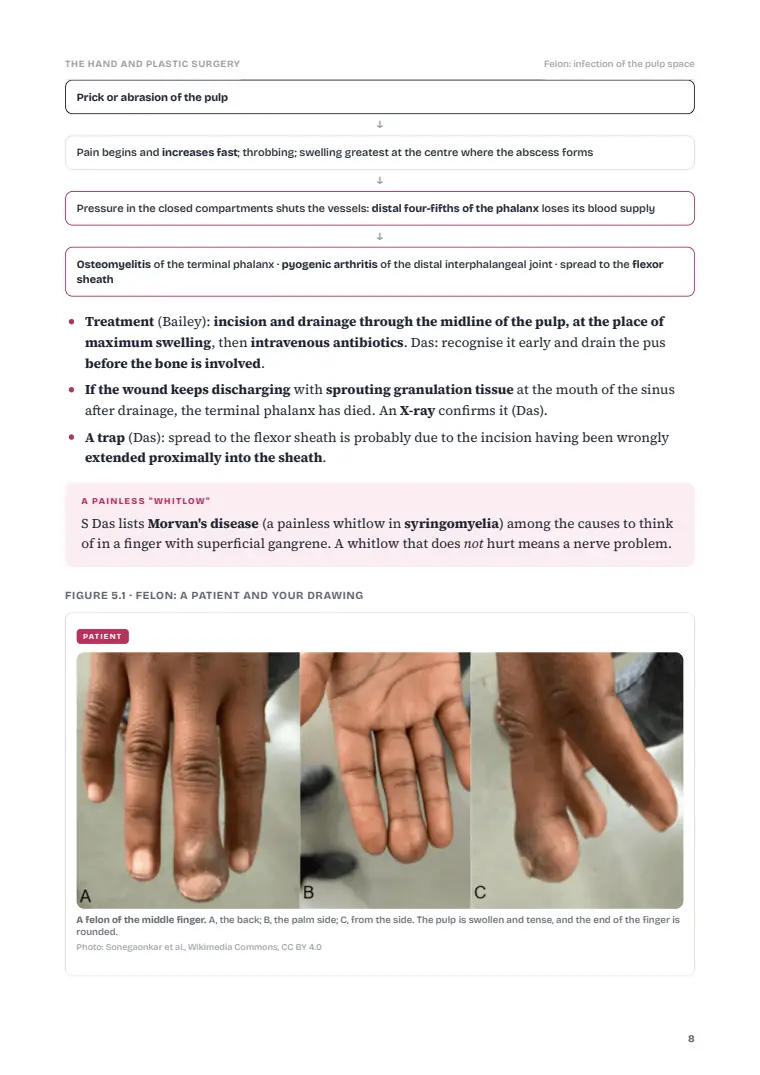
p. 8 · Inside the chapter 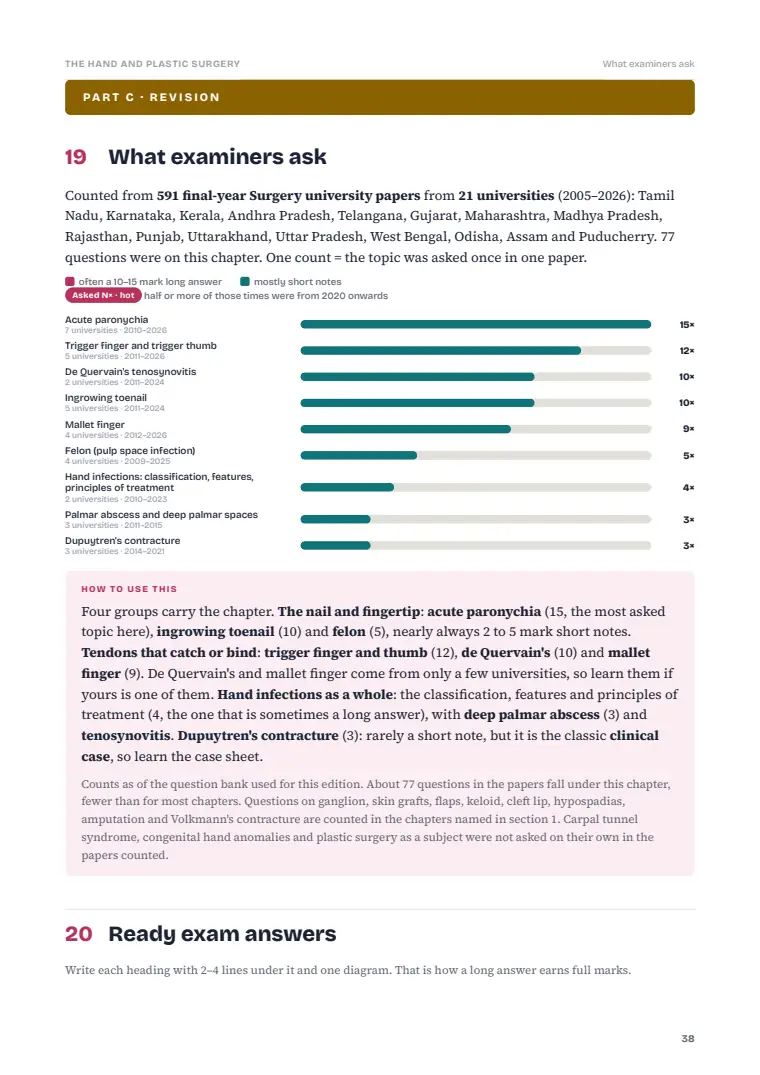
p. 38 · What examiners ask: previous years' questions
Head, neck and breast
- Oral Cavity Cancer and the Neck
Preview and contents
What you get (46 pages)- Ulcer not healing in 2 weeks: biopsy
- Tobacco, betel quid, alcohol
- Palpate the tongue at rest
- Hard neck node: find the primary
- Most asked: jaw cysts (28×)
- Long-answer favourite: carcinoma tongue (21×)
Asked most in previous papers28× Dentigerous and dental (radicular) cysts of the jaw21× Carcinoma of the tongue: aetiology, features, spread, treatment19× Premalignant lesions and conditions of the oral cavityPart A · TheoryThe story · The mouth: sites and lymph · Ulcers, stomatitis, tongue · White and red patches · Oral cancer: the big picture · Carcinoma of the tongue · Cheek, gum, floor, palate, lip · Treating oral cancer · Neck nodes, neck dissection · Oropharynx · Cervical lymphadenopathy · Neck swellings by site · Lymphomas in the neck · Jaw swellings and cysts · Jaw infection, Ludwig, trismusPart B · ClinicalHow to examine · Case sheets (two)Part C · RevisionWhat examiners ask · Exam answers · Viva cards · Night-before recap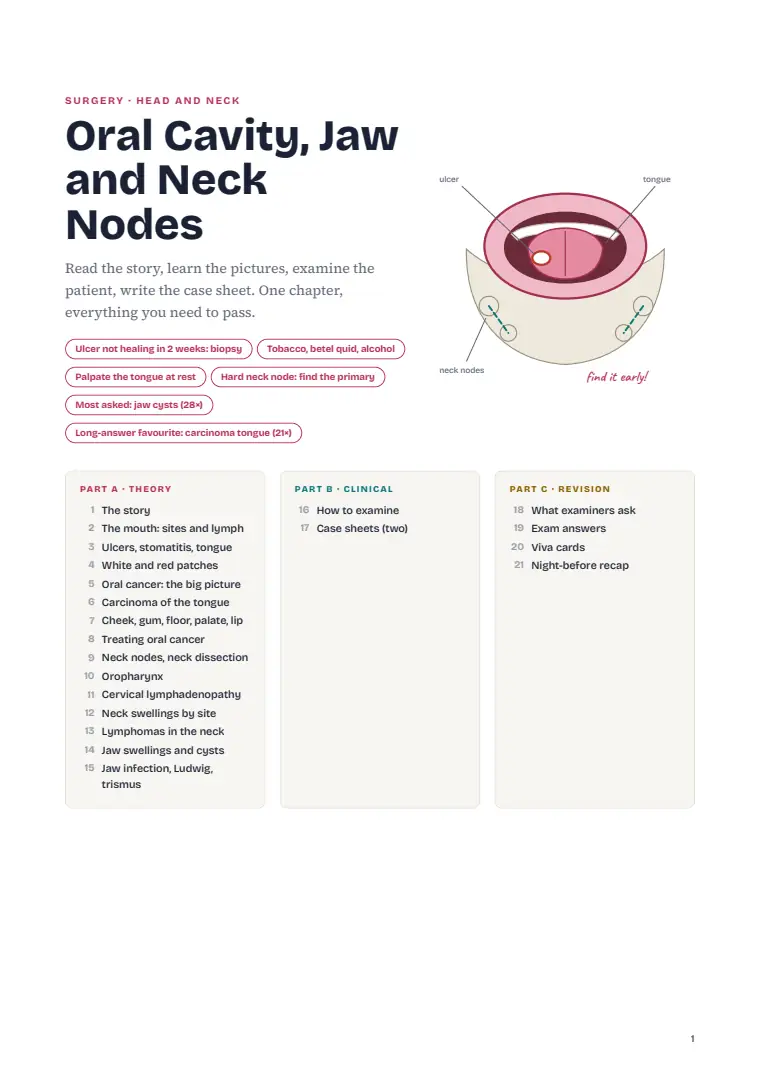
p. 1 · First page 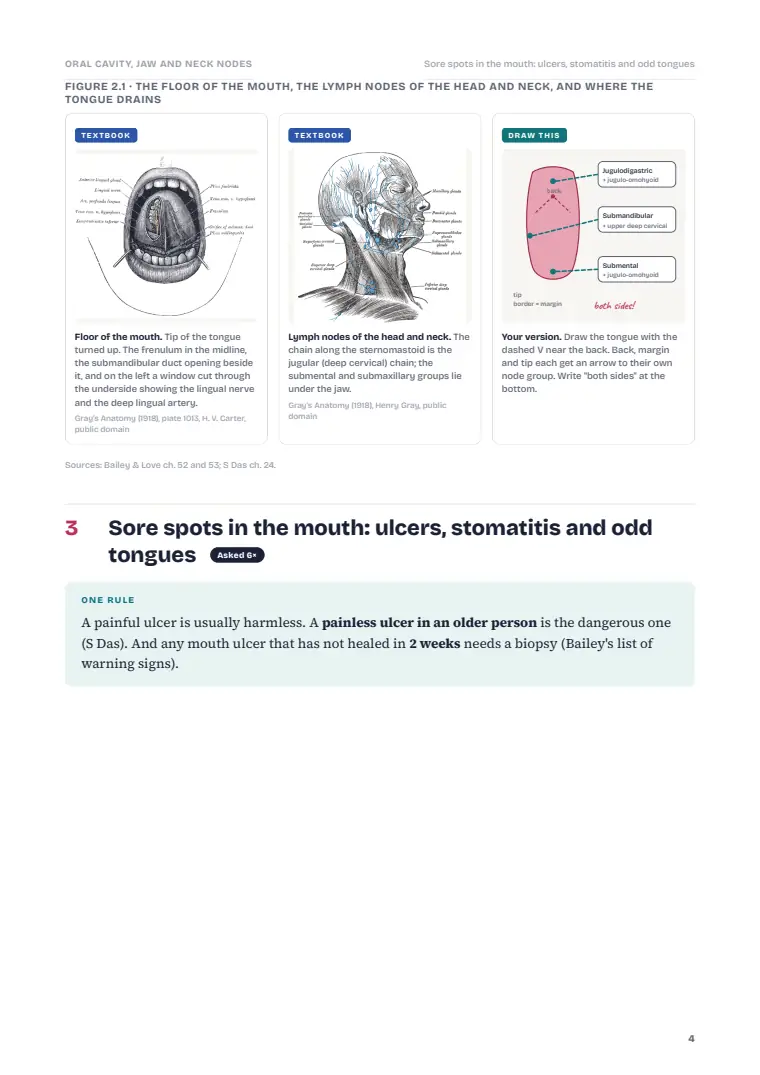
p. 4 · Inside the chapter 
p. 7 · Inside the chapter 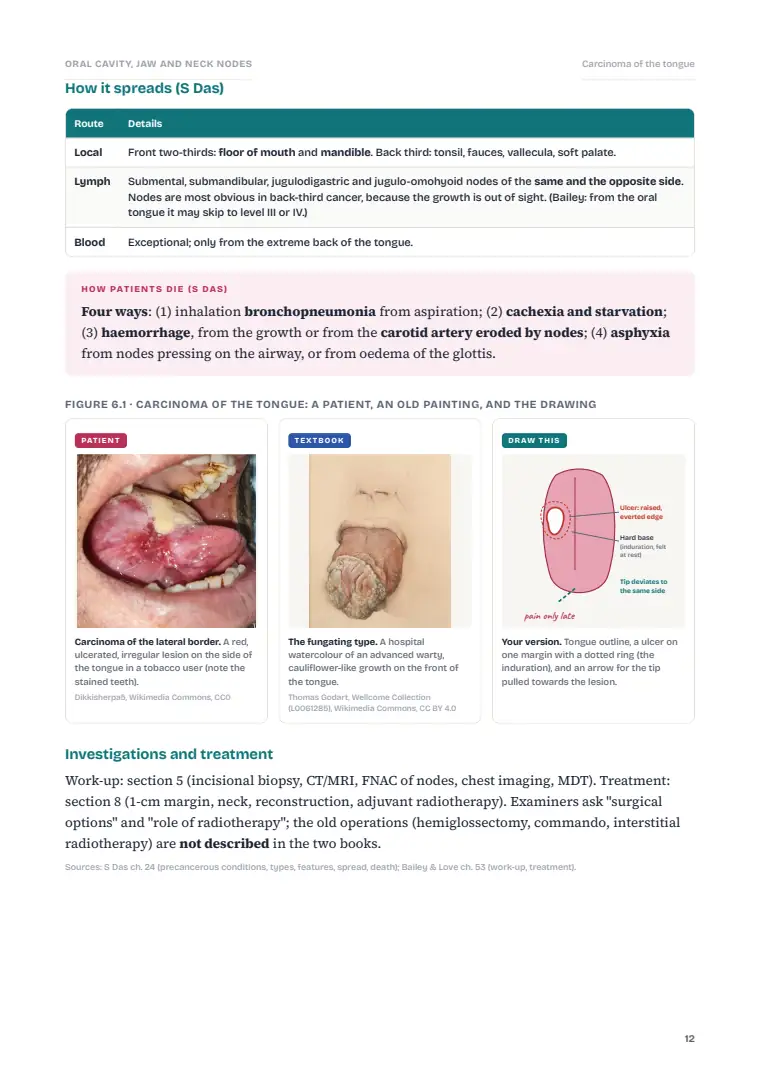
p. 12 · Inside the chapter 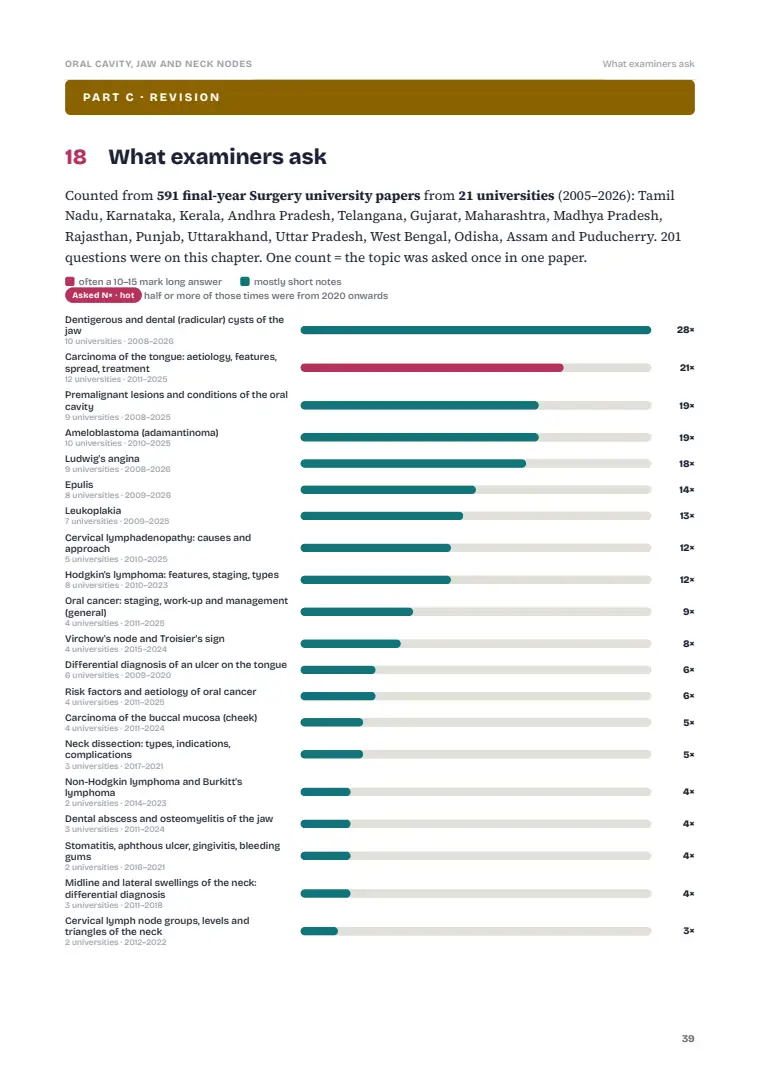
p. 39 · What examiners ask: previous years' questions - Disorders of the Salivary Glands
Preview and contents
What you get (47 pages)- The facial nerve runs through the parotid
- Painless, slow lump near the ear: pleomorphic adenoma
- Pain and swelling at meals: a stone
- Submandibular lump: node first, gland second
- Blue translucent swelling beside the frenulum: ranula
- Most asked: pleomorphic adenoma (55×)
Asked most in previous papers55× Pleomorphic adenoma (mixed parotid tumour): pathology, features, treatment41× Ranula (incl. plunging ranula)40× Parotid tumour: clinical features, malignancy signs and managementPart A · TheoryThe story · Anatomy and the facial nerve · Tests: imaging, sialography, FNAC · A lump near the ear or jaw · Inflammation: mumps, abscess, sialadenitis · Salivary stones · Ranula and mucous cysts · Sjögren's and Mikulicz's · Tumours: classification and staging · Pleomorphic adenoma · Warthin's and other benign tumours · Malignant tumours · Operations: parotid and submandibular · Complications and Frey's syndrome · Facial nerve and its paralysis · Trauma, dry mouth, droolingPart B · ClinicalHow to examine · Parotid swelling sheet · Submandibular swelling sheetPart C · RevisionWhat examiners ask · Exam answers · Viva cards · Night-before recap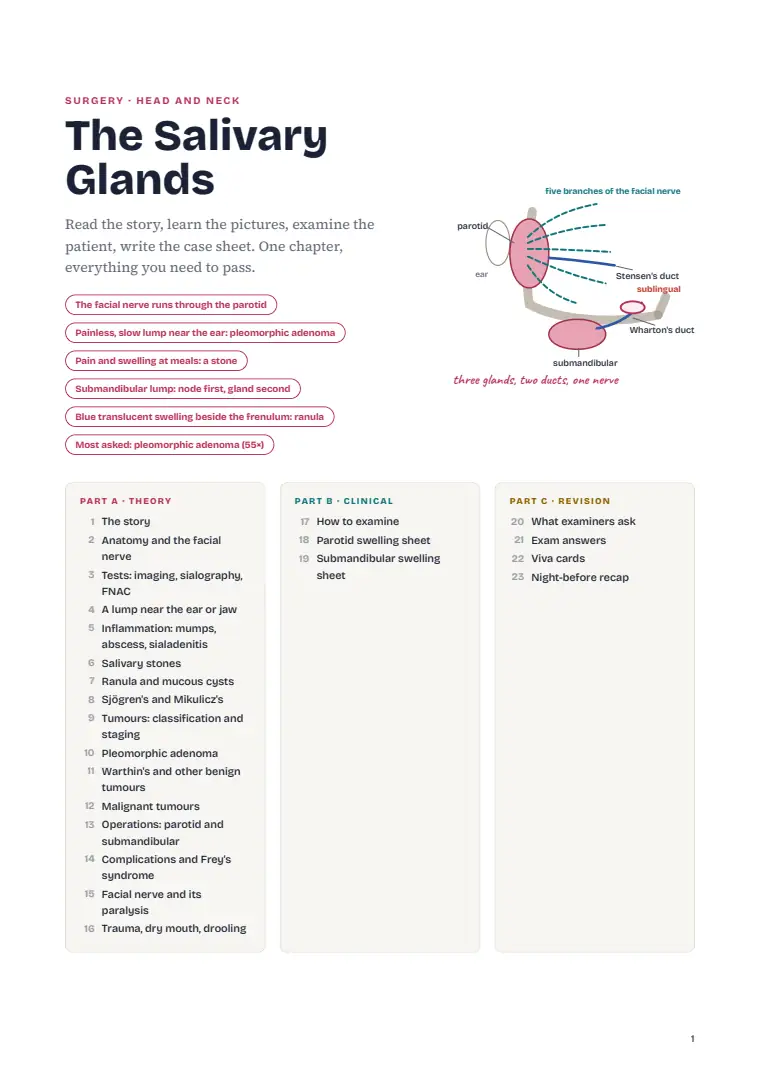
p. 1 · First page 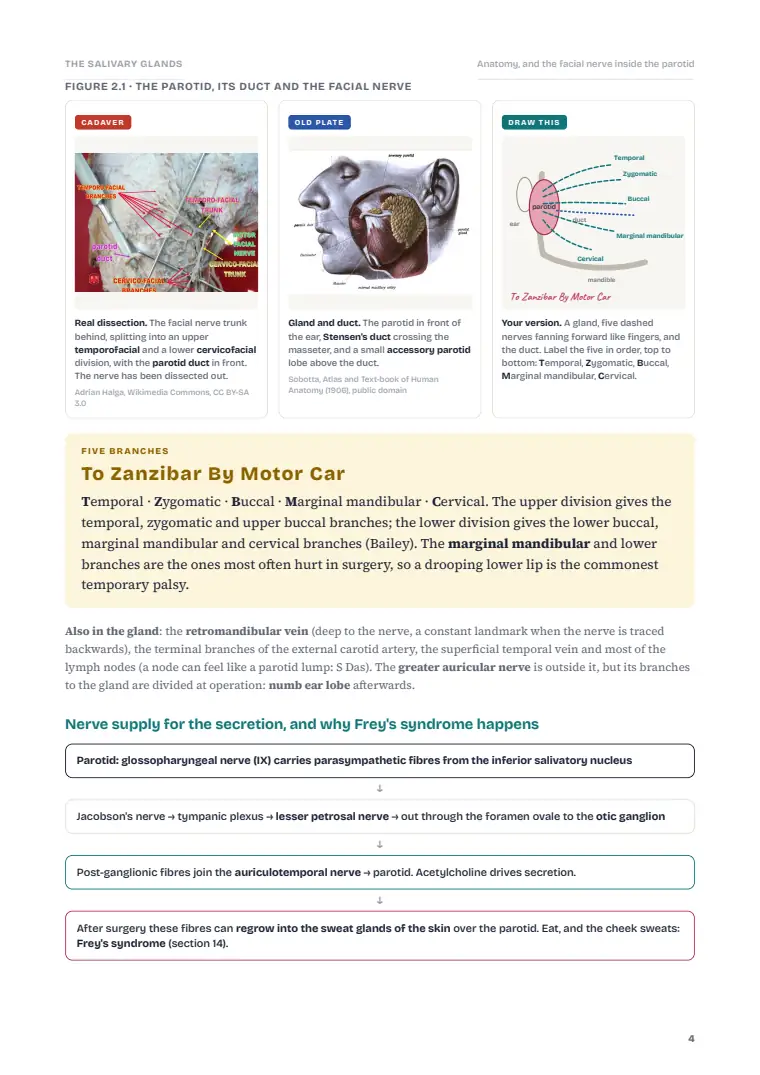
p. 4 · Inside the chapter 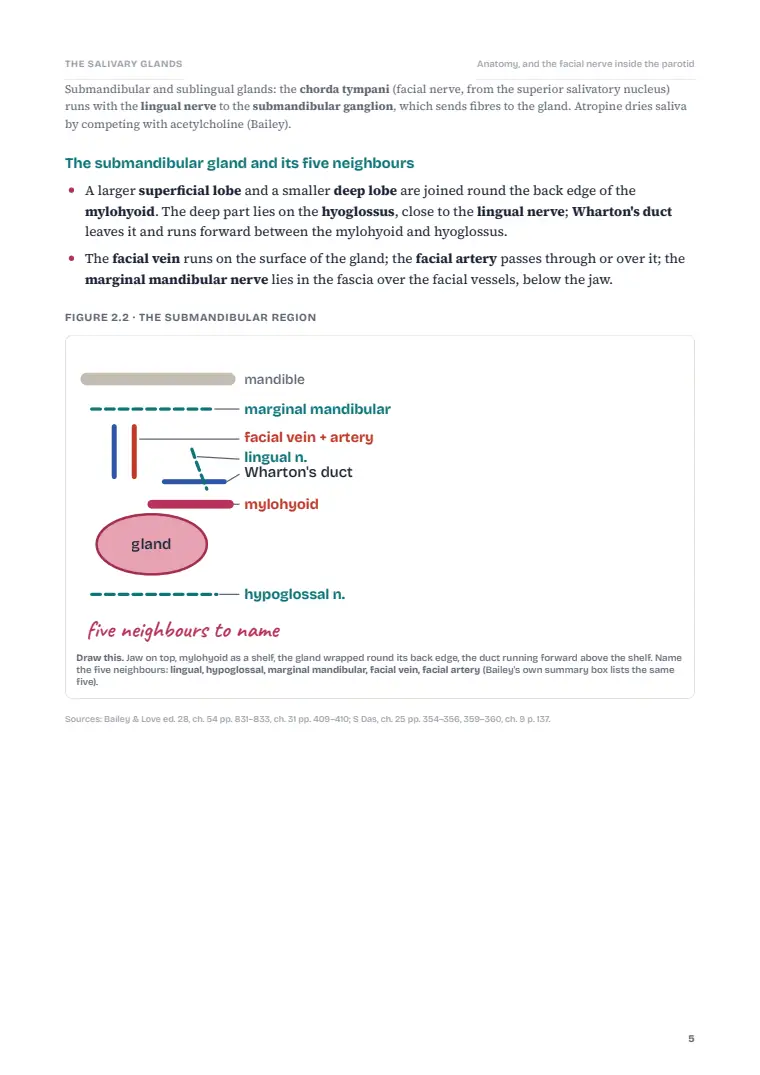
p. 5 · Inside the chapter 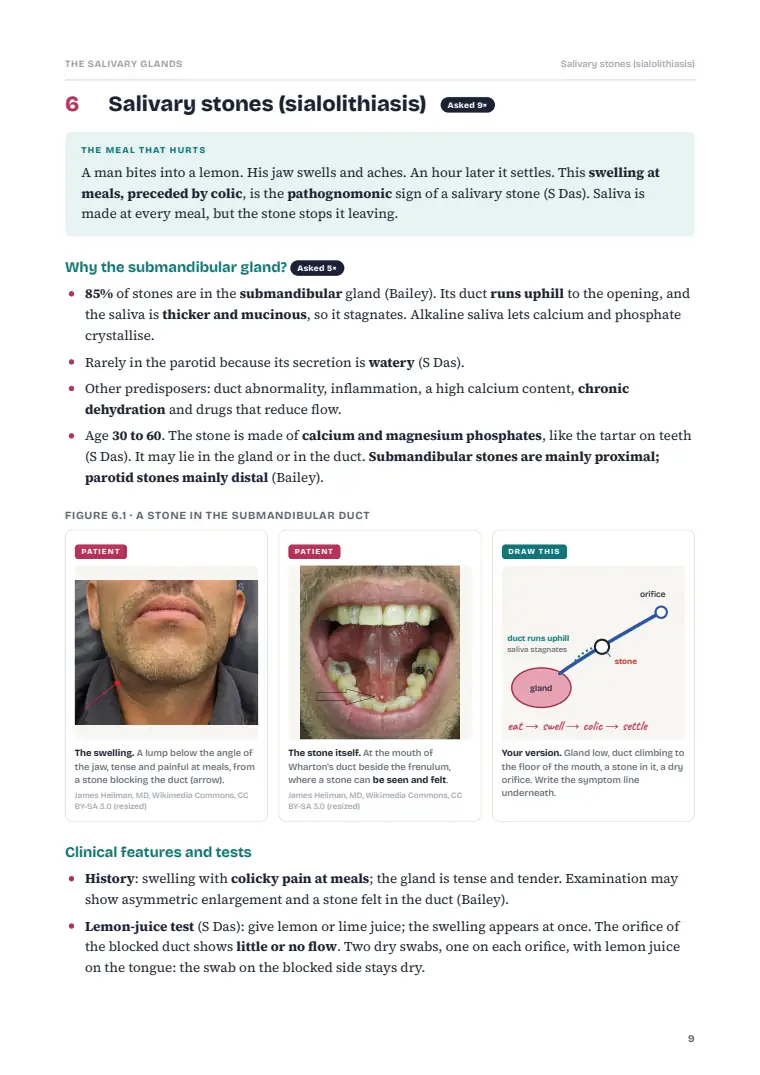
p. 9 · Inside the chapter 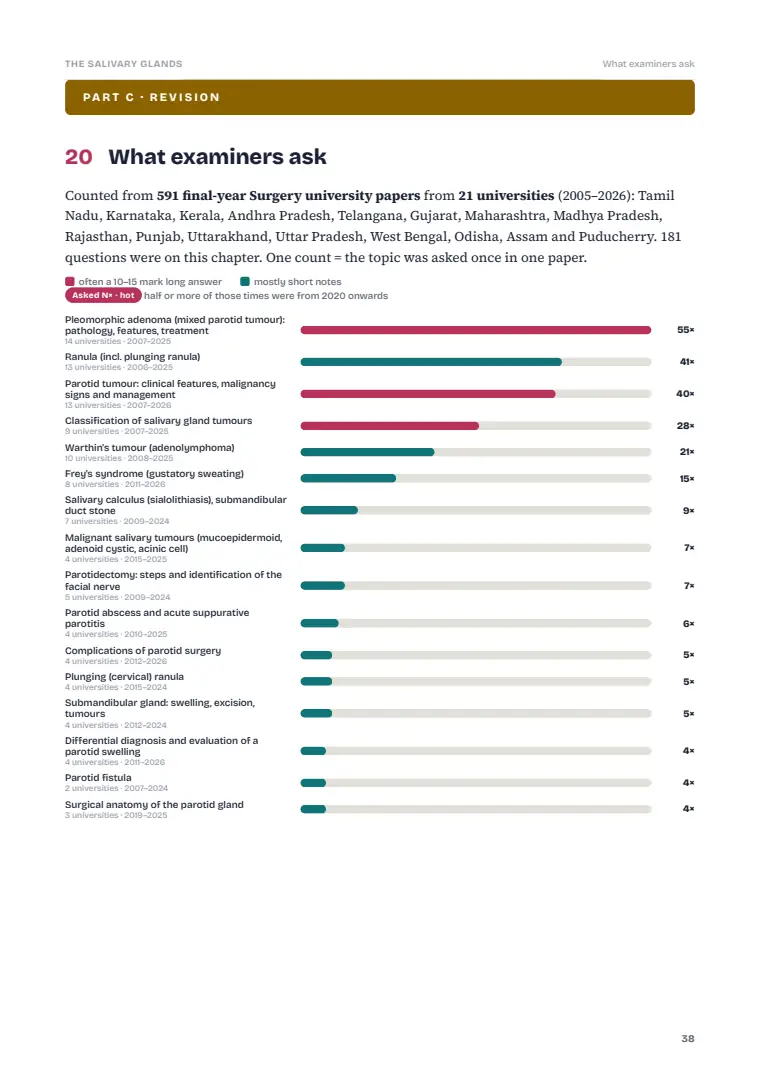
p. 38 · What examiners ask: previous years' questions - The Thyroid Gland
Preview and contents
What you get (36 pages)- Moves with swallowing
- RLN at Berry's ligament
- FNAC first for a nodule
- Papillary 80%
- Bleeding in 24 h
- Most asked: solitary nodule (68×)
Asked most in previous papers69× Solitary thyroid nodule: causes, evaluation, management60× Thyrotoxicosis / Graves' disease (primary)57× Thyroglossal cyst / fistula (Sistrunk)Part A · TheoryThe story · Anatomy · Physiology, TFT · Investigations · Classification · Simple goitre, MNG · Solitary nodule · Thyrotoxicosis · Cancers · Thyroiditis · Thyroglossal, retrosternal · Operations, complicationsPart B · ClinicalHow to examine · Case sheetPart C · RevisionWhat examiners ask · Exam answers · Viva cards · Night-before recap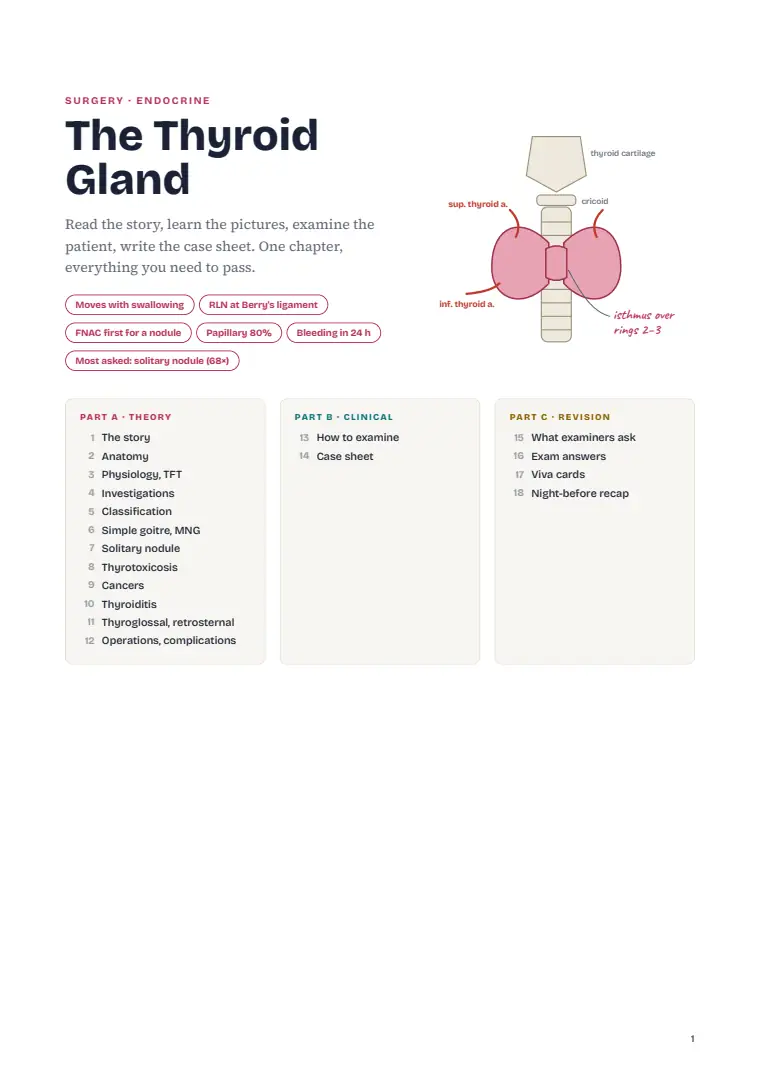
p. 1 · First page 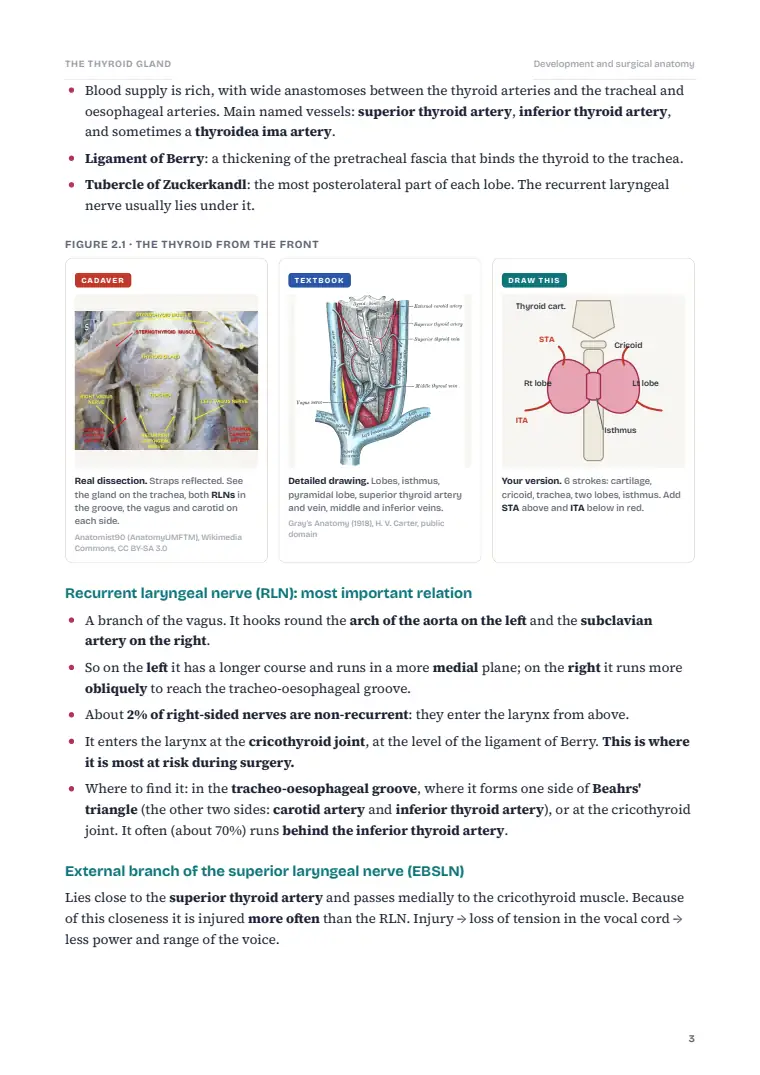
p. 3 · Inside the chapter 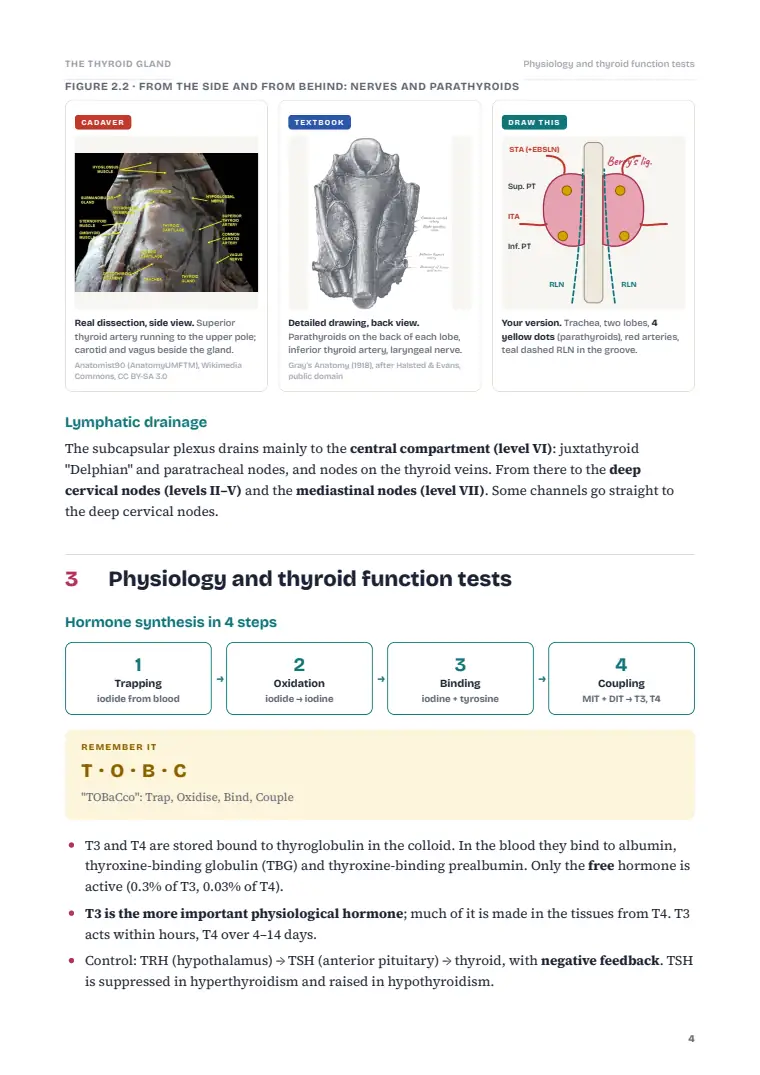
p. 4 · Inside the chapter 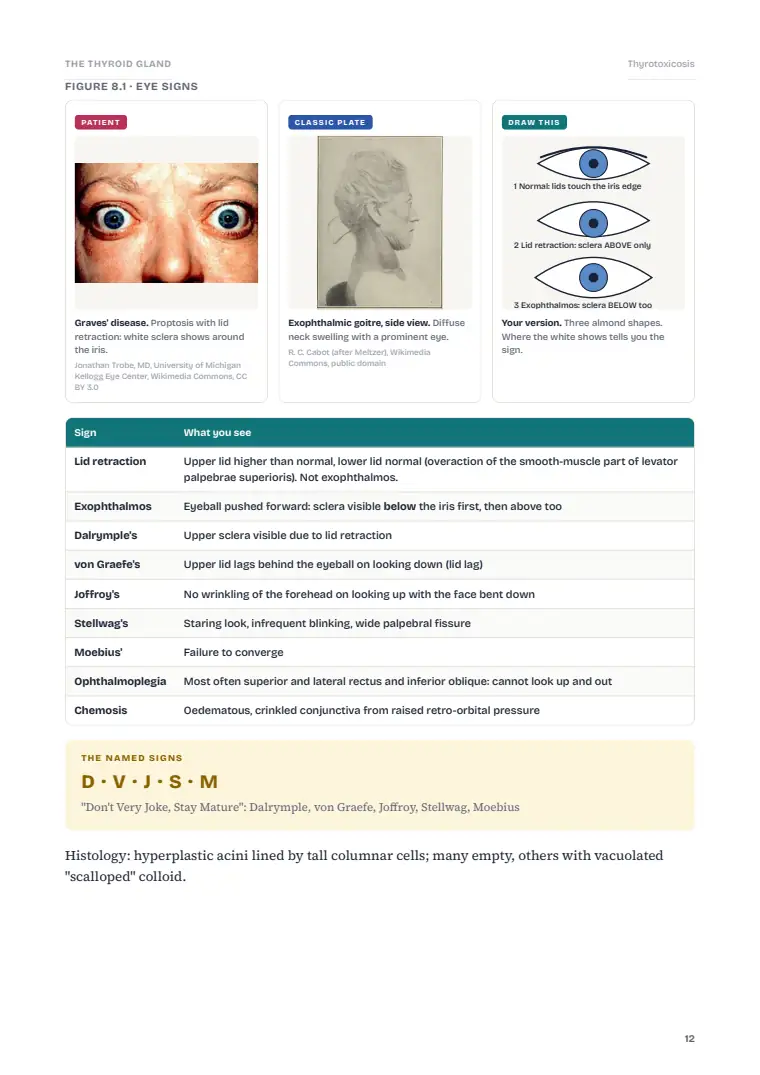
p. 12 · Inside the chapter 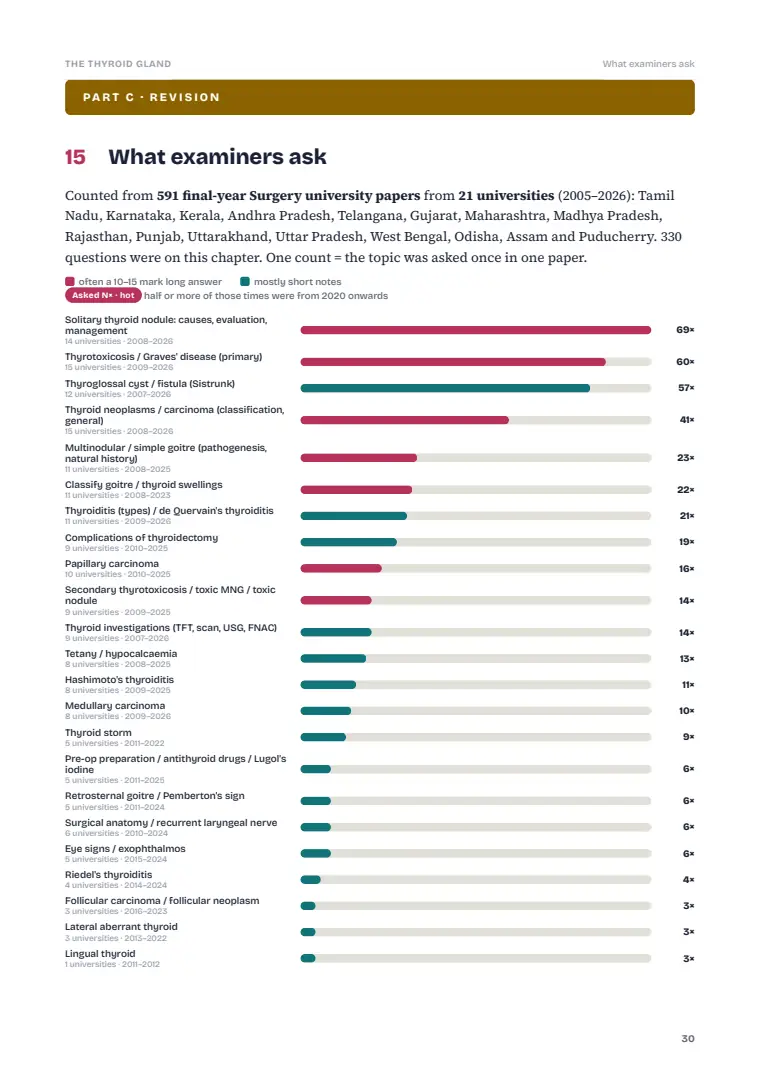
p. 30 · What examiners ask: previous years' questions - The Parathyroid and Adrenal Glands
Preview and contents
What you get (45 pages)- High calcium + PTH not suppressed: primary hyperparathyroidism
- Headache, sweating, palpitations + hypertension: phaeochromocytoma; block α first
- Carcinoid syndrome means liver metastases
- MEN 1 = three Ps; MEN 2A = medullary + phaeo + parathyroid
- Most asked: phaeochromocytoma (25×)
Asked most in previous papers25× Phaeochromocytoma: features, investigations, management21× Carcinoid tumour and carcinoid syndrome19× MEN syndromes: types and componentsPart A · TheoryThe story · Parathyroid anatomy and calcium · Hypercalcaemia and its crisis · Primary hyperparathyroidism · Tests and localisation · Treatment of PHPT · Secondary, tertiary, recurrent, carcinoma · Adrenal anatomy and incidentaloma · Cushing's syndrome · Conn's, adrenal cancer, metastases · Adrenal failure, CAH, haemorrhage · Phaeochromocytoma and paraganglioma · Adrenal operations · Carotid body tumour · Neuroendocrine tumours and carcinoid · Pancreatic endocrine tumours · MEN syndromesPart B · ClinicalHow to examine · Case sheetPart C · RevisionWhat examiners ask · Exam answers · Viva cards · Night-before recap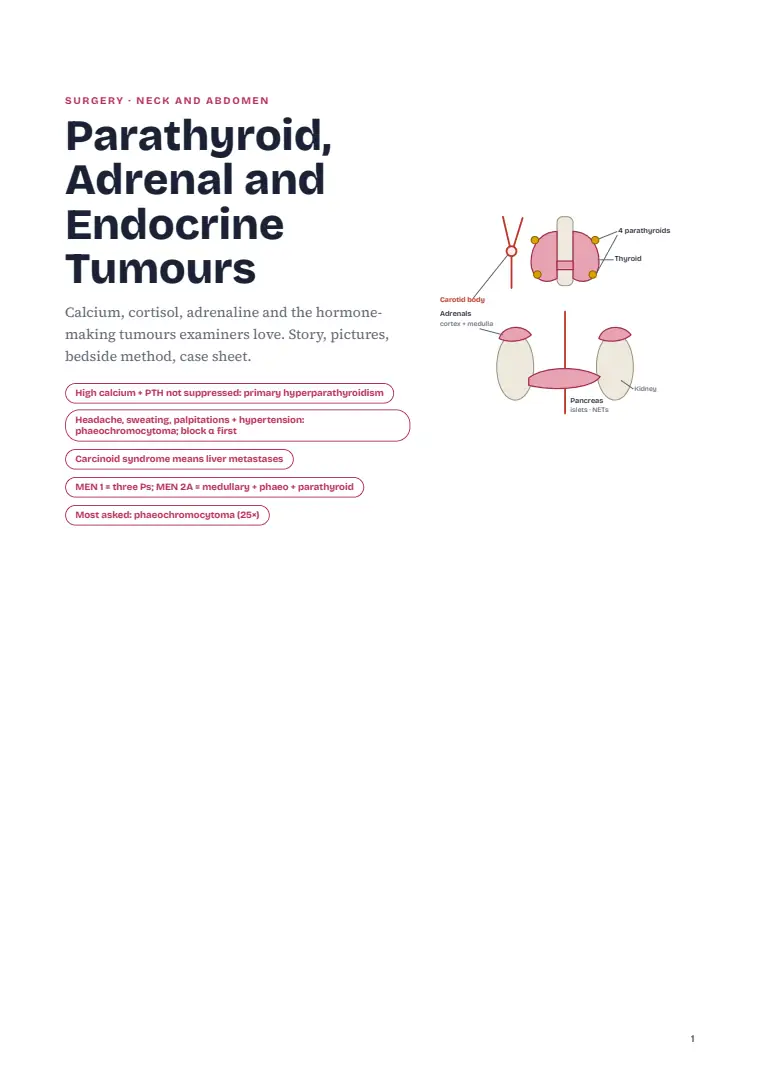
p. 1 · First page 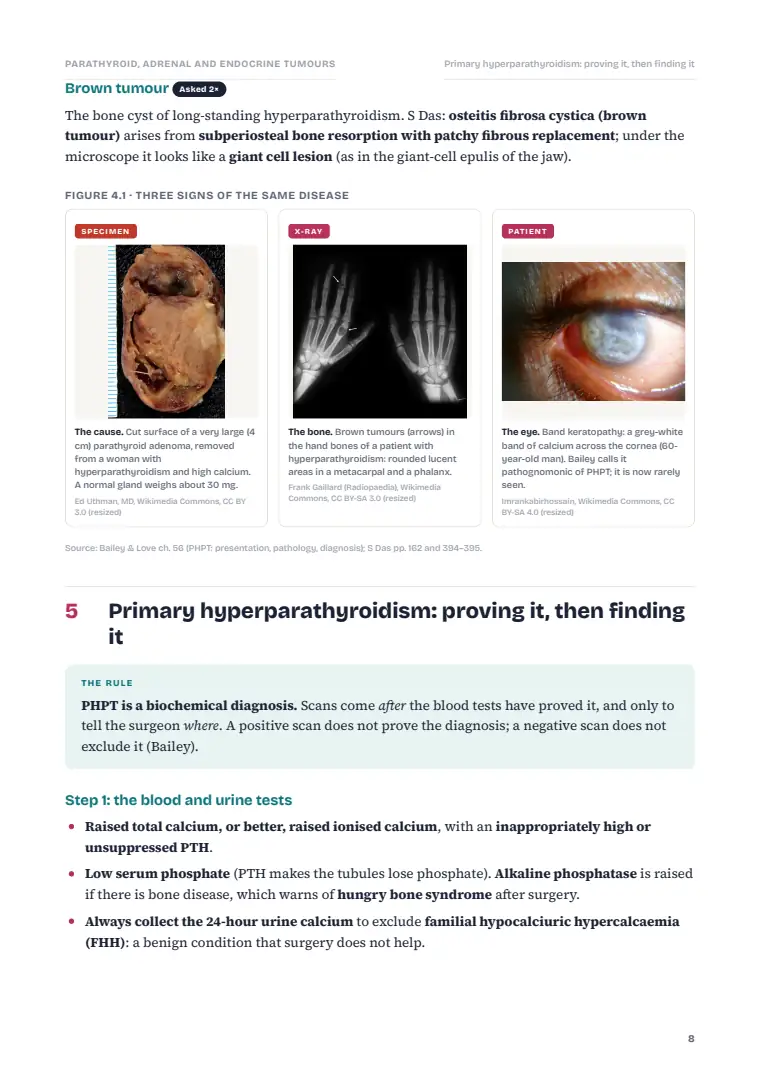
p. 8 · Inside the chapter 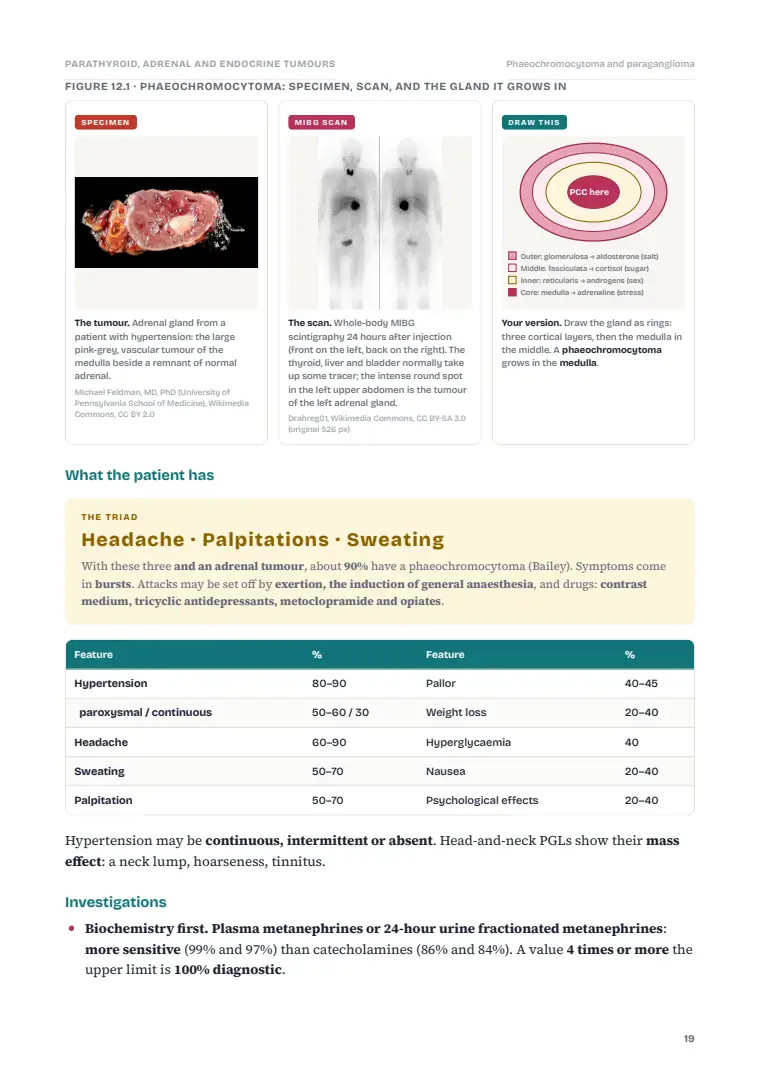
p. 19 · Inside the chapter 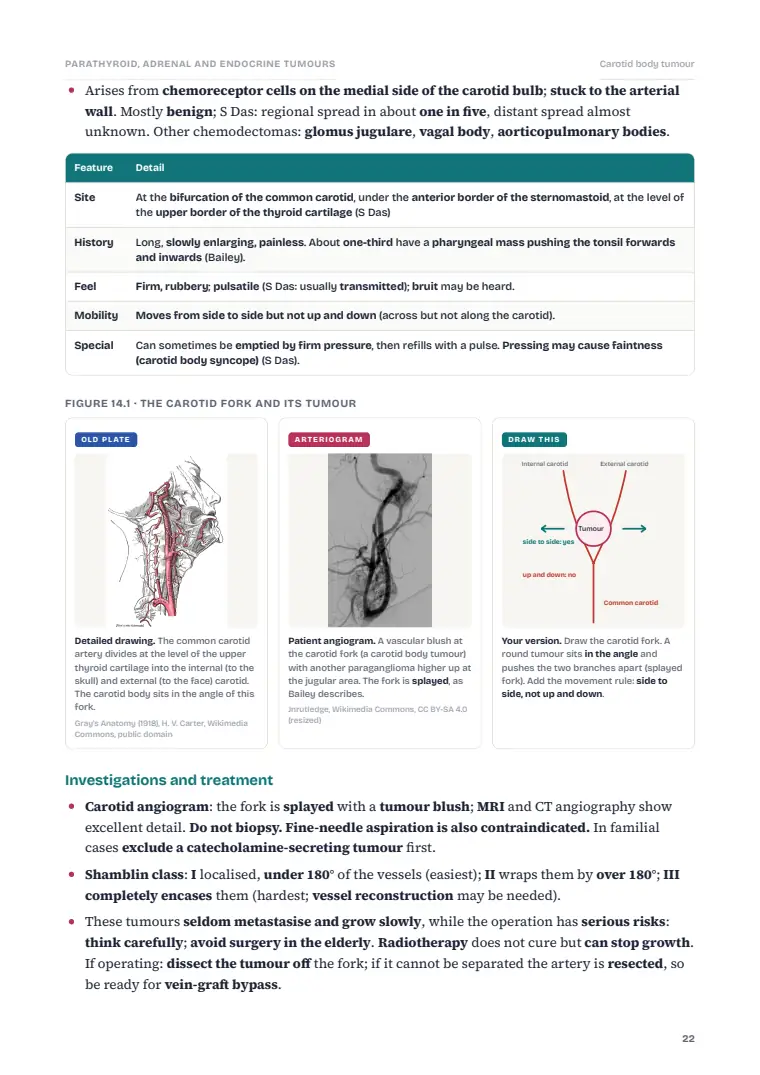
p. 22 · Inside the chapter 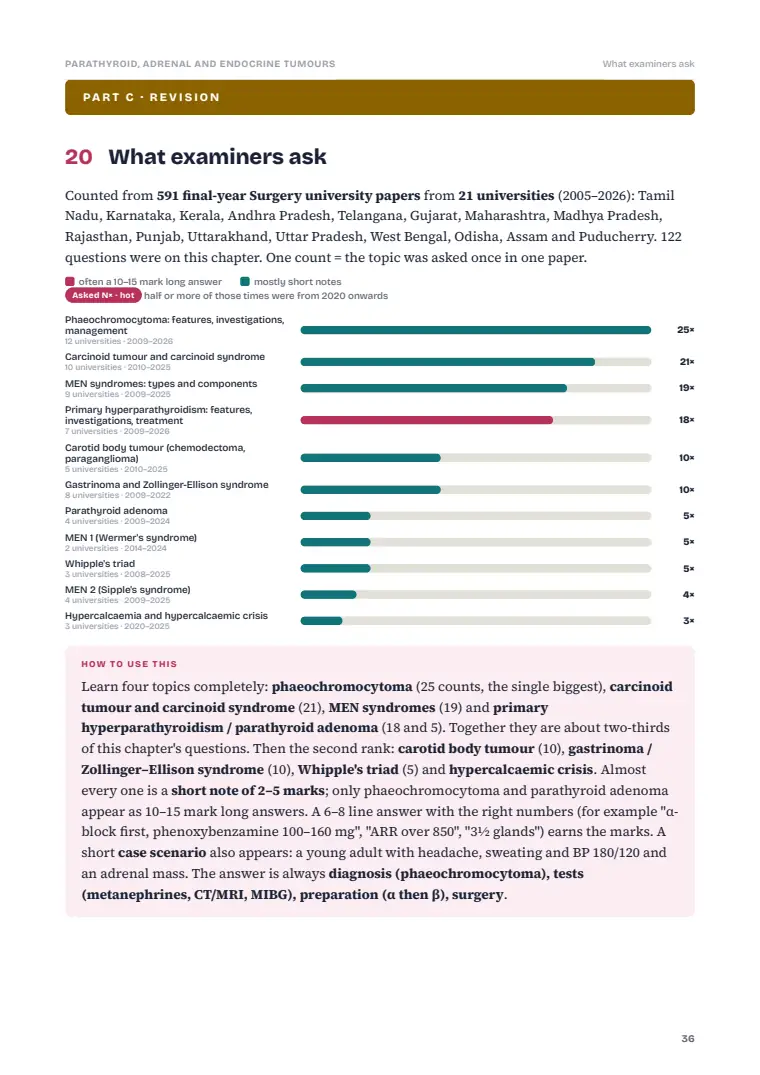
p. 36 · What examiners ask: previous years' questions - The Breast
Preview and contents
What you get (46 pages)- Triple assessment for every lump
- Upper outer quadrant
- Fibroadenoma 15–25 y
- Sentinel node first
- ER · PR · HER2
- Most asked: carcinoma breast (99×)
Asked most in previous papers99× Carcinoma breast: aetiology, clinical features, management (long answer)38× Phyllodes tumour / cystosarcoma phyllodes31× Staging / TNM of breast cancerPart A · TheoryThe story · Anatomy, lymphatics · Development, the nipple · Investigations · ANDI, mastalgia · Fibroadenoma, phyllodes, cysts · Mastitis, abscess, duct ectasia · Nipple discharge · Paget's disease · Cancer: risk, genes · Pathology, spread · Clinical features · TNM staging · Treatment of early cancer · Advanced, recurrent · Gynaecomastia, male breast, screeningPart B · ClinicalHow to examine · Case sheetPart C · RevisionWhat examiners ask · Exam answers · Viva cards · Night-before recap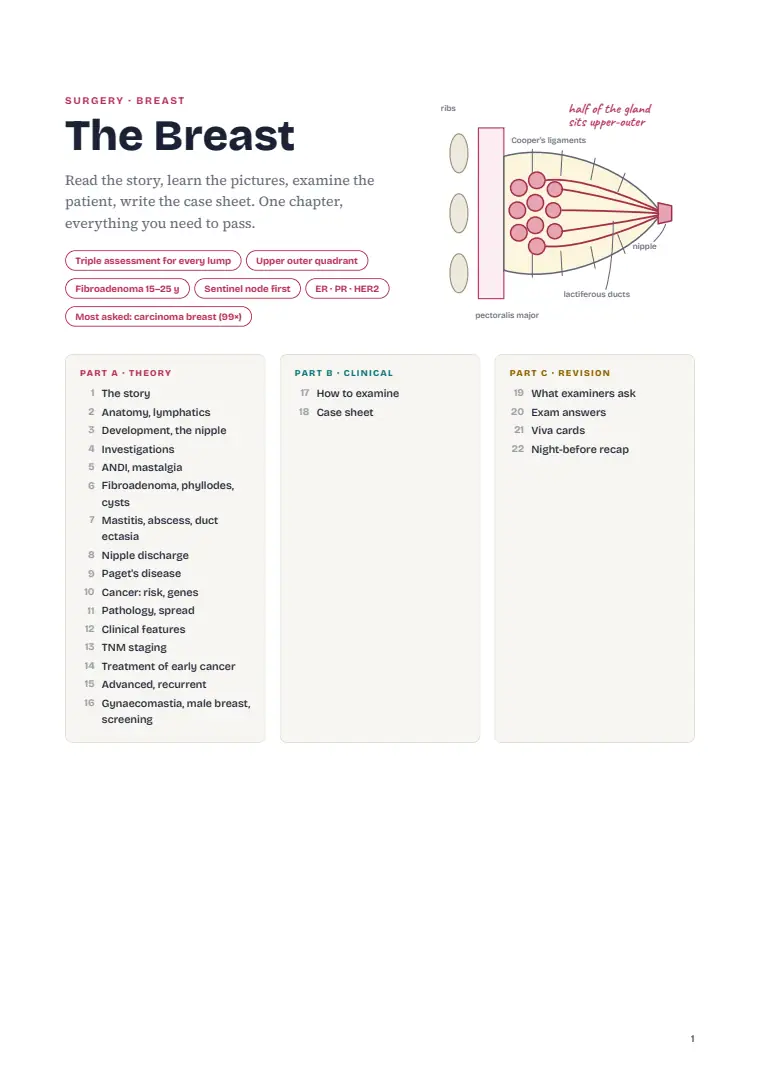
p. 1 · First page 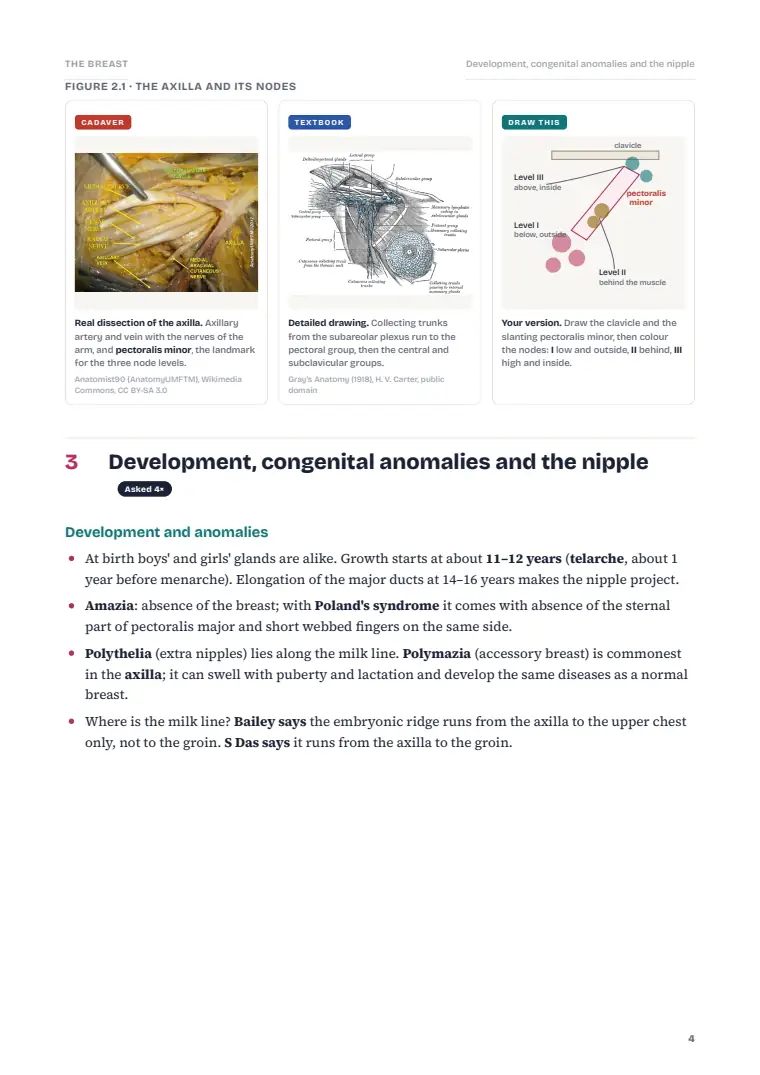
p. 4 · Inside the chapter 
p. 11 · Inside the chapter 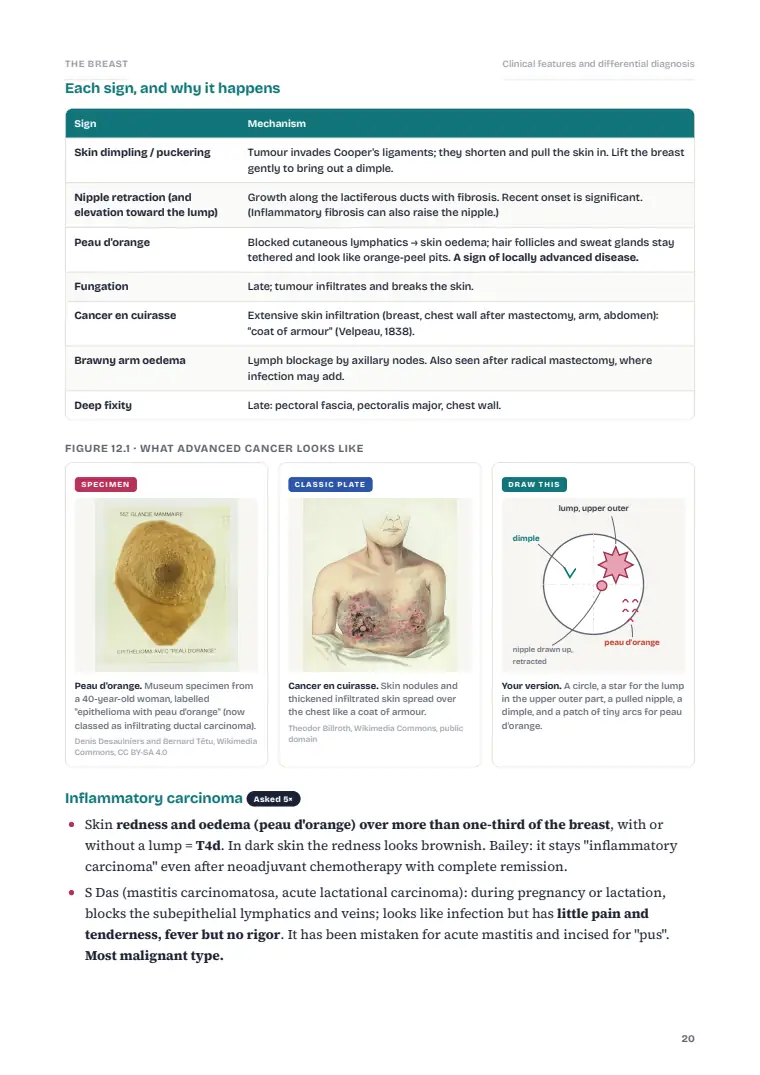
p. 20 · Inside the chapter 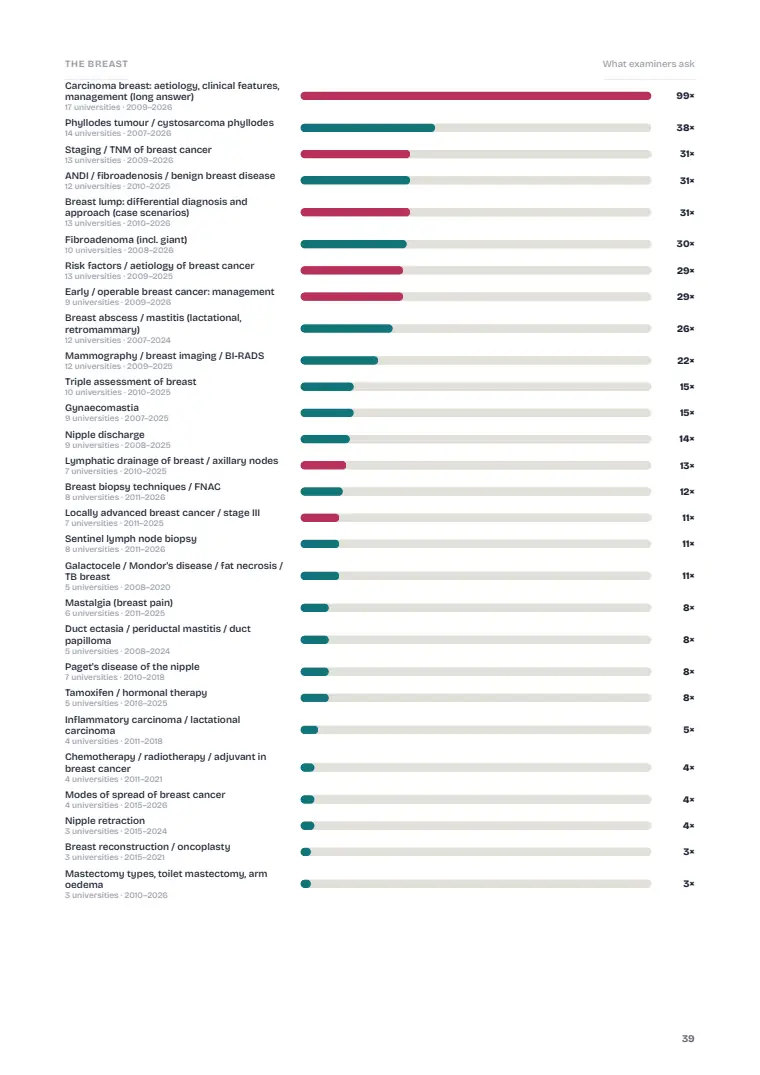
p. 39 · What examiners ask: previous years' questions
Vascular and chest
- Arterial Disorders
Preview and contents
What you get (45 pages)- Pain one level below the block
- ABPI below 0.9
- Buerger's: stop smoking
- Embolus: heparin, then Fogarty
- AAA repair above 55 mm
- Most asked: Buerger's (64×)
Asked most in previous papers64× Buerger's disease (thromboangiitis obliterans)43× Gangrene: definition, types, causes, management27× Diabetic foot / diabetic gangrenePart A · TheoryThe story · Arteries and pulses · Atherosclerosis · Chronic limb ischaemia · Investigations · Treating chronic ischaemia · Buerger's disease · Raynaud's, arteritis · Acute limb ischaemia · Gangrene · Diabetic foot · Amputations · Aneurysms · AV fistula · Carotid, subclavian, cervical ribPart B · ClinicalHow to examine · Case sheetPart C · RevisionWhat examiners ask · Exam answers · Viva cards · Night-before recap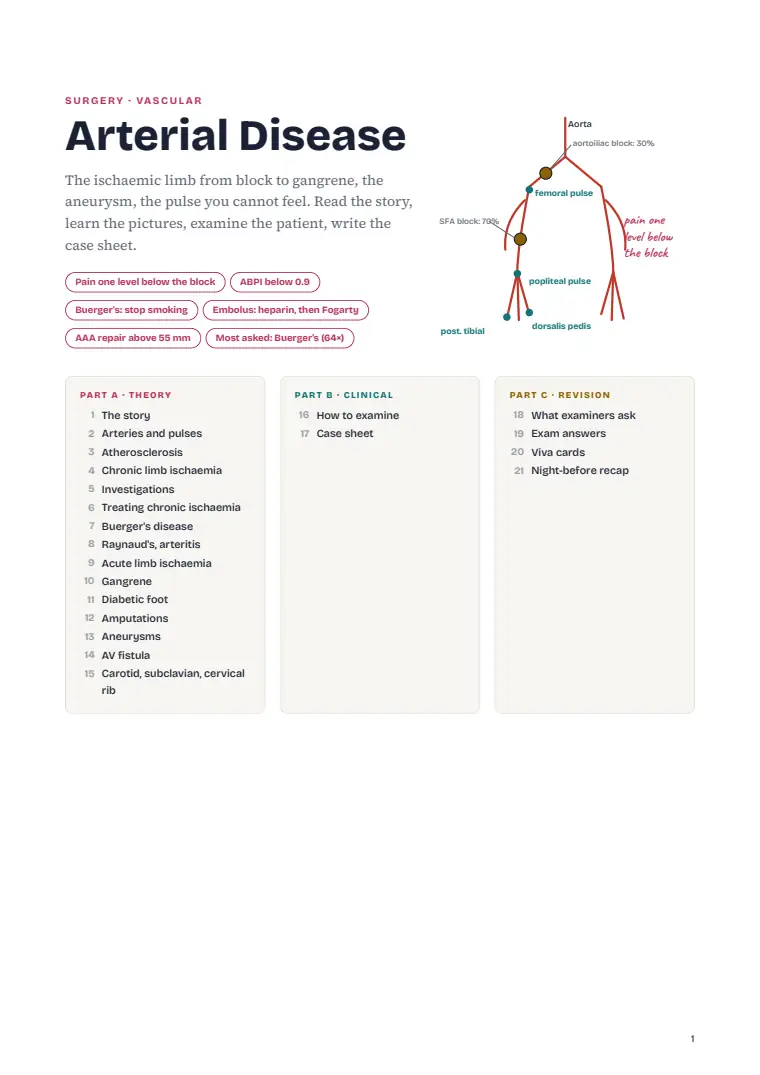
p. 1 · First page 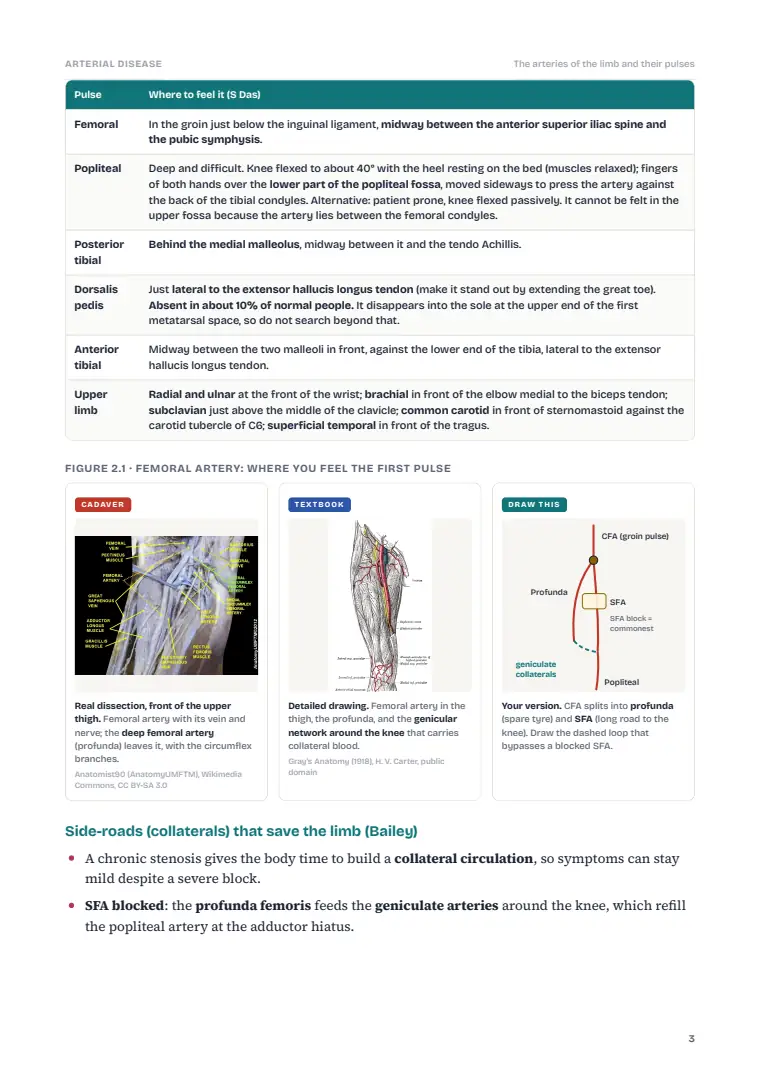
p. 3 · Inside the chapter 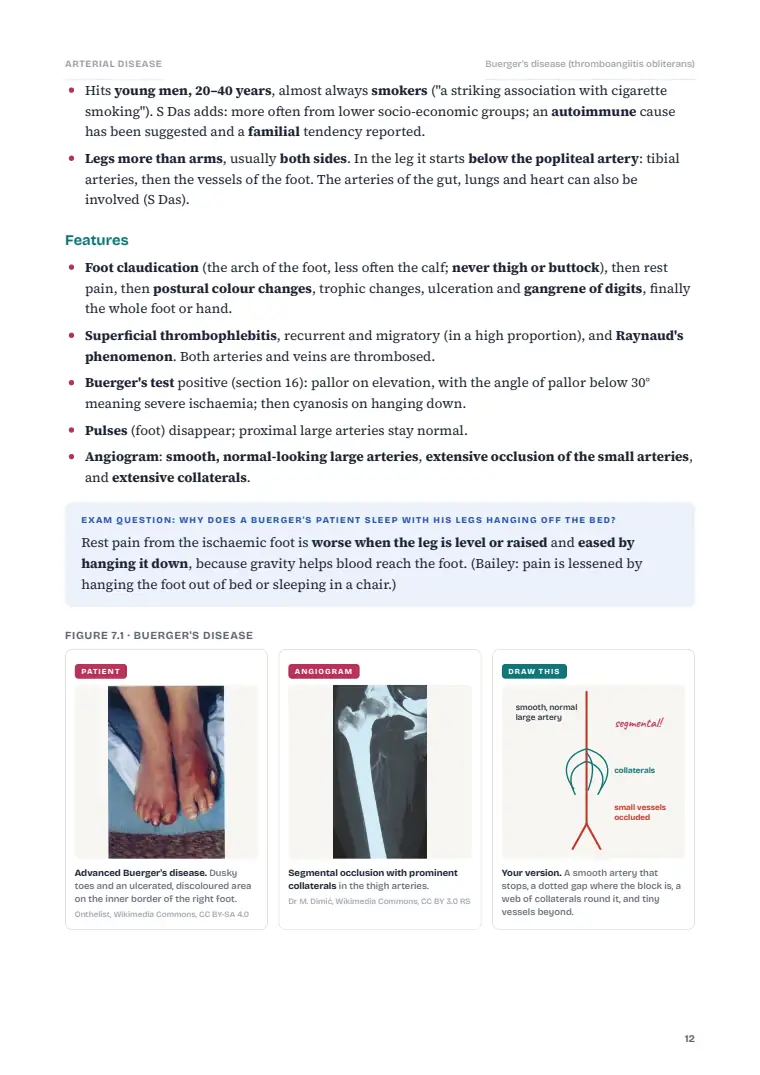
p. 12 · Inside the chapter 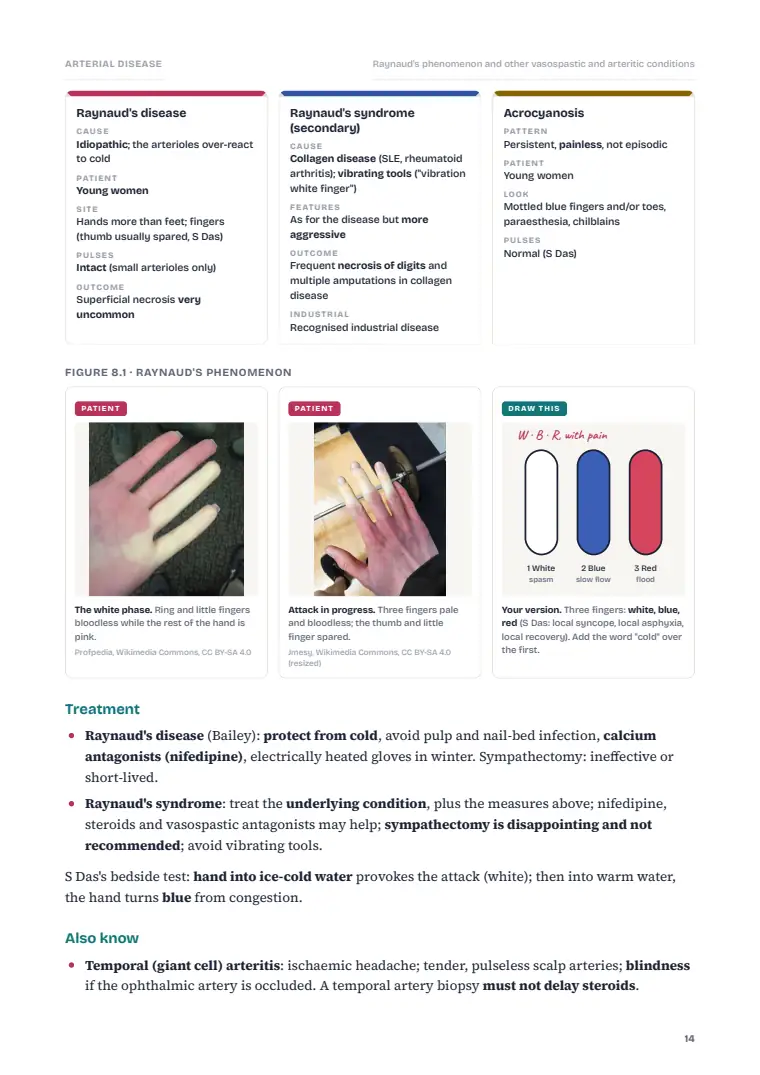
p. 14 · Inside the chapter 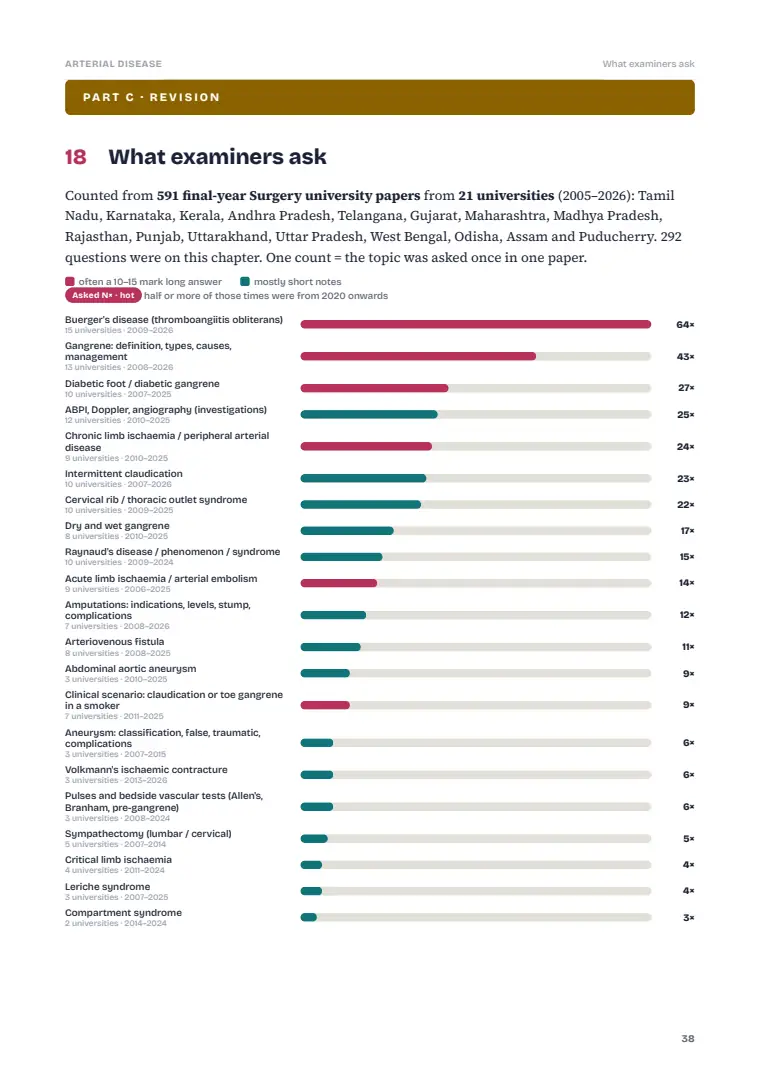
p. 38 · What examiners ask: previous years' questions - Venous Disorders
Preview and contents
What you get (47 pages)- Valves fail, pressure rises
- Trendelenburg tests the groin valve
- Duplex before any treatment
- Virchow's triad
- Compression heals the ulcer
- Most asked: varicose veins (55×)
Asked most in previous papers55× Varicose veins: aetiology, clinical features, investigations, management40× Deep vein thrombosis: aetiology, clinical features, diagnosis, treatment37× Venous ulcer (varicose ulcer): causes, features, managementPart A · TheoryThe story · Venous anatomy · Venous hypertension, CEAP · Varicose veins · Tests and duplex · Treatment · Complications · Venous ulcer · Deep vein thrombosis · Lymphoedema, filariasis · Cellulitis, lymphangitis · The swollen limb: causesPart B · ClinicalHow to examine · Case sheetsPart C · RevisionWhat examiners ask · Exam answers · Viva cards · Night-before recap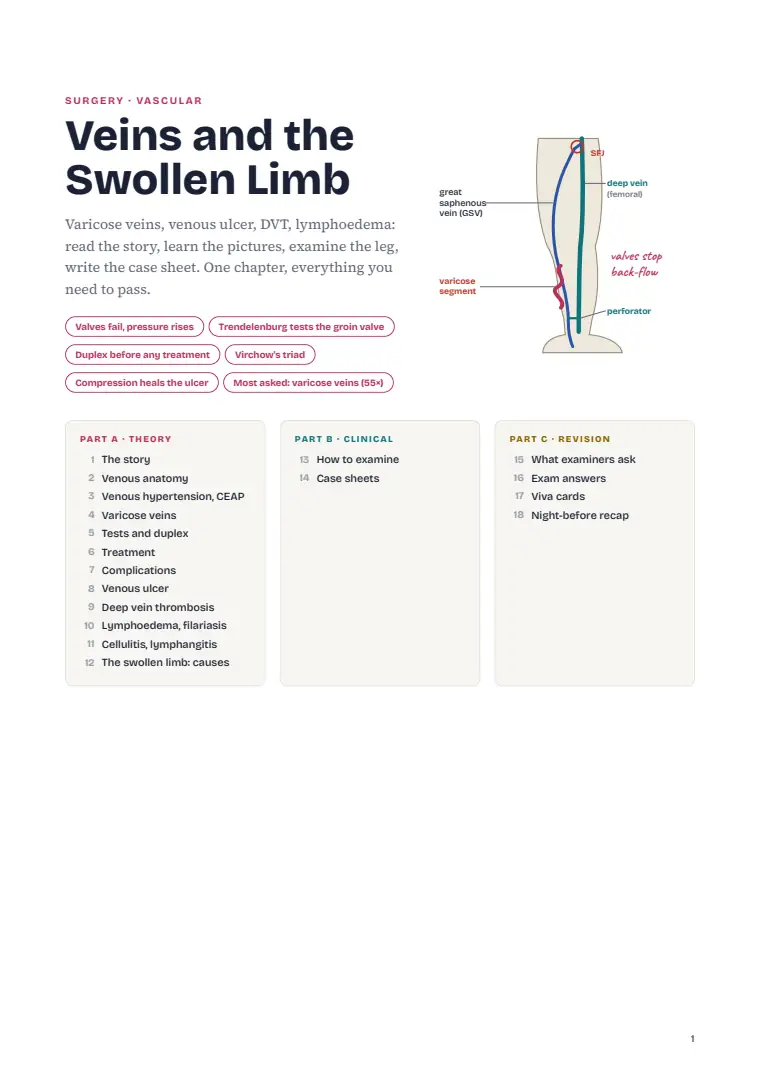
p. 1 · First page 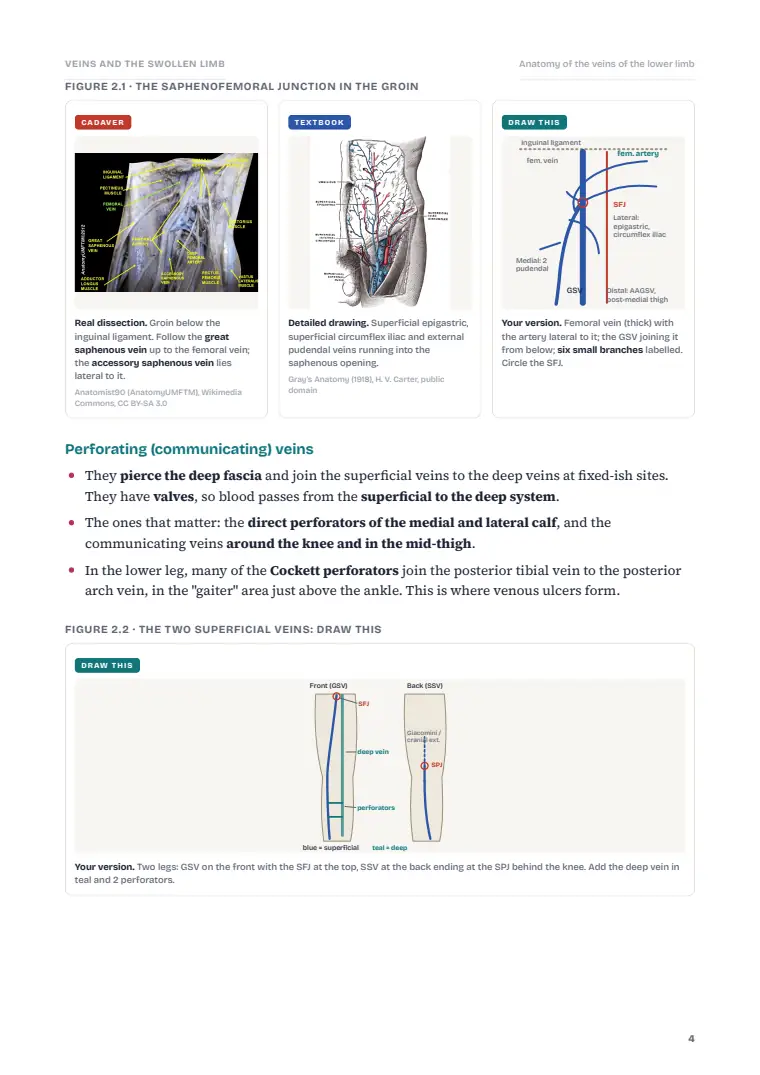
p. 4 · Inside the chapter 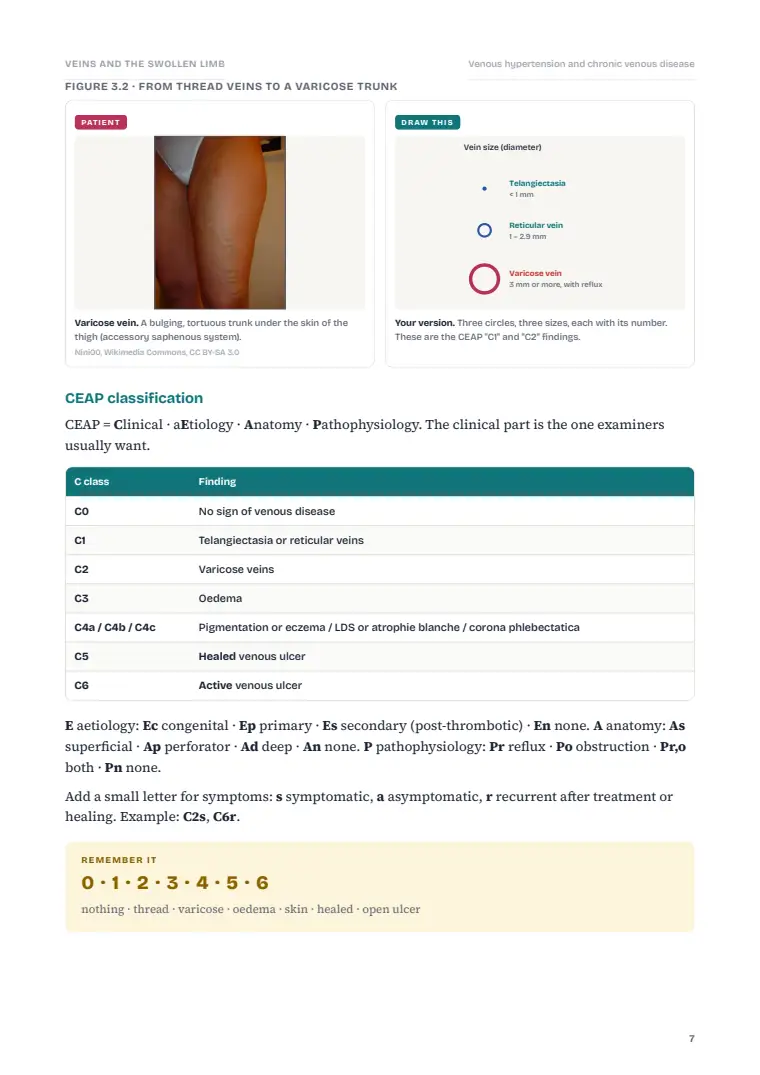
p. 7 · Inside the chapter 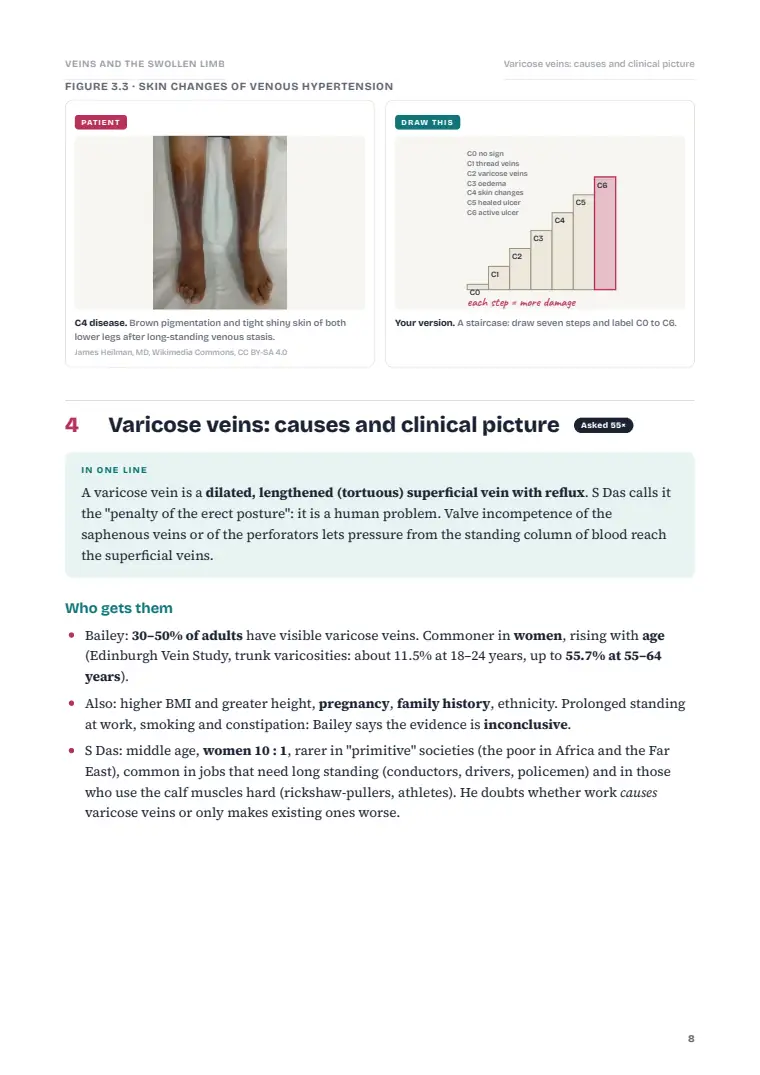
p. 8 · Inside the chapter 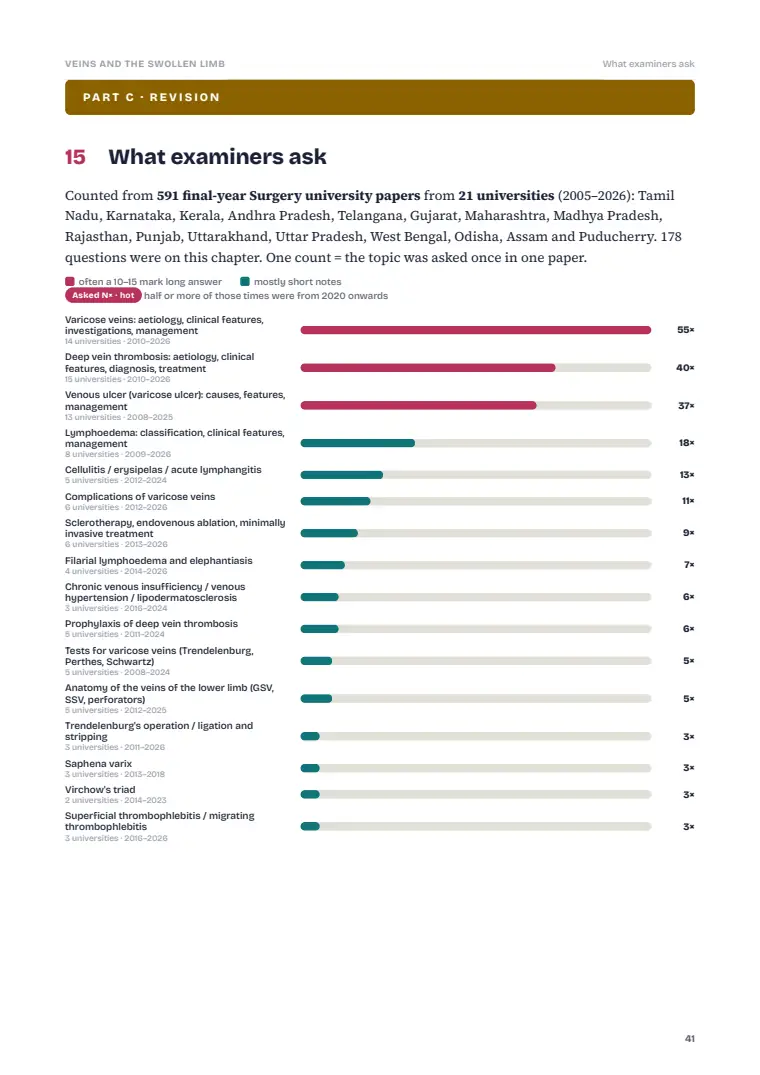
p. 41 · What examiners ask: previous years' questions - Cranial Neurosurgery, Cardiac Surgery and the Thorax
Preview and contents
What you get (48 pages)- Pus in the pleura: drain it, then free the lung
- A chest swelling that moves with a cough: empyema necessitans
- Hydrocephalus: too much CSF
- Never a lumbar puncture in obstructive hydrocephalus
- Most asked: empyema thoracis (14×), chest drain (14×) and hydrocephalus (14×)
Asked most in previous papers14× Empyema thoracis: causes, features, treatment14× Intercostal drain (chest tube), water-seal, triangle of safety14× Hydrocephalus: causes, features, VP shuntPart A · TheoryThe story · The chest in place · Tests, scopes and the way in · Fluid in the pleura; the chest drain · Empyema thoracis · Lung abscess, bronchiectasis, lung cysts · Lung tumours · The mediastinum · Chest wall and diaphragm · Heart operations at a glance · Congenital heart disease · The head as a closed box: CSF and pressure · Hydrocephalus · Neural tube defects · Brain tumours · Infection and bleeding inside the skullPart B · ClinicalHow to examine · Case sheet: chest wall swelling with chronic coughPart C · RevisionWhat examiners ask · Exam answers · Viva cards · Night-before recap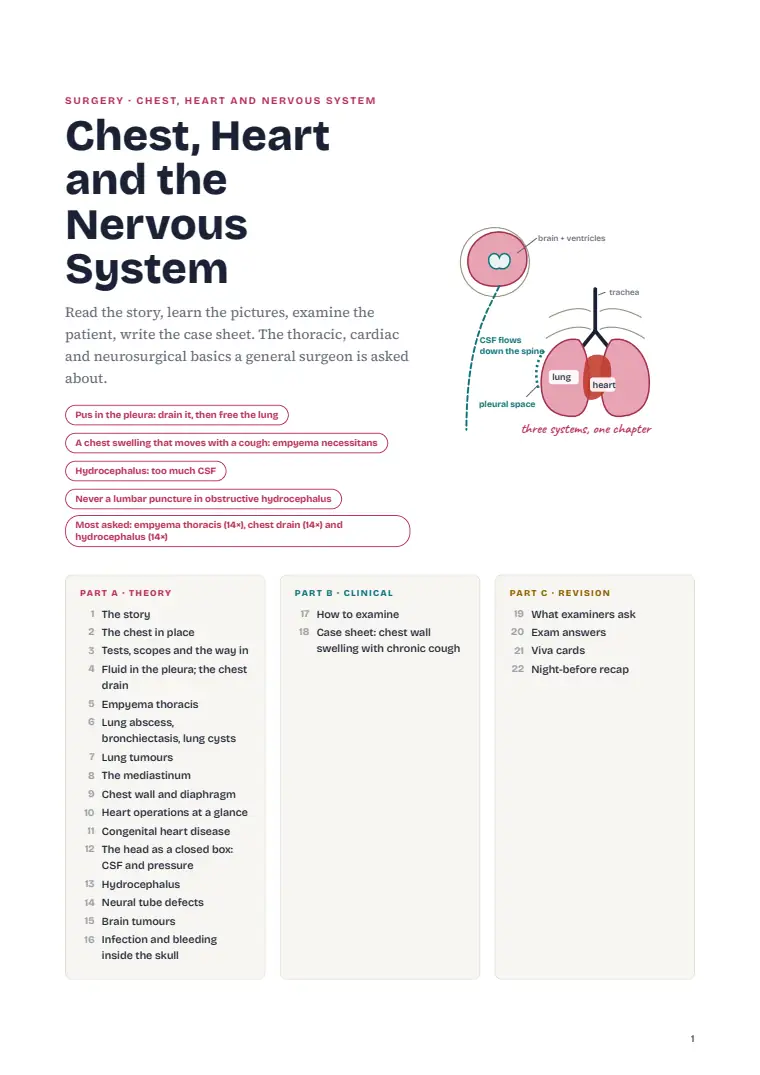
p. 1 · First page 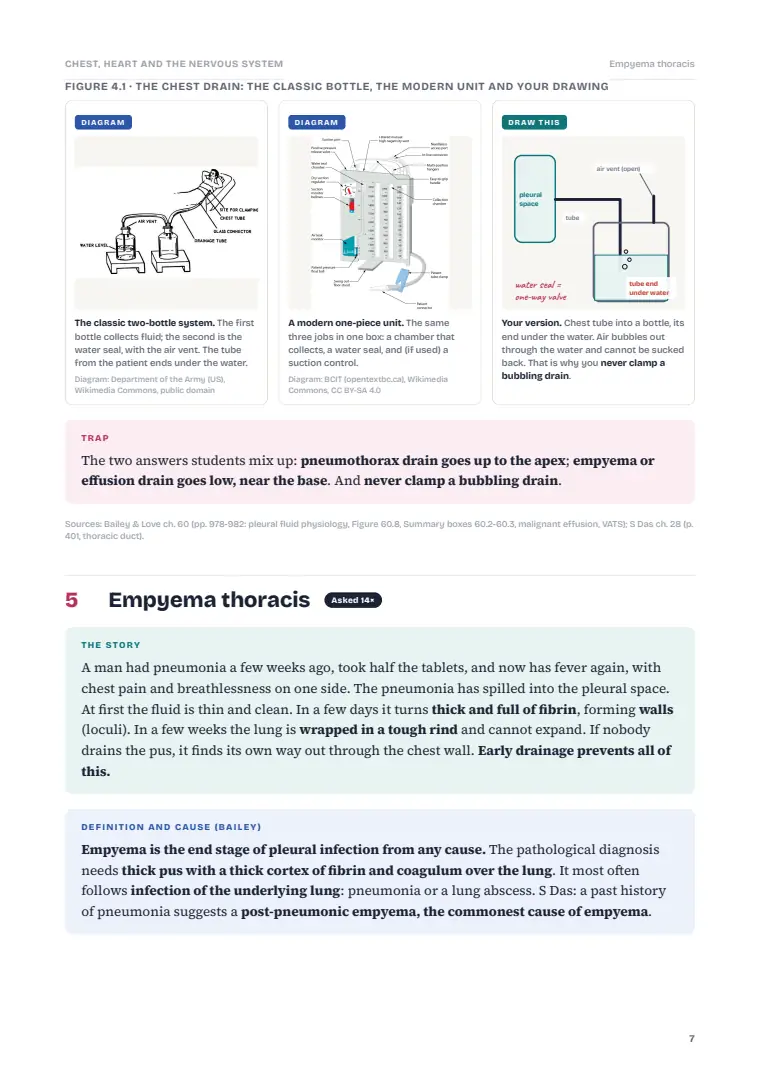
p. 7 · Inside the chapter 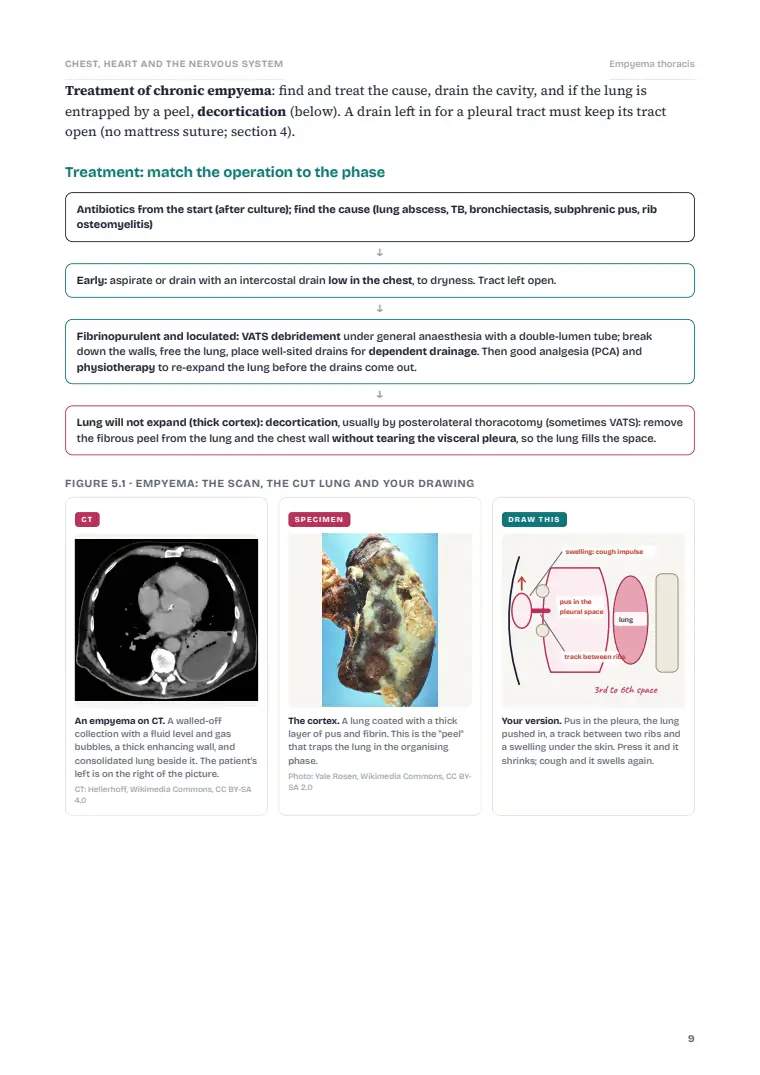
p. 9 · Inside the chapter 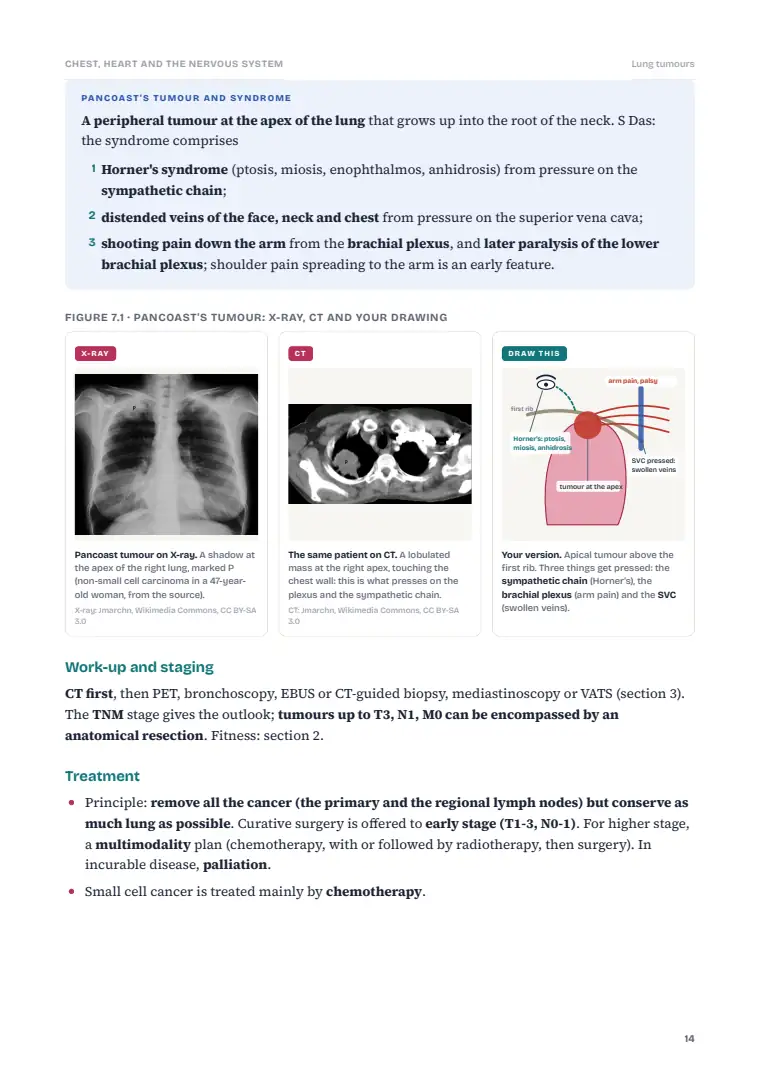
p. 14 · Inside the chapter 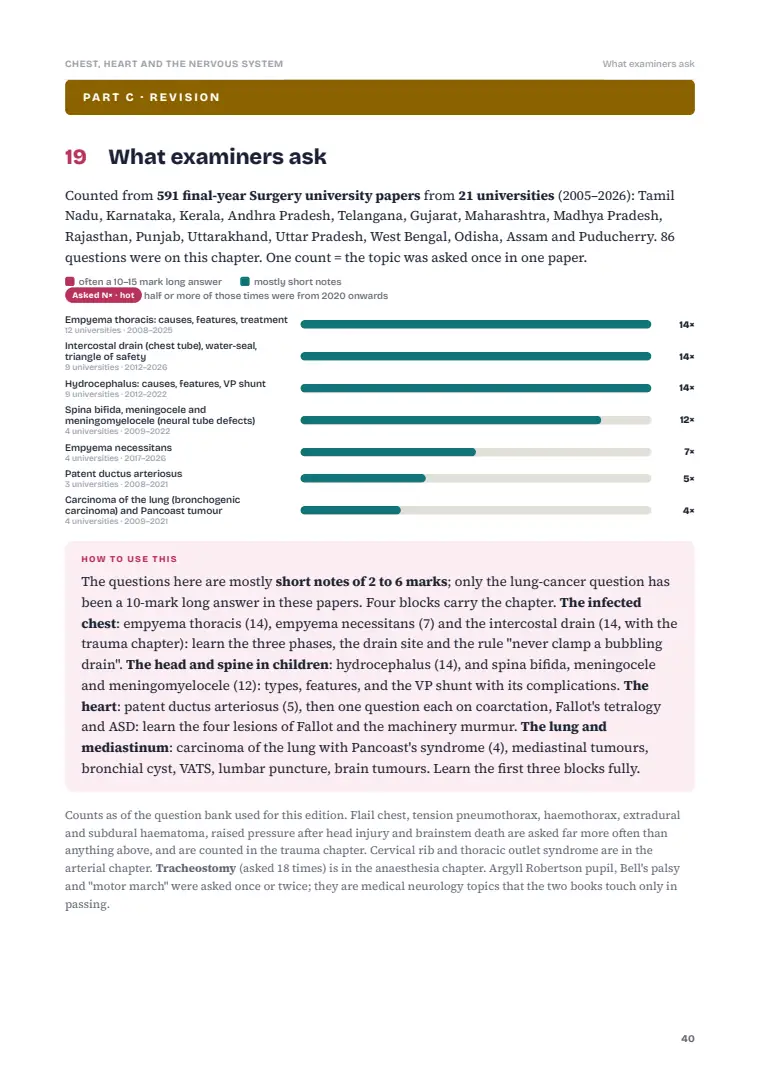
p. 40 · What examiners ask: previous years' questions
Abdomen
- The Oesophagus
Preview and contents
What you get (47 pages)- Dysphagia in an older patient is cancer until proved otherwise
- Solids first = blockage; liquids first = achalasia
- Achalasia: bird's beak, HRM, myotomy or POEM
- Barrett's: Seattle biopsies, surveillance
- Most asked: achalasia cardia (57×)
Asked most in previous papers57× Achalasia cardia: aetiology, features, investigations, treatment20× Barrett's oesophagus19× Gastro-oesophageal reflux disease (GERD) and reflux oesophagitisPart A · TheoryThe story · Anatomy · Investigating the oesophagus · Dysphagia: the approach · Achalasia cardia · Other motility disorders · Reflux disease (GORD) · Hiatus hernia · Barrett's oesophagus · Carcinoma: causes, features, diagnosis · Carcinoma: staging and treatment · Pouches, webs and rings · Perforation and Boerhaave's · Corrosives, strictures, foreign bodies · Other conditionsPart B · ClinicalHow to examine: dysphagia · Case sheetPart C · RevisionWhat examiners ask · Exam answers · Viva cards · Night-before recap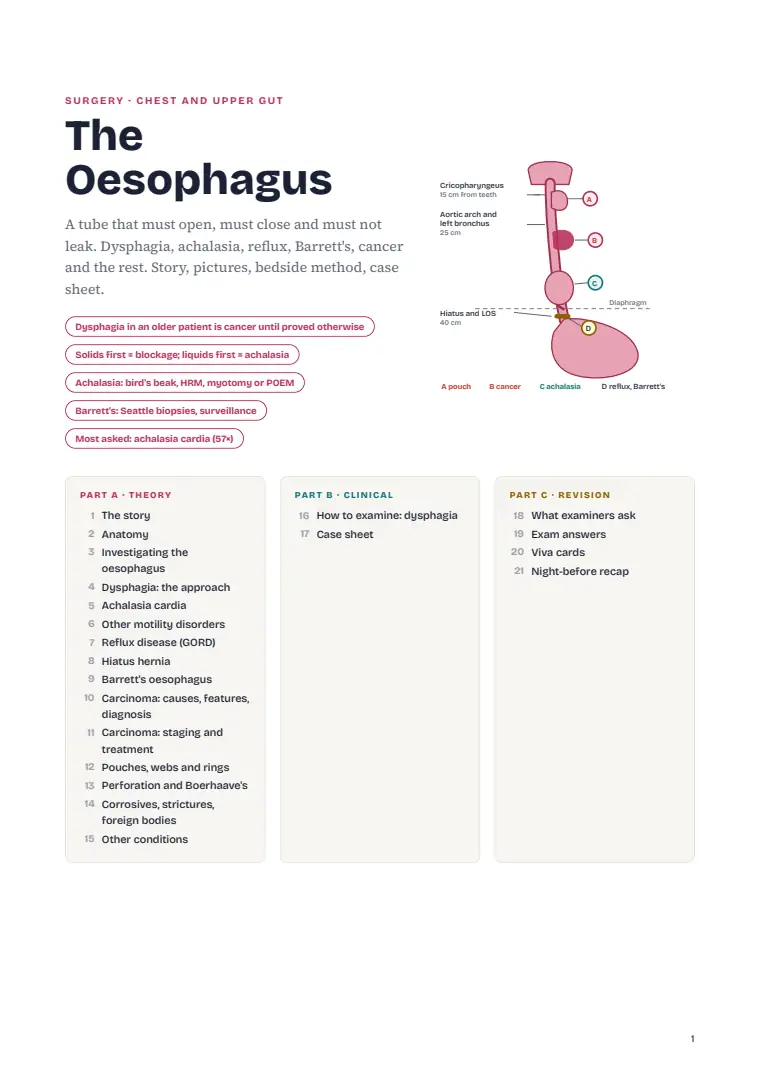
p. 1 · First page 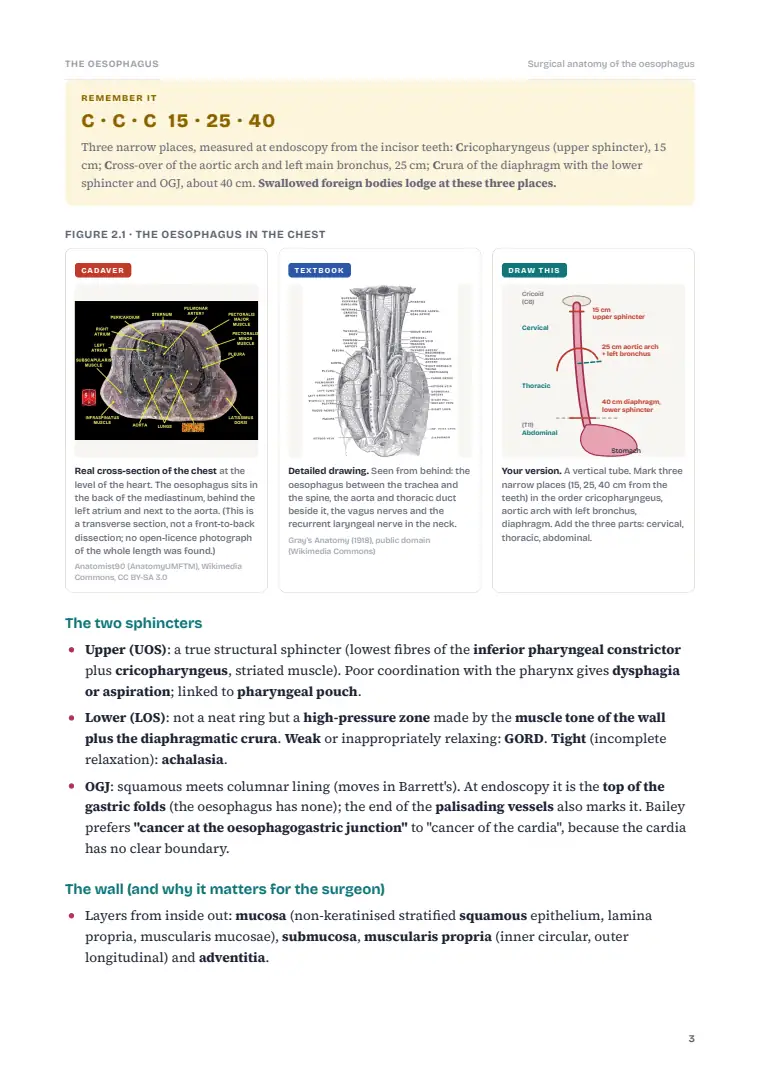
p. 3 · Inside the chapter 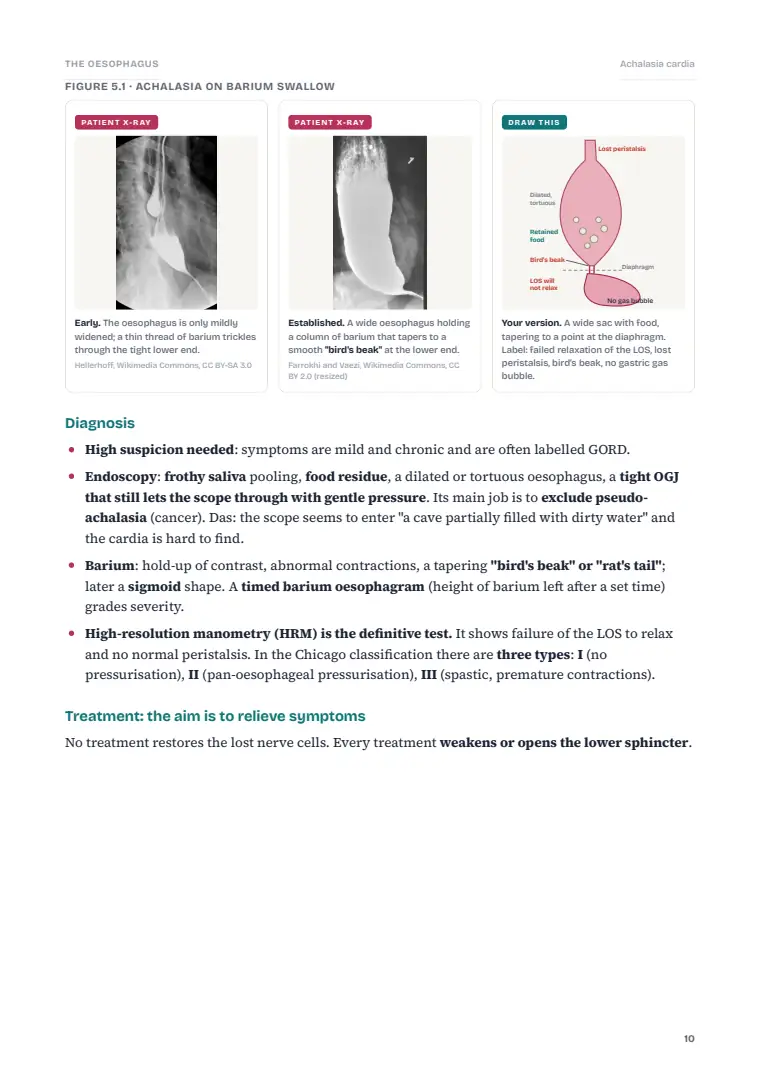
p. 10 · Inside the chapter 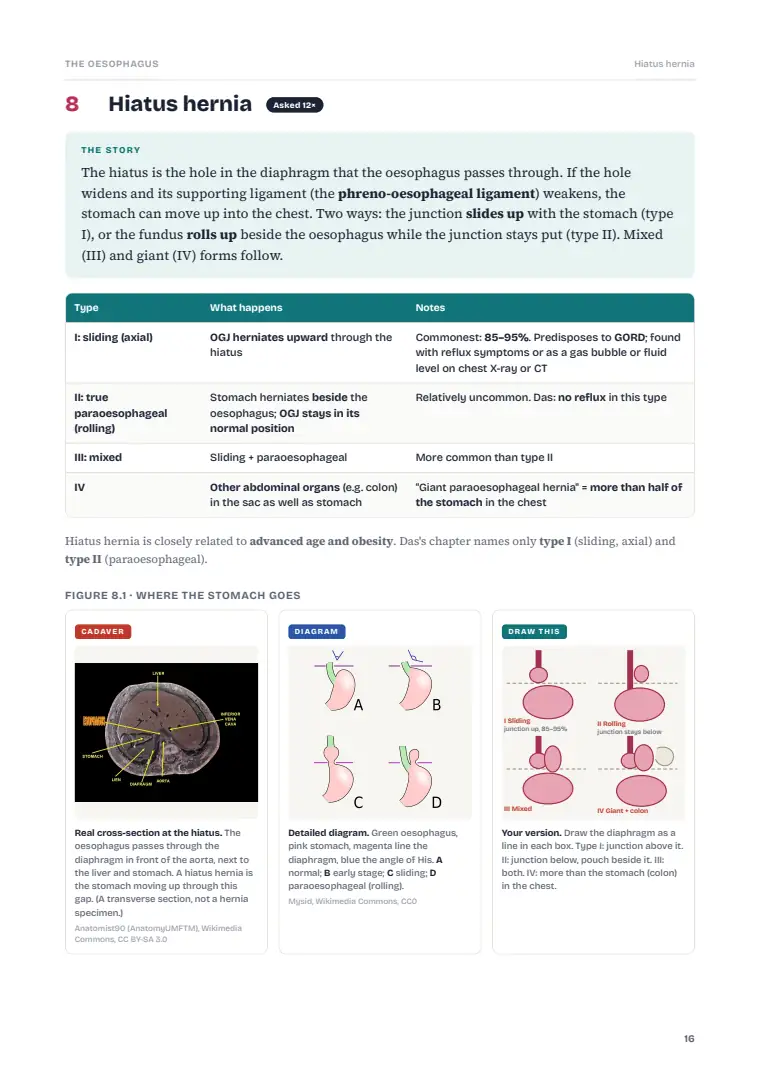
p. 16 · Inside the chapter 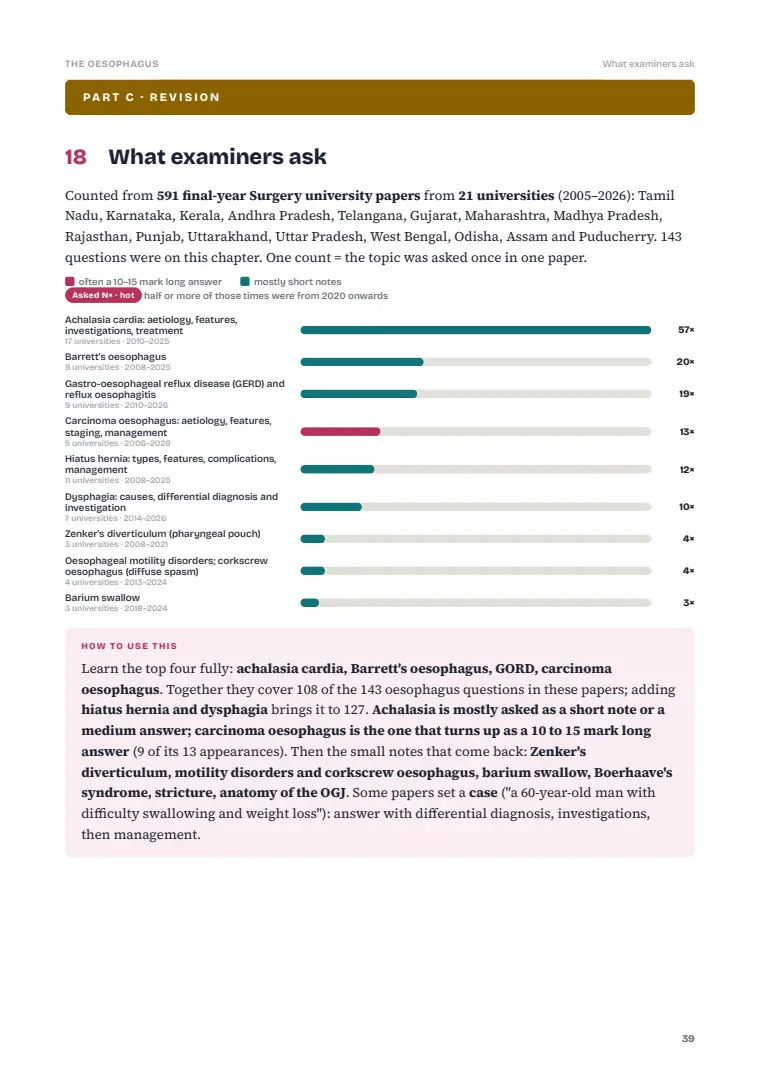
p. 39 · What examiners ask: previous years' questions - The Stomach and Duodenum
Preview and contents
What you get (45 pages)- H. pylori and NSAIDs cause most ulcers
- Gastric ulcer: biopsy it, think cancer
- Perforation: free gas, laparotomy, omental patch
- Vomit with food but no bile = outlet obstruction
- Most asked: carcinoma stomach (54×)
Asked most in previous papers54× Carcinoma stomach: aetiology, pathology, clinical features, staging, management31× Gastric outlet obstruction (pyloric stenosis in adults)27× Perforated peptic ulcer: features, investigations, managementPart A · TheoryThe story · Anatomy of stomach and duodenum · Acid, mucus, investigations · H. pylori and gastritis · Peptic ulcer: causes and features · Treating an ulcer · Ulcer operations and their sequelae · Perforated ulcer · Haematemesis and melaena · Gastric outlet obstruction · Carcinoma of the stomach · Spread, staging, treatment · Other tumours and conditionsPart B · ClinicalHow to examine · Case sheetPart C · RevisionWhat examiners ask · Exam answers · Viva cards · Night-before recap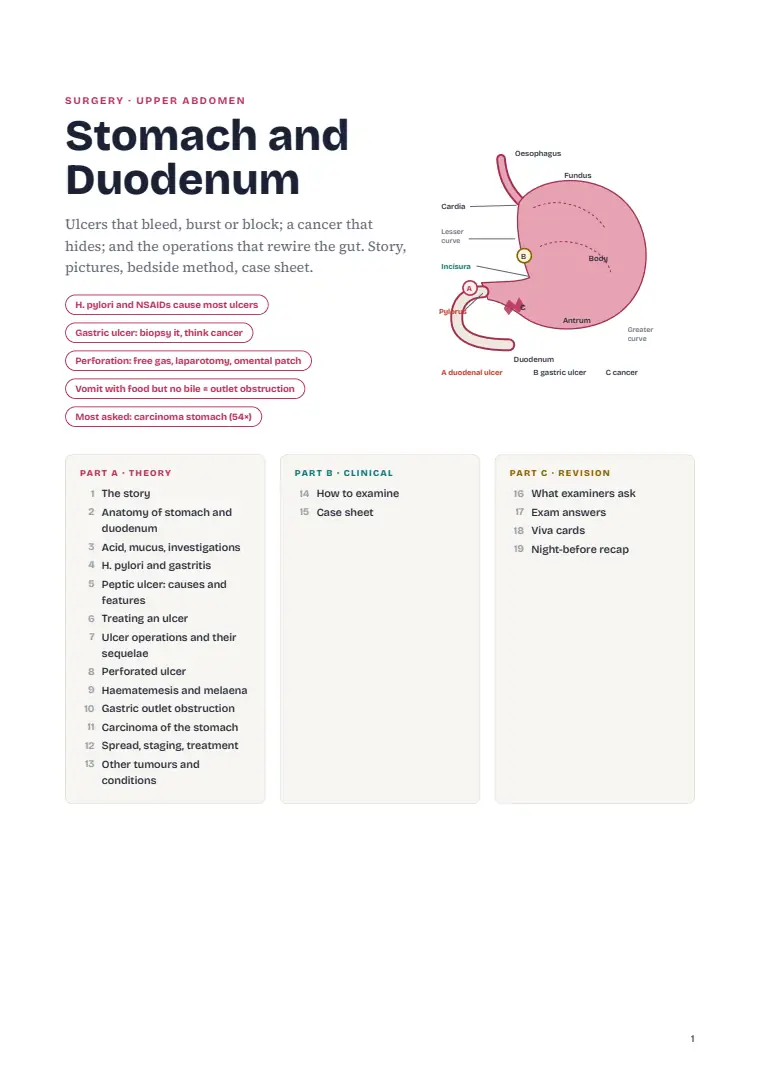
p. 1 · First page 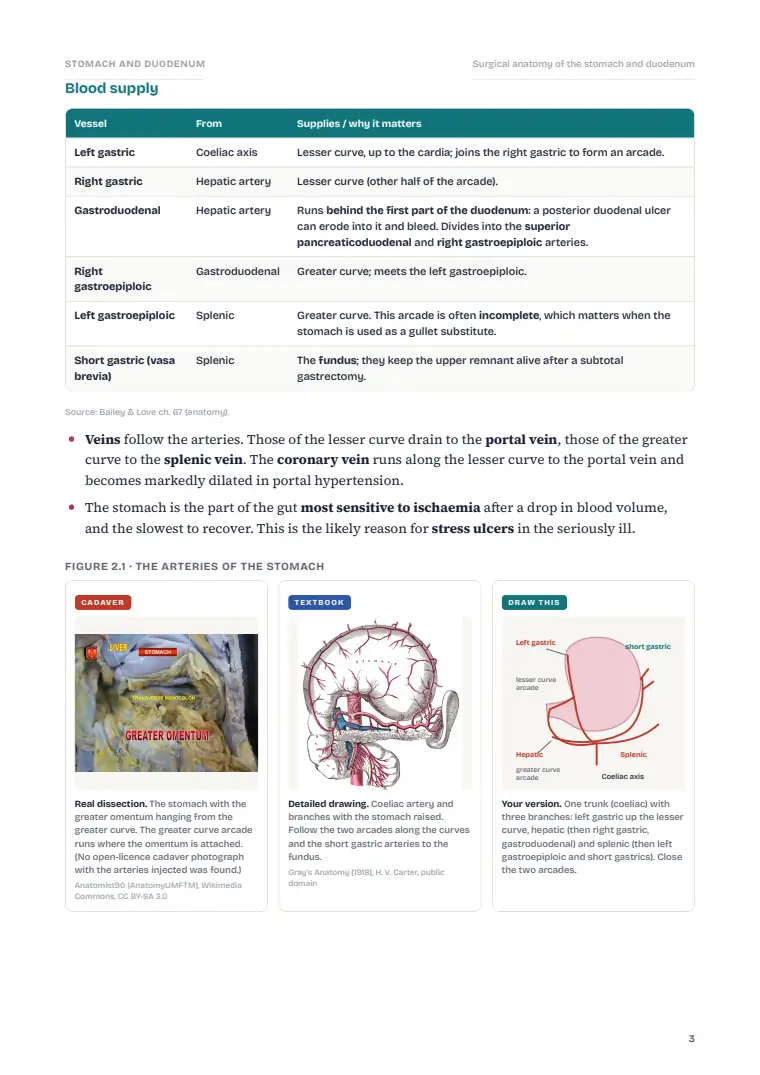
p. 3 · Inside the chapter 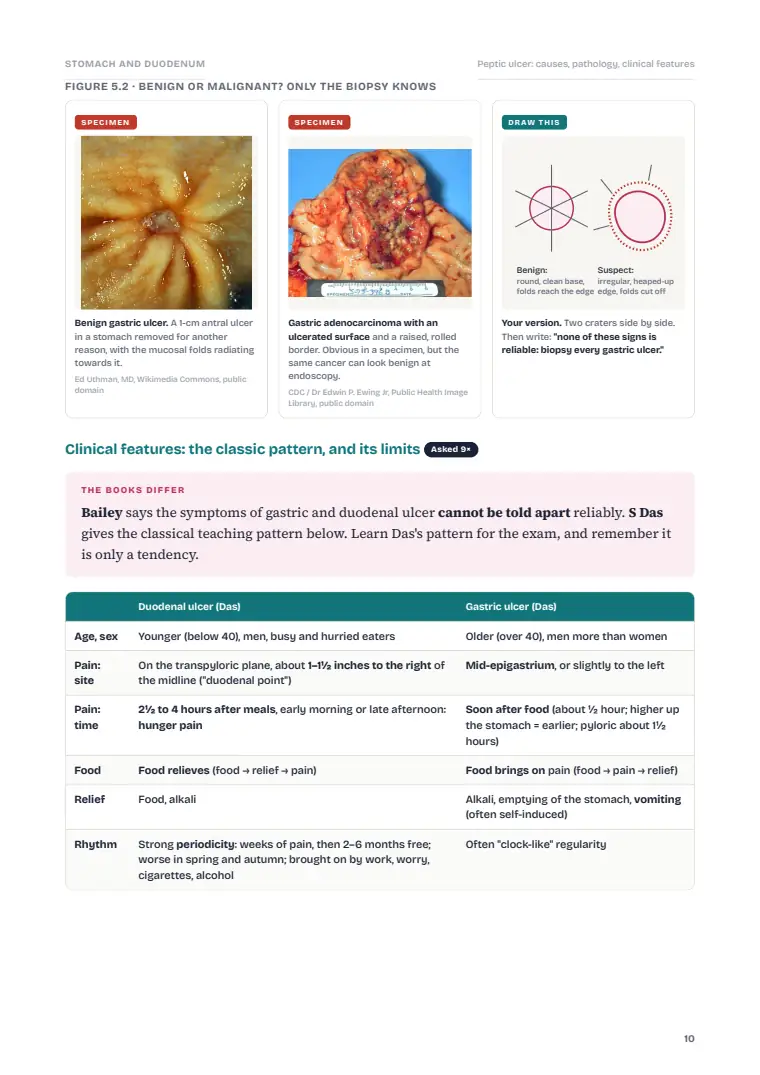
p. 10 · Inside the chapter 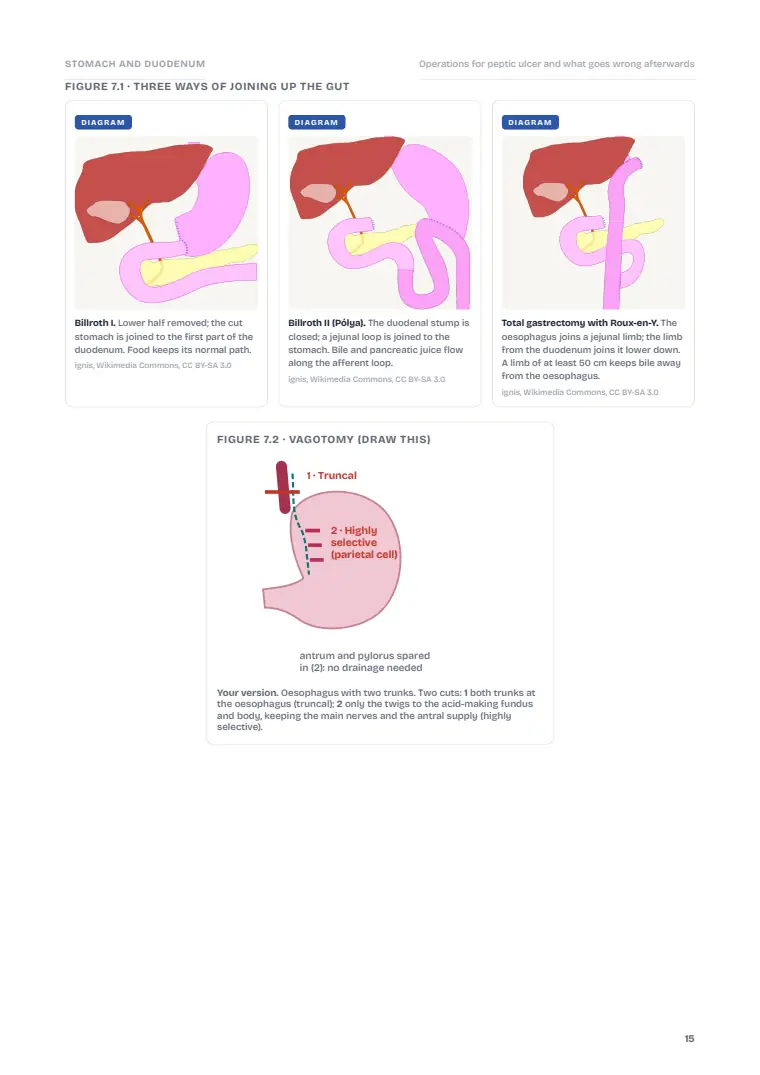
p. 15 · Inside the chapter 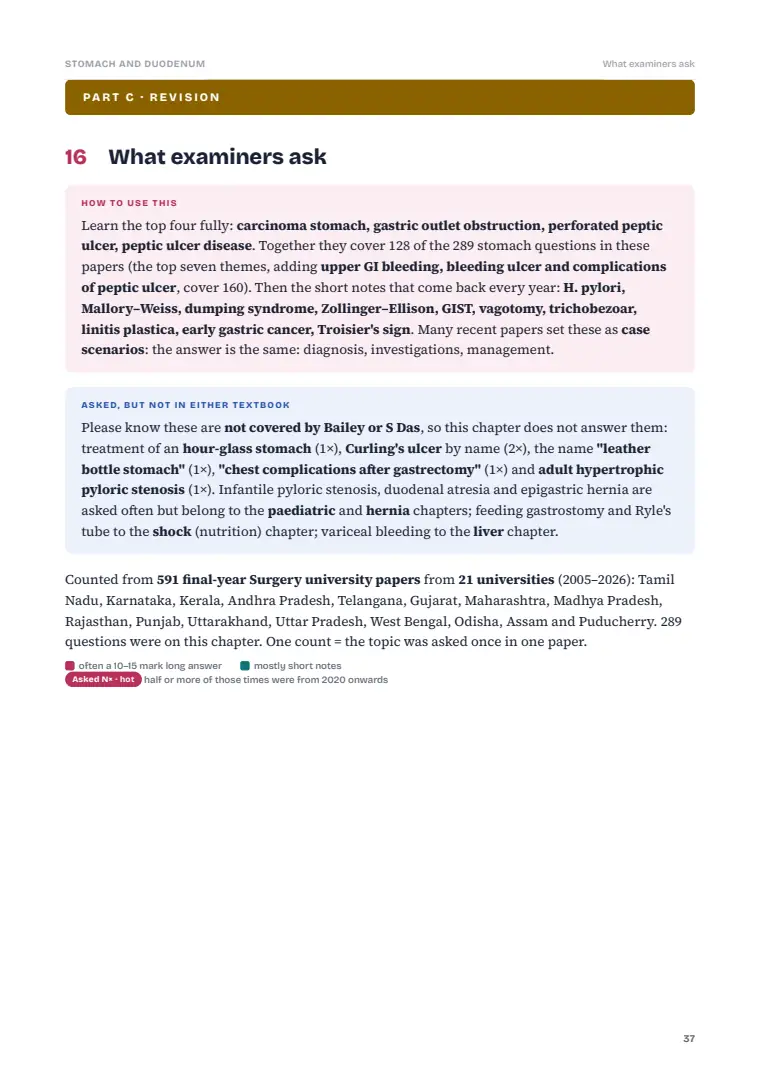
p. 37 · What examiners ask: previous years' questions - The Liver
Preview and contents
What you get (45 pages)- Anchovy-sauce pus: amoebic abscess
- Never biopsy a hydatid cyst
- Varices: resuscitate, drug, band, tube, TIPSS
- Portal vein carries 80% of the flow
- Most asked: hydatid cyst (74×)
- Long-answer favourites: liver abscess (58×) and varices (22×)
Asked most in previous papers74× Hydatid cyst of the liver: life cycle, pathology, features, complications, treatment58× Liver abscess: types, causes, clinical features, management47× Amoebic liver abscess: aetiology, features, investigations, treatmentPart A · TheoryThe story · Anatomy of the liver · Function, tests, liver failure · Imaging and biopsy · Pyogenic liver abscess · Amoebic liver abscess · Hydatid disease · Portal hypertension · Bleeding varices · After the bleed: TIPSS, shunts · Ascites · Budd-Chiari, other liver diseases · Benign lumps and cysts · Liver cancer (HCC) · Liver secondaries · Liver surgery, transplantPart B · ClinicalHow to examine · Case sheet: hepatomegalyPart C · RevisionWhat examiners ask · Exam answers · Viva cards · Night-before recap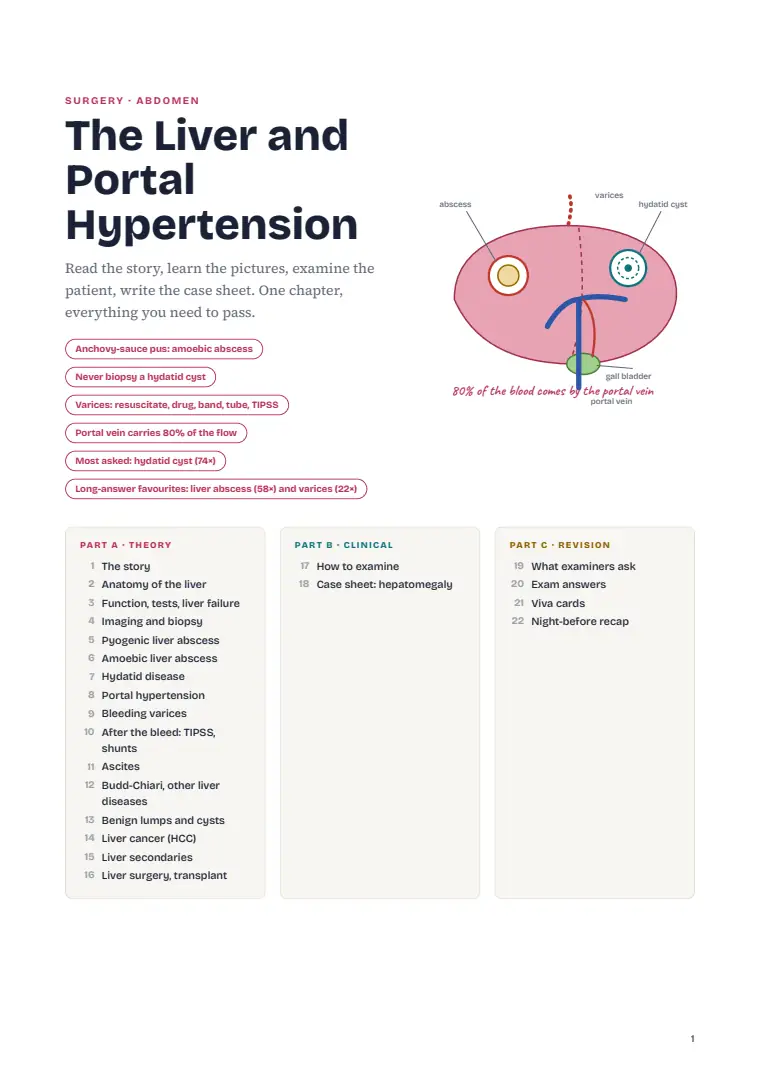
p. 1 · First page 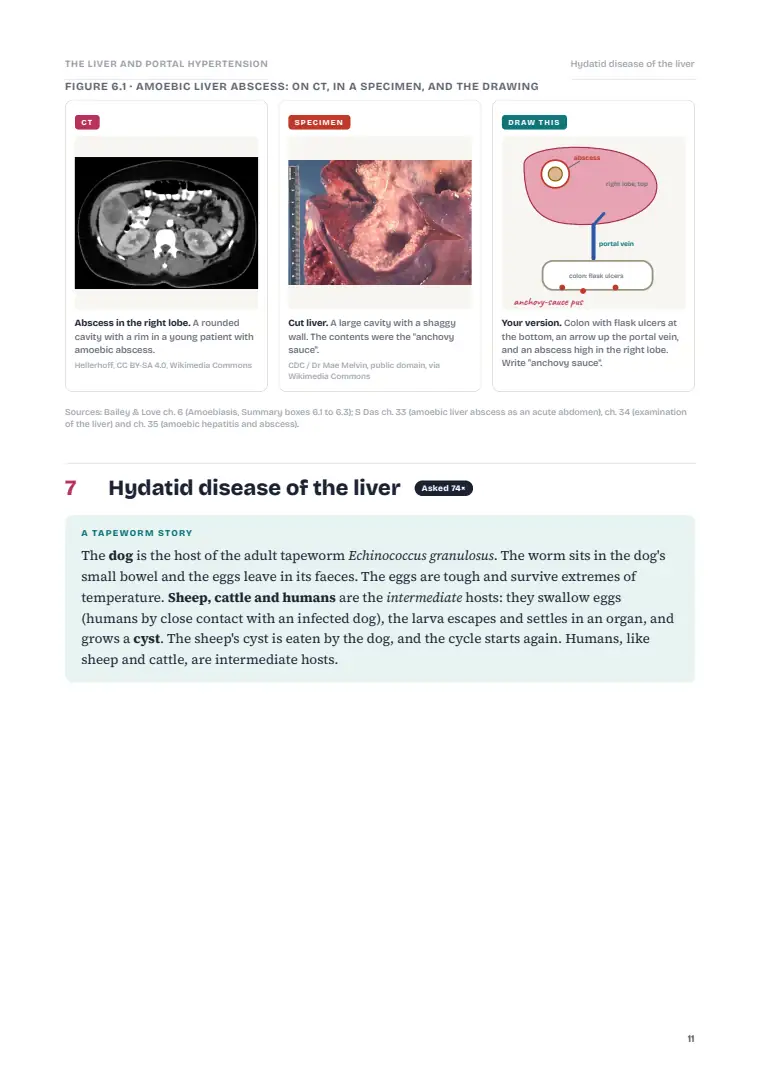
p. 11 · Inside the chapter 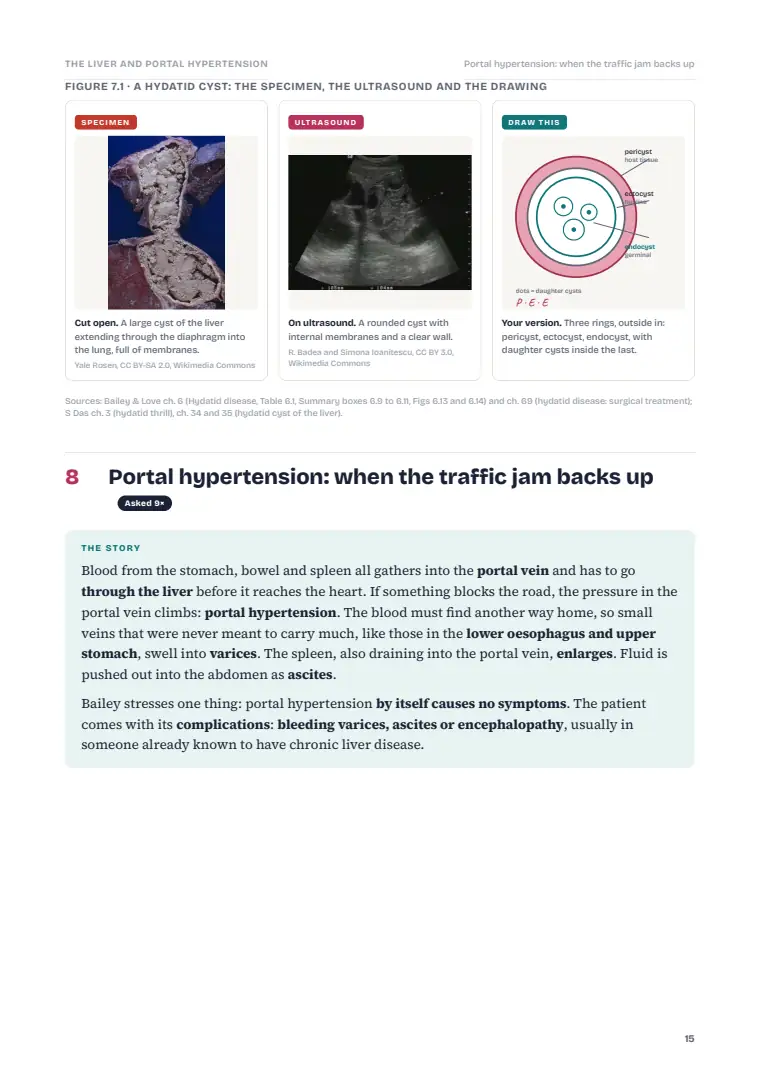
p. 15 · Inside the chapter 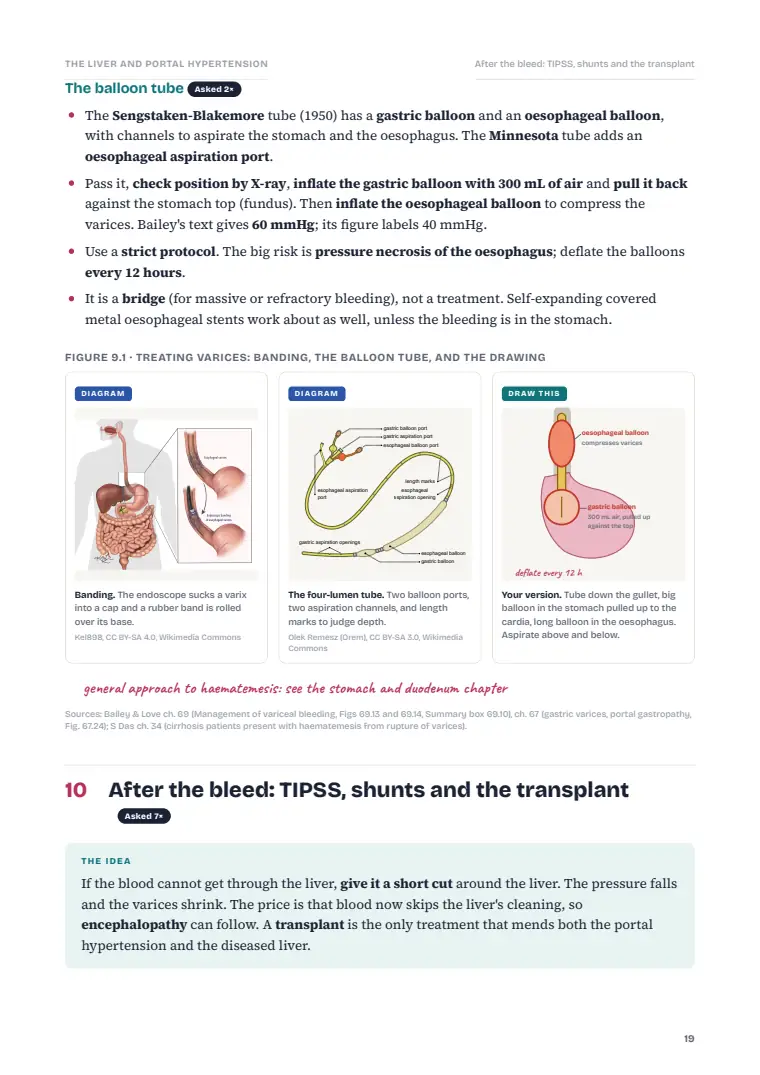
p. 19 · Inside the chapter 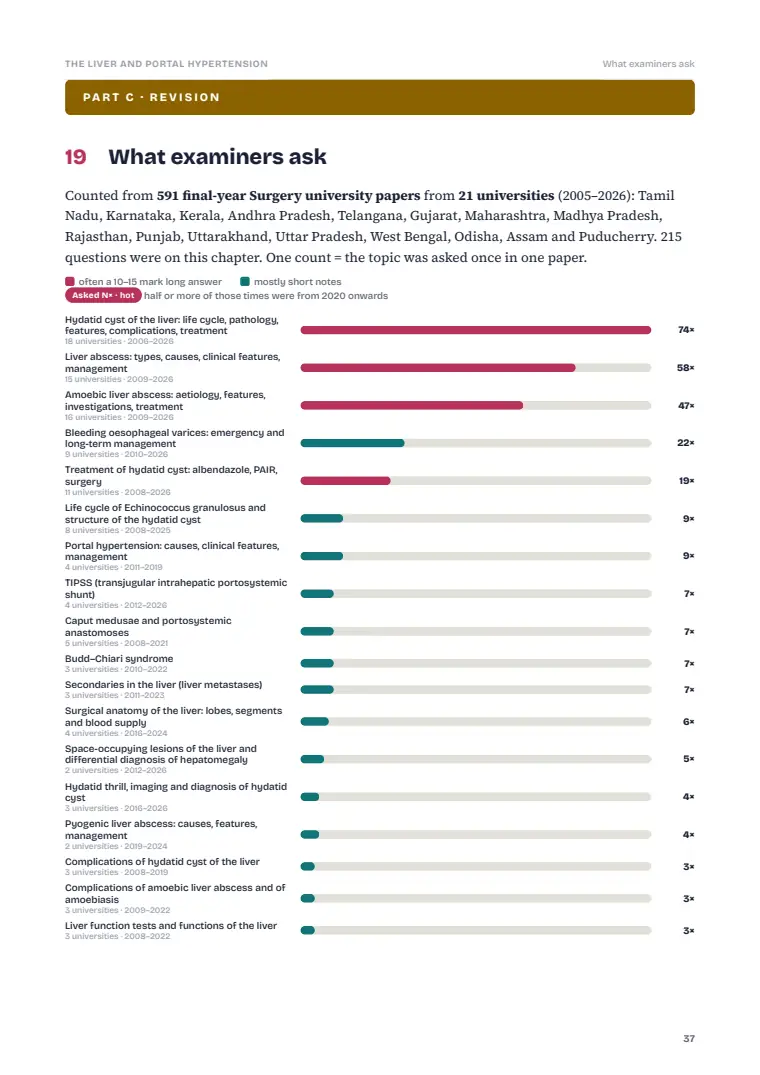
p. 37 · What examiners ask: previous years' questions - The Spleen
Preview and contents
What you get (44 pages)- Notch on the front edge
- Hand cannot get above it
- Unstable and ruptured: laparotomy
- Vaccinate before it comes out
- Most asked: complications of splenectomy (25×)
- Then: indications (21×) and hypersplenism (16×)
Asked most in previous papers25× Complications of splenectomy21× Indications for splenectomy16× HypersplenismPart A · TheoryThe story · Where it sits and what it joins · What it does; how to test it · Odd spleens: extra, missing, cysts · Splenomegaly: the causes · Hypersplenism · Blood diseases that reach the surgeon · Splenic injury · Abscess, infarct, aneurysm · Splenectomy · Life without a spleen: OPSIPart B · ClinicalHow to examine; spleen or kidney? · Case sheet: splenomegalyPart C · RevisionWhat examiners ask · Exam answers · Viva cards · Night-before recap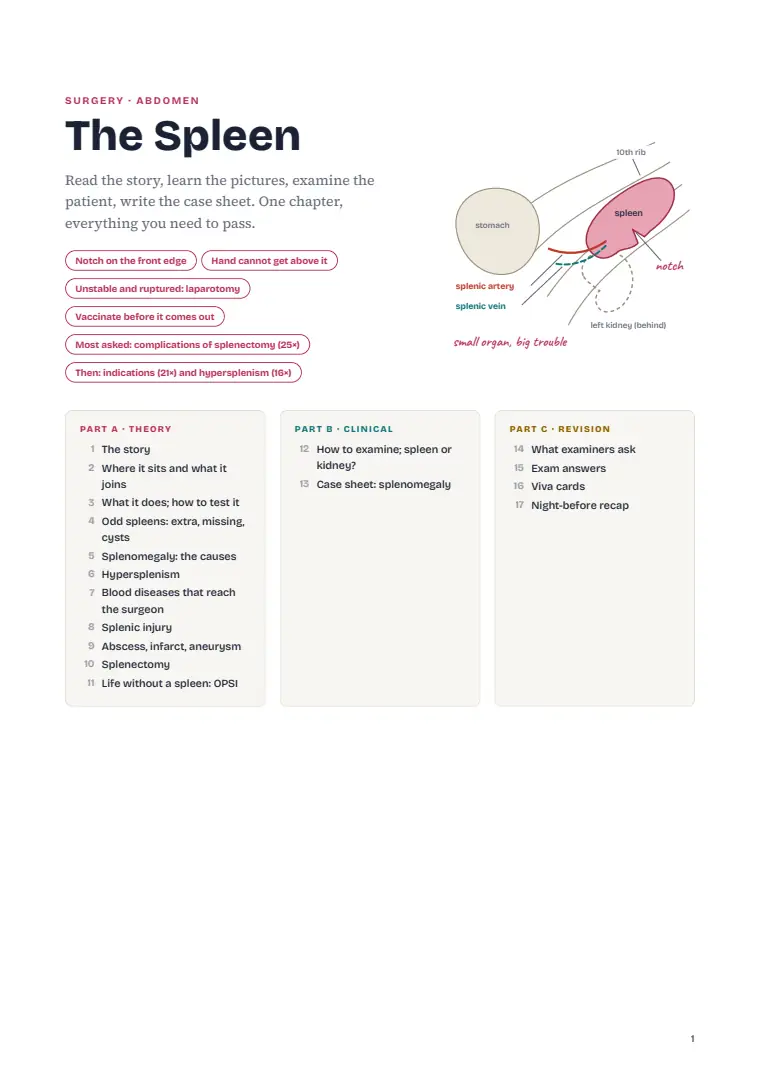
p. 1 · First page 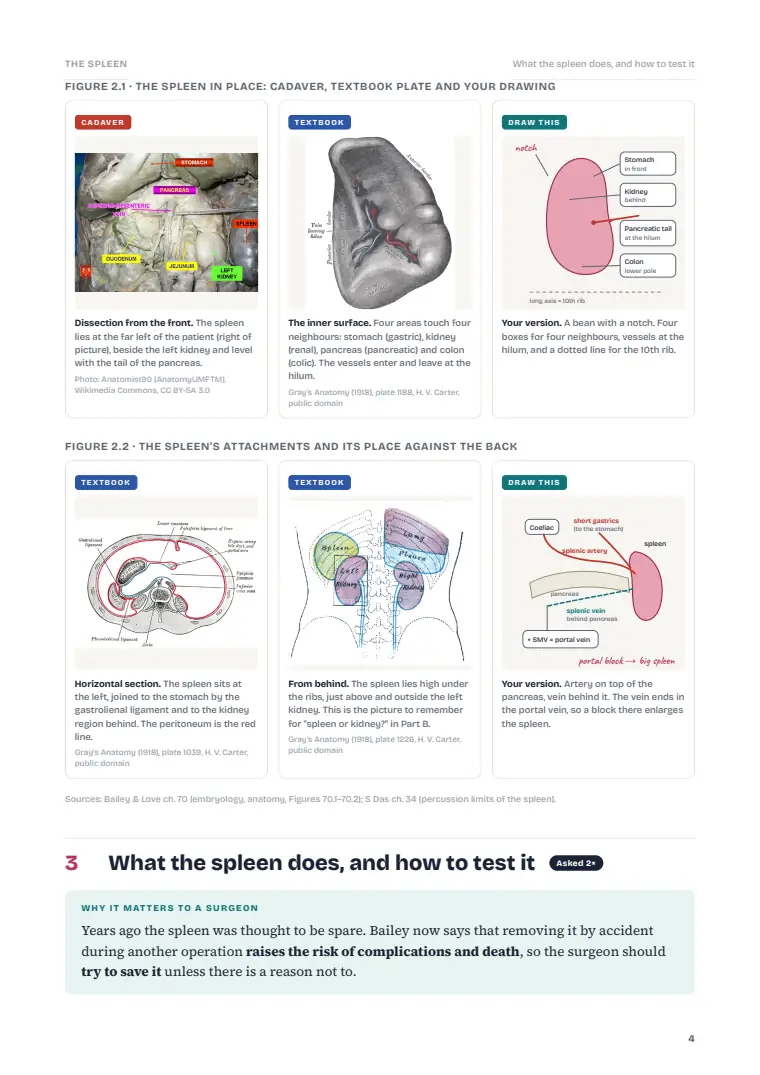
p. 4 · Inside the chapter 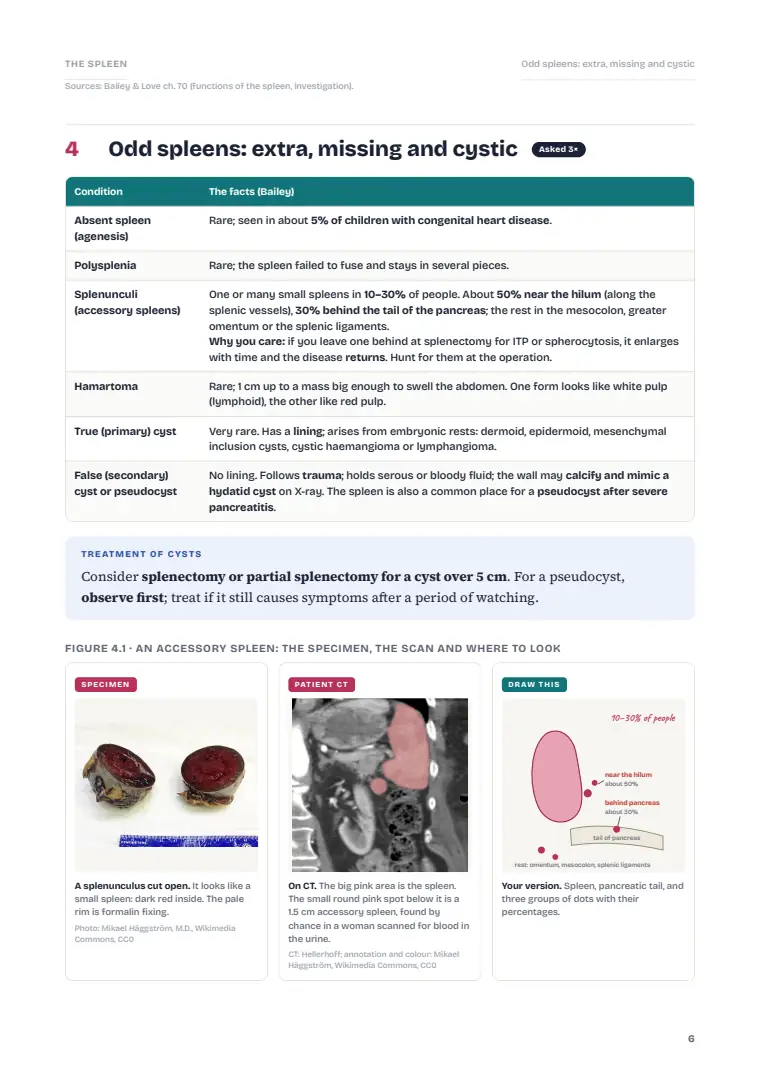
p. 6 · Inside the chapter 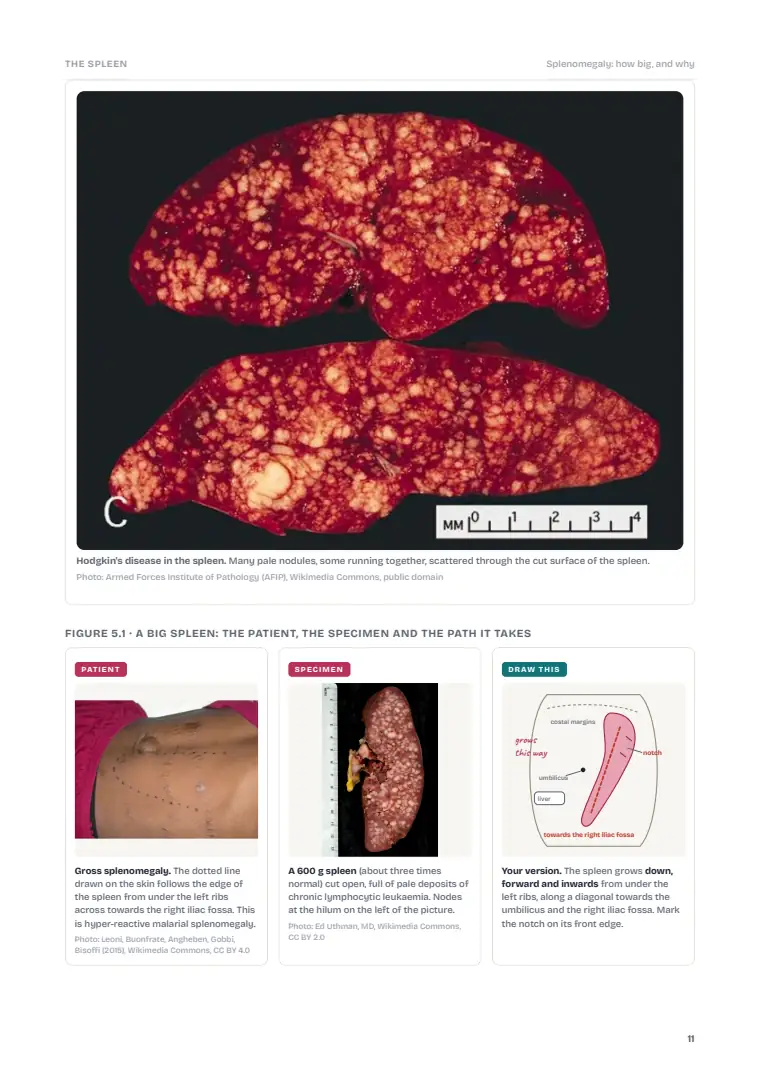
p. 11 · Inside the chapter 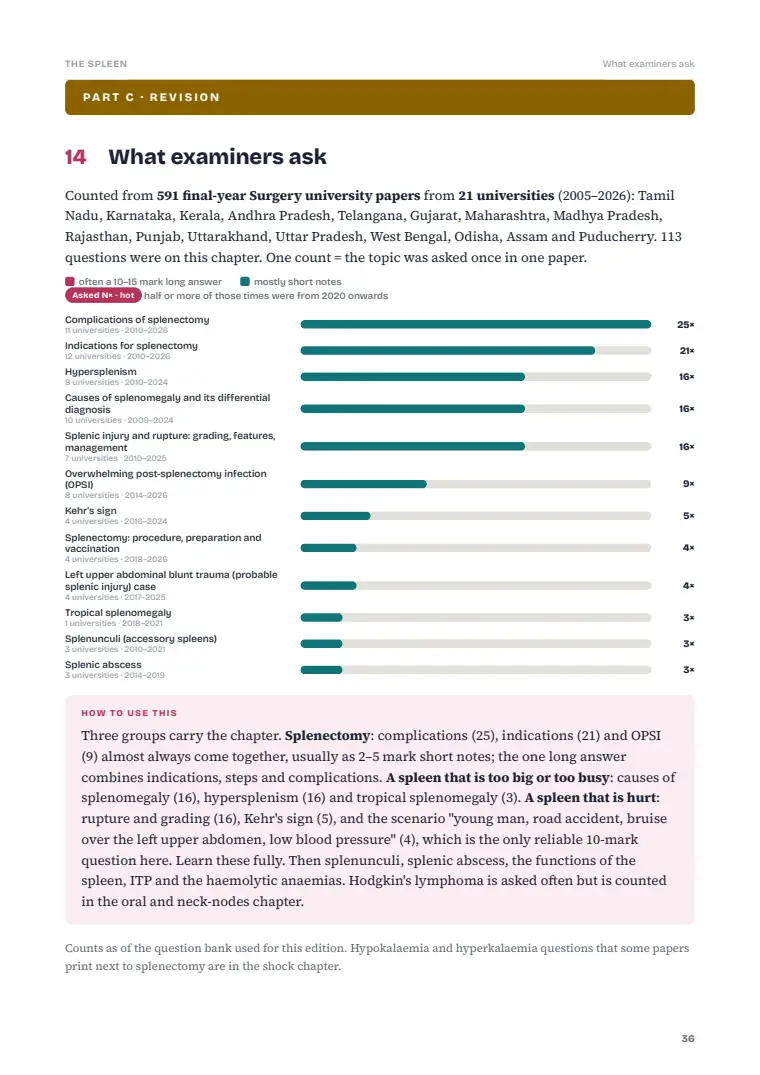
p. 36 · What examiners ask: previous years' questions - The Gallbladder and Bile Ducts
Preview and contents
What you get (47 pages)- Calot's triangle holds the cystic artery
- Critical view of safety
- Courvoisier's law
- Charcot's triad
- MRCP to see, ERCP to treat
- Most asked: gallstones (65×)
Asked most in previous papers65× Gallstones: types, aetiopathogenesis, clinical features, management39× Obstructive (surgical) jaundice: causes, features, management36× ERCPPart A · TheoryThe story · Surgical anatomy · Bile, bilirubin · Jaundice: types, approach · Investigations · Gallstones · Acute cholecystitis · Chronic cholecystitis, others · Complications of stones · Bile duct stones, cholangitis · Operations, complications · Strictures · Atresia, choledochal cyst · TumoursPart B · ClinicalHow to examine · Case sheetsPart C · RevisionWhat examiners ask · Exam answers · Viva cards · Night-before recap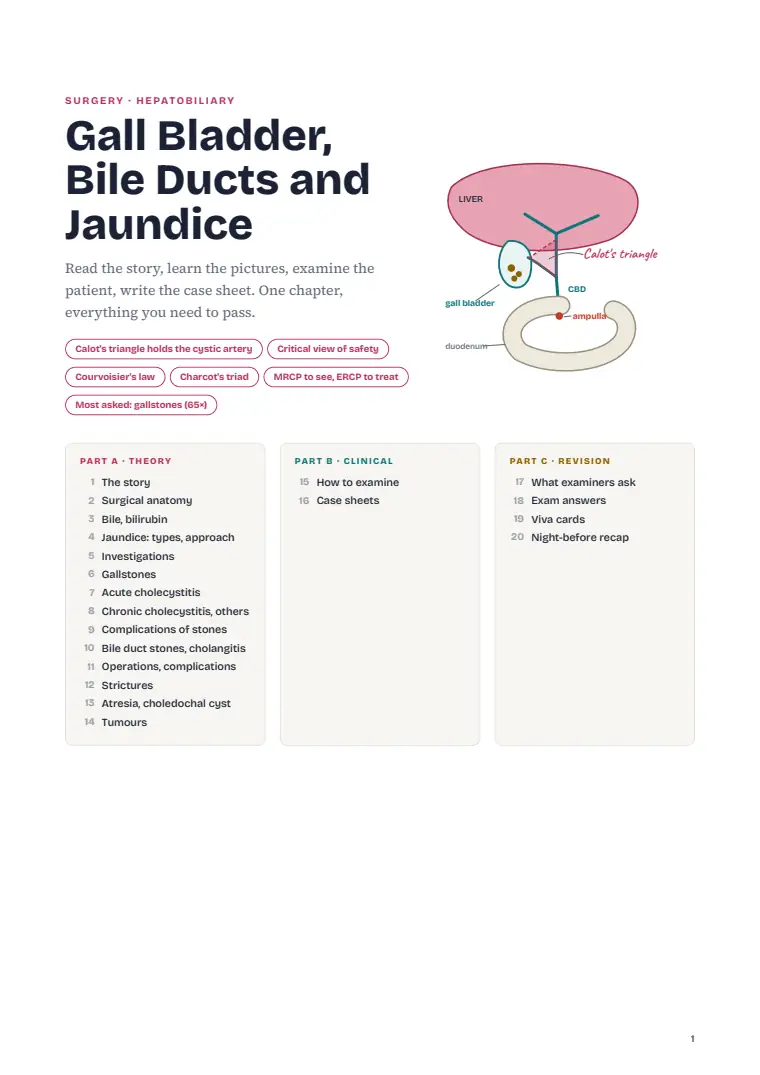
p. 1 · First page 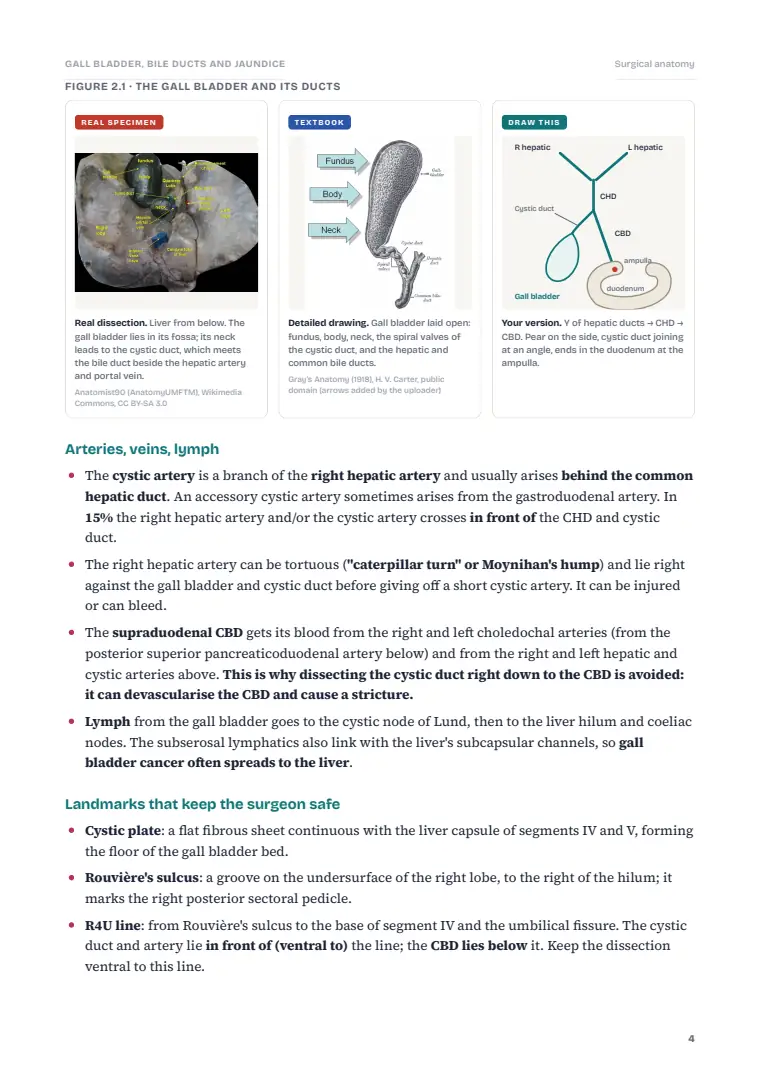
p. 4 · Inside the chapter 
p. 5 · Inside the chapter 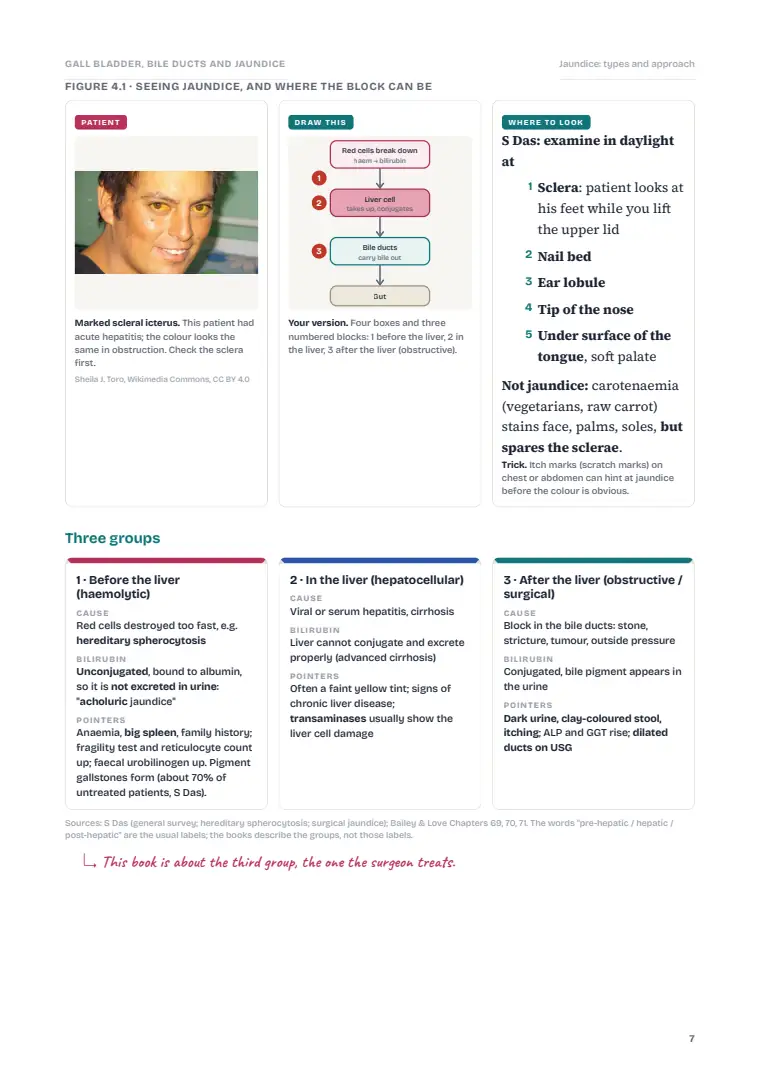
p. 7 · Inside the chapter 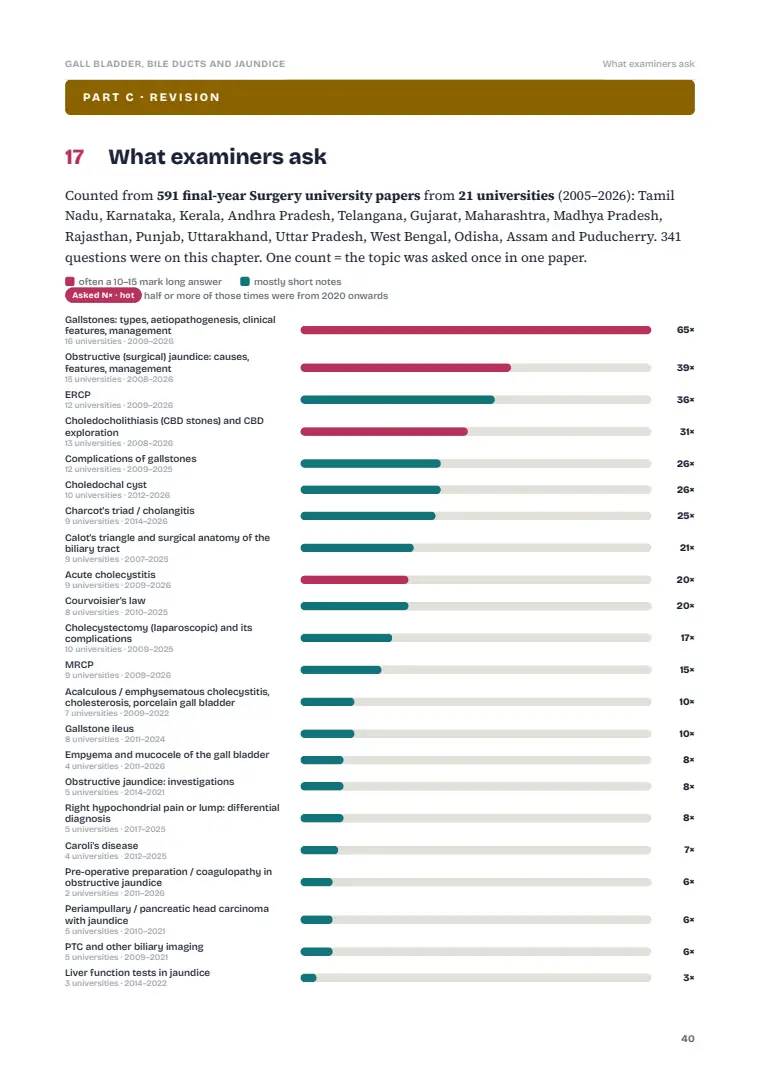
p. 40 · What examiners ask: previous years' questions - The Pancreas
Preview and contents
What you get (46 pages)- Gallstones and alcohol cause most acute pancreatitis
- Pain bores to the back; amylase 3× or more
- Pseudocyst needs at least 4 weeks
- Painless jaundice: think head of pancreas
- Most asked: acute pancreatitis (68×)
Asked most in previous papers68× Acute pancreatitis: causes, pathology, clinical features, investigations, management63× Pancreatic pseudocyst: causes, features, investigations, management21× Aetiology / causes of acute pancreatitisPart A · TheoryThe story · Anatomy and development · Enzymes and investigations · Acute pancreatitis: causes · Acute pancreatitis: features and severity · Acute pancreatitis: treatment · Complications and necrosis · Pseudocyst · Chronic pancreatitis · Carcinoma of the pancreas · Whipple, adjuvant and palliation · Ampullary and cystic tumours · Congenital anomalies, injury, fistulaPart B · ClinicalHow to examine · Case sheetPart C · RevisionWhat examiners ask · Exam answers · Viva cards · Night-before recap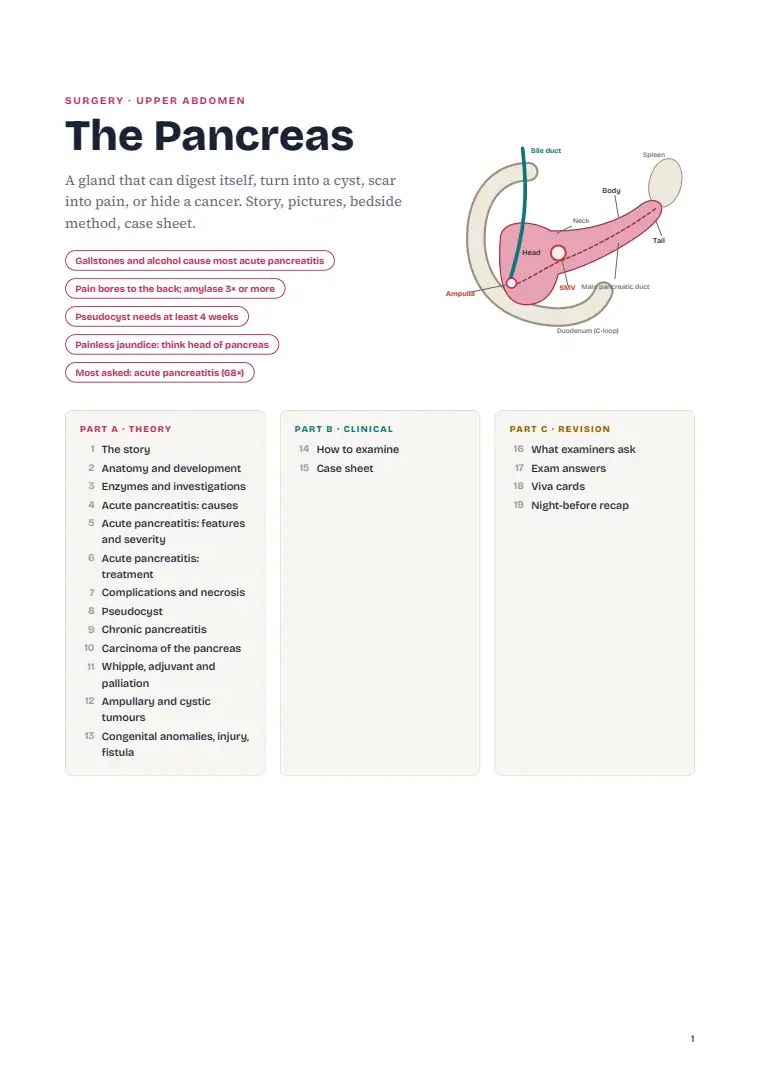
p. 1 · First page 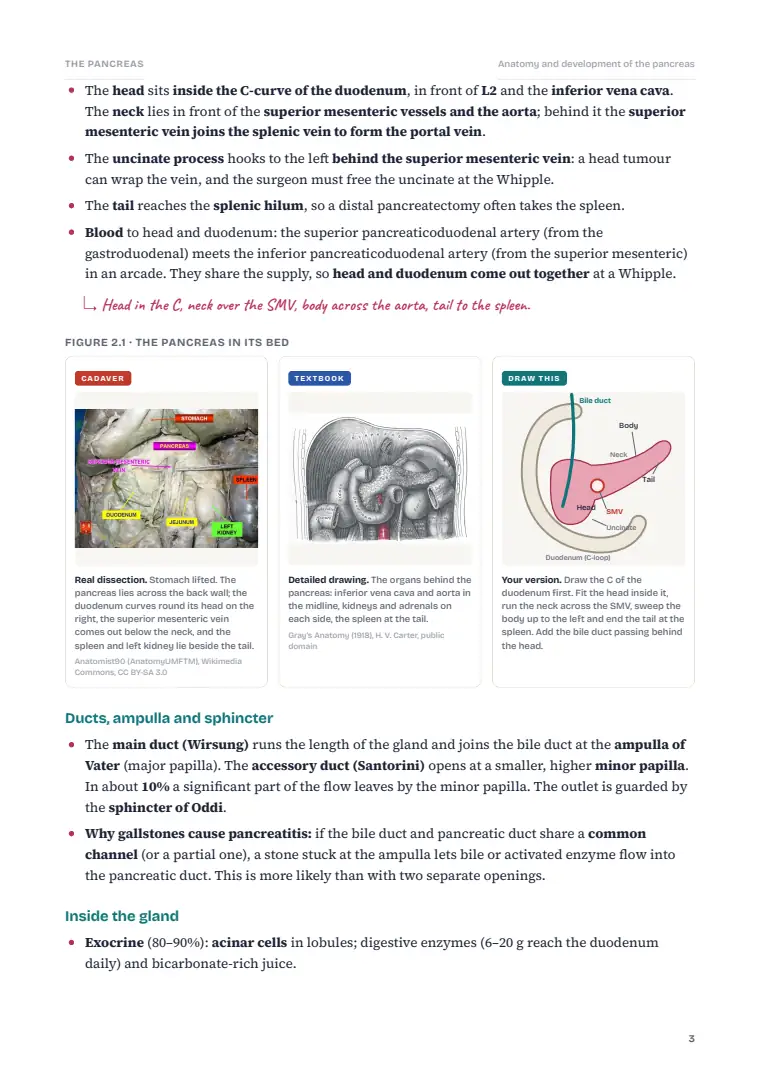
p. 3 · Inside the chapter 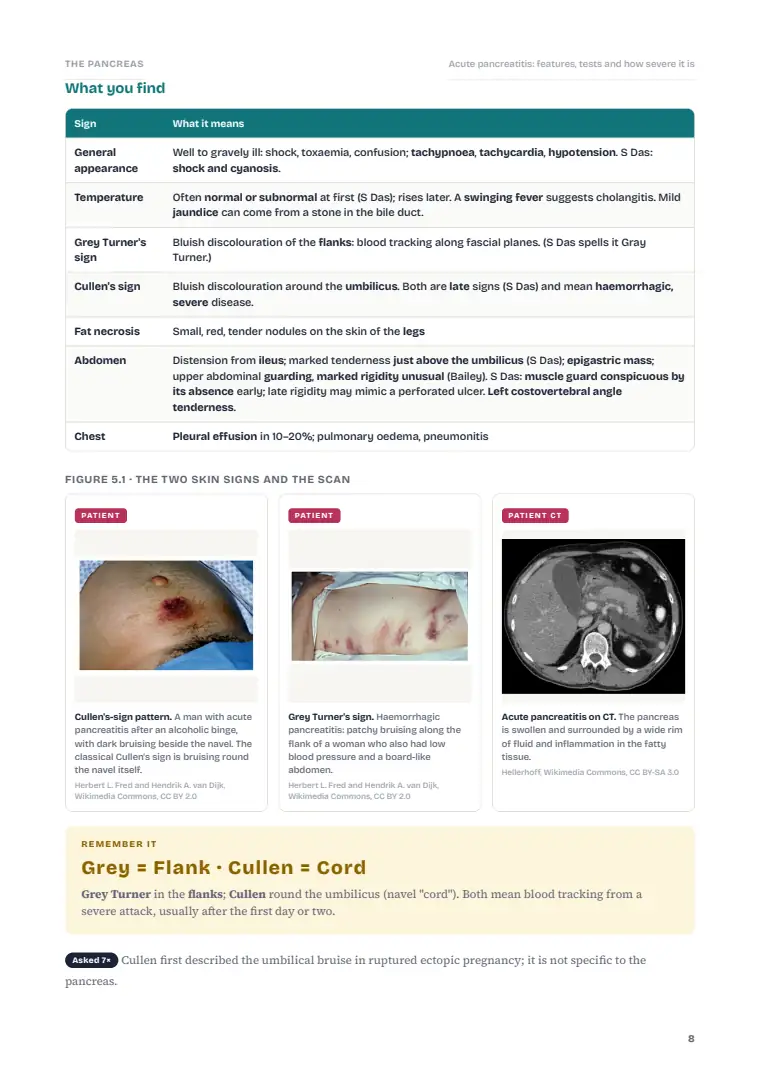
p. 8 · Inside the chapter 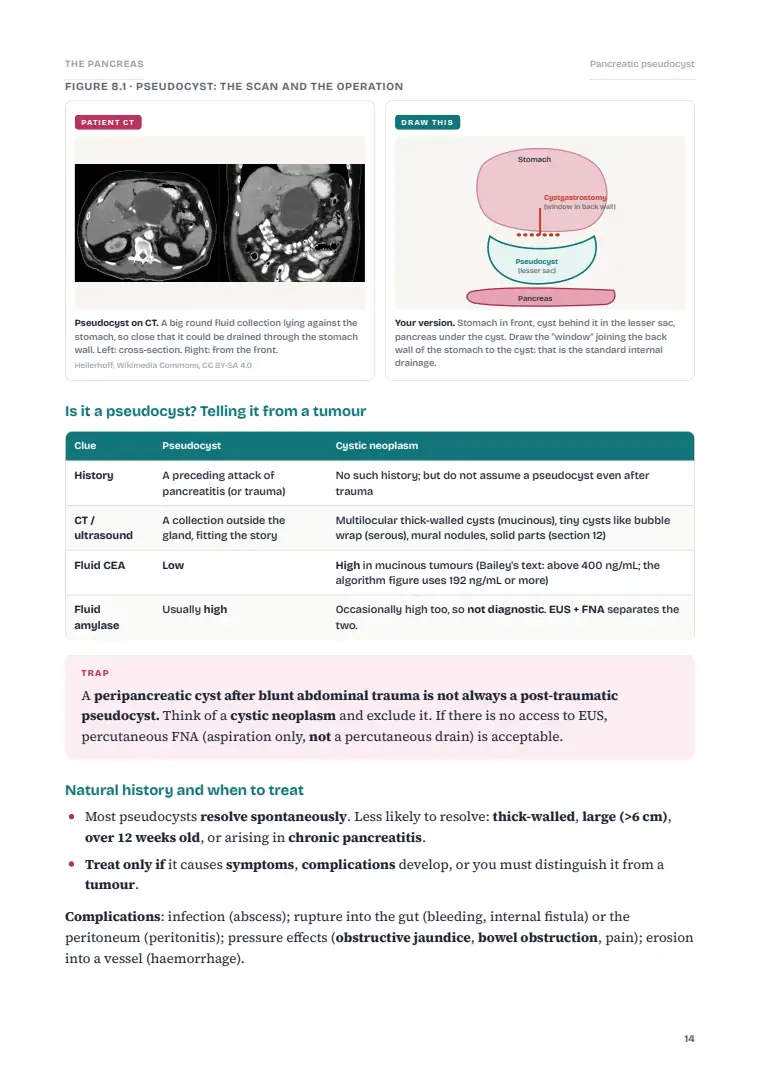
p. 14 · Inside the chapter 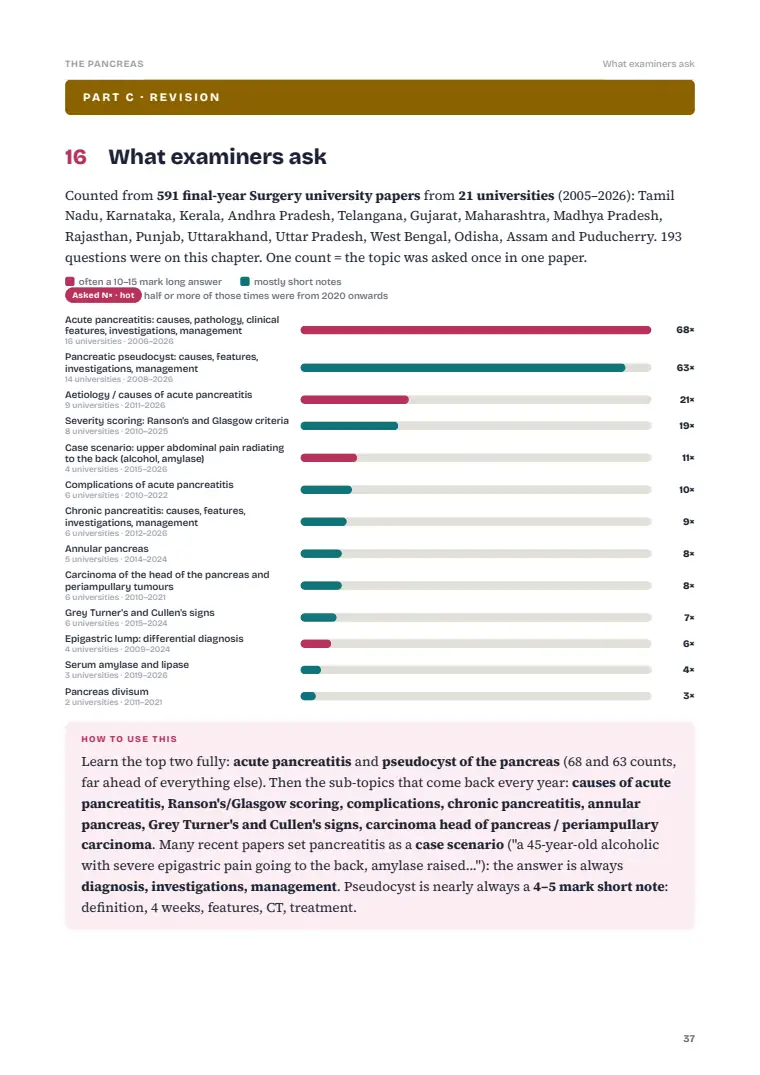
p. 37 · What examiners ask: previous years' questions - The Small Intestine and Intestinal Obstruction
Preview and contents
What you get (48 pages)- Pain, vomiting, distension, constipation
- Look at every hernial orifice
- Constant pain means strangulation
- Drip and suck, then operate
- Meckel's: 2, 2, 2
- Most asked: intussusception (54×)
Asked most in previous papers54× Intussusception50× Meckel's diverticulum42× Volvulus (sigmoid, caecal, small bowel)Part A · TheoryThe story · Small bowel anatomy · Classification, causes · What happens inside · Clinical features · X-ray, CT, tests · Treatment · Adhesions, internal hernia · Bolus: gallstone, worms · Intussusception · Volvulus · Large bowel obstruction · Paralytic ileus, pseudo-obstruction · Crohn's disease · Intestinal TB · Typhoid perforation · Meckel's diverticulum · Small bowel tumours · Mesenteric ischaemia · Mesenteric cyst · Short bowel, fistulaPart B · ClinicalHow to examine · Case sheetPart C · RevisionWhat examiners ask · Exam answers · Viva cards · Night-before recap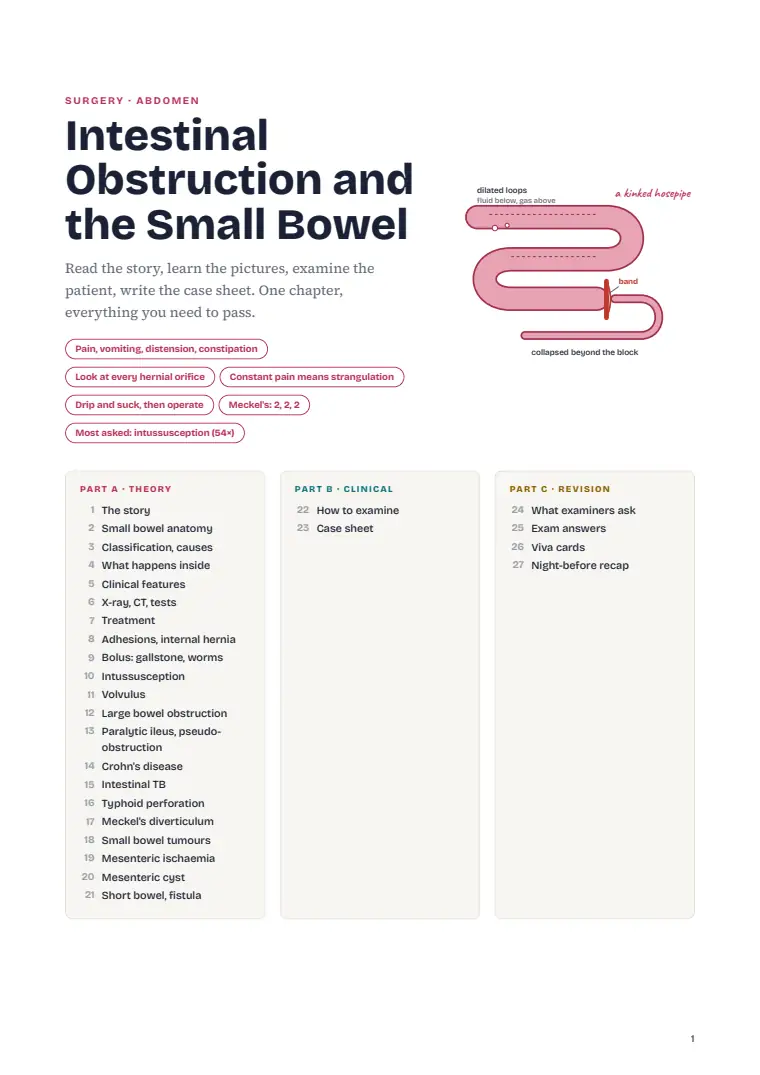
p. 1 · First page 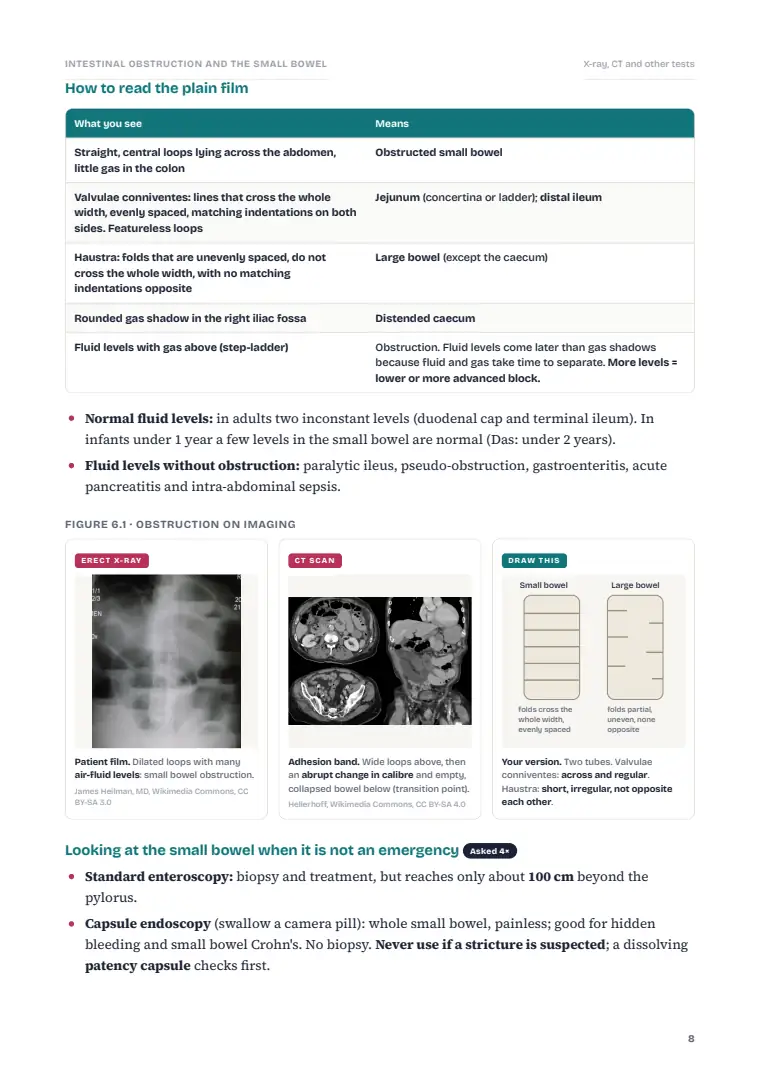
p. 8 · Inside the chapter 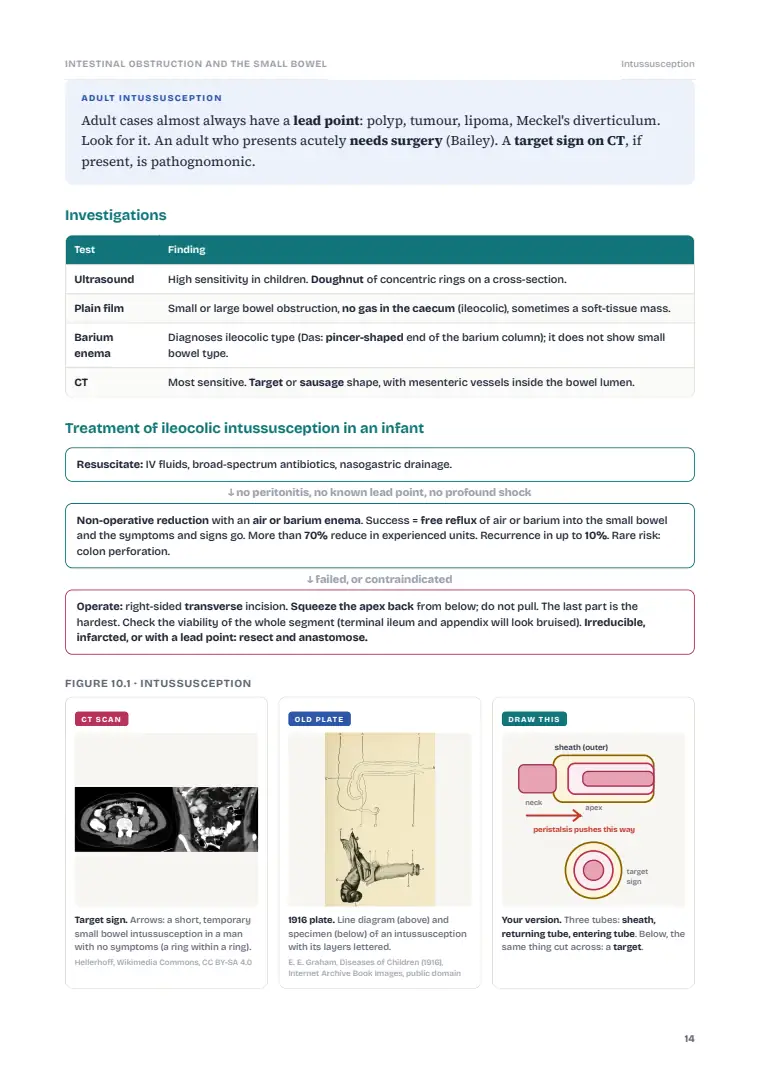
p. 14 · Inside the chapter 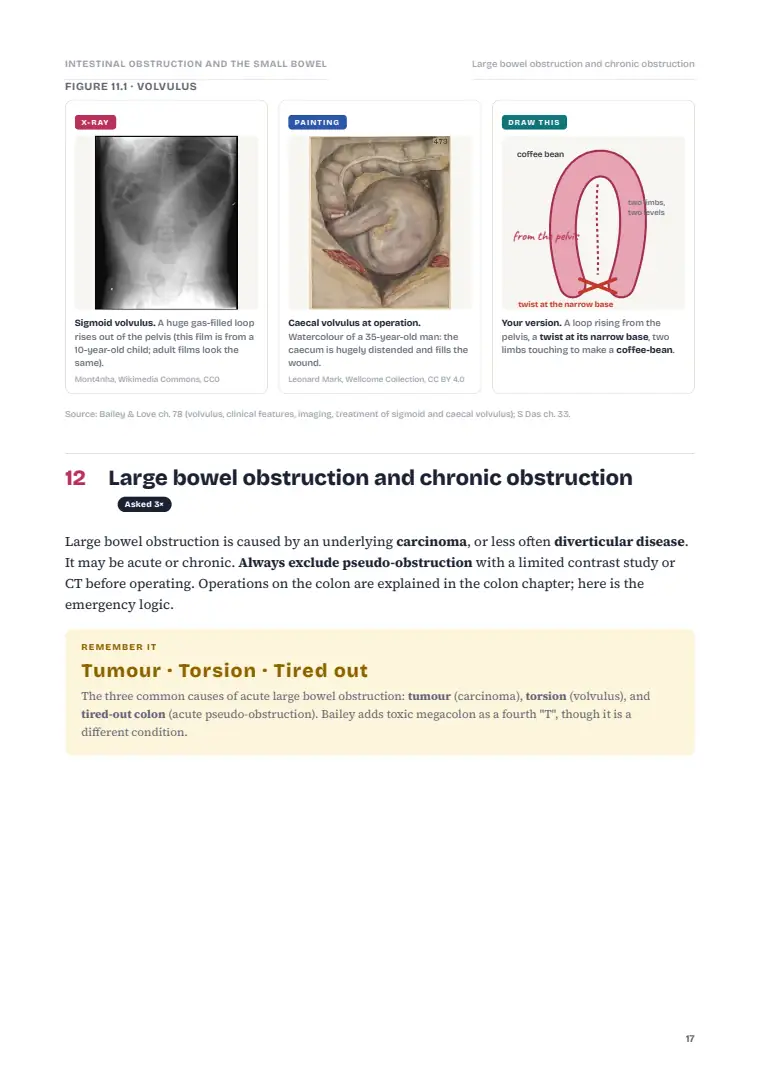
p. 17 · Inside the chapter 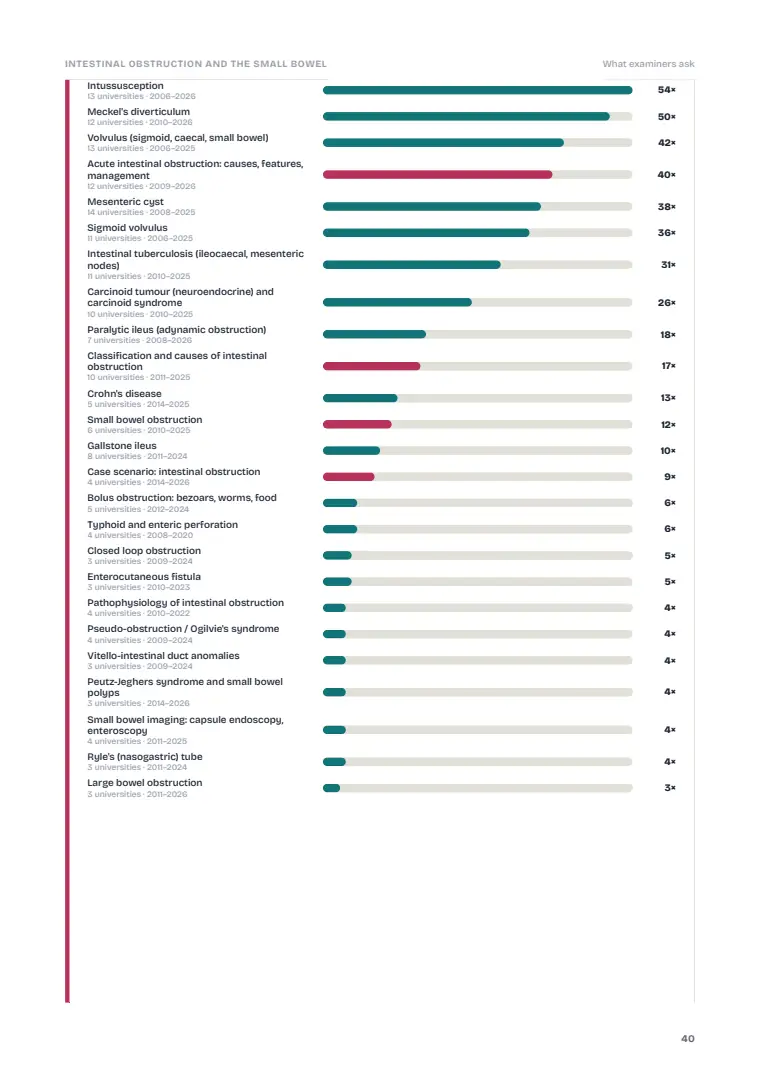
p. 40 · What examiners ask: previous years' questions - The Vermiform Appendix and the Peritoneum
Preview and contents
What you get (46 pages)- Pain starts at the umbilicus, then moves to the right iliac fossa
- Always do a rectal examination and look at the scrotum
- Alvarado 7 or more: appendicitis
- A mass? Ochsner-Sherren, not the knife
- Peritonitis: drip, antibiotics, source control
- Most asked: appendicular mass (57×)
Asked most in previous papers57× Appendicular mass and Ochsner-Sherren regimen53× Acute appendicitis: causes, features, investigations, treatment21× Acute peritonitis: causes, features, investigations, managementPart A · TheoryThe story · The appendix in one page · Why it happens · Clinical features · Signs and positions · Differential diagnosis · Tests and Alvarado score · Treatment and operation · Complications after operation · Children, pregnancy, elderly · Appendix mass and abscess · Lump in the right iliac fossa · Appendix tumours, mucocele, PMP · The peritoneum · Peritonitis · Kinds of peritonitis · TB peritonitis, tumours · Abdominal and pelvic abscess · Also know: ascites, mesentery, retroperitoneum, wall · The acute abdomenPart B · ClinicalHow to examine · Case sheetPart C · RevisionWhat examiners ask · Exam answers · Viva cards · Night-before recap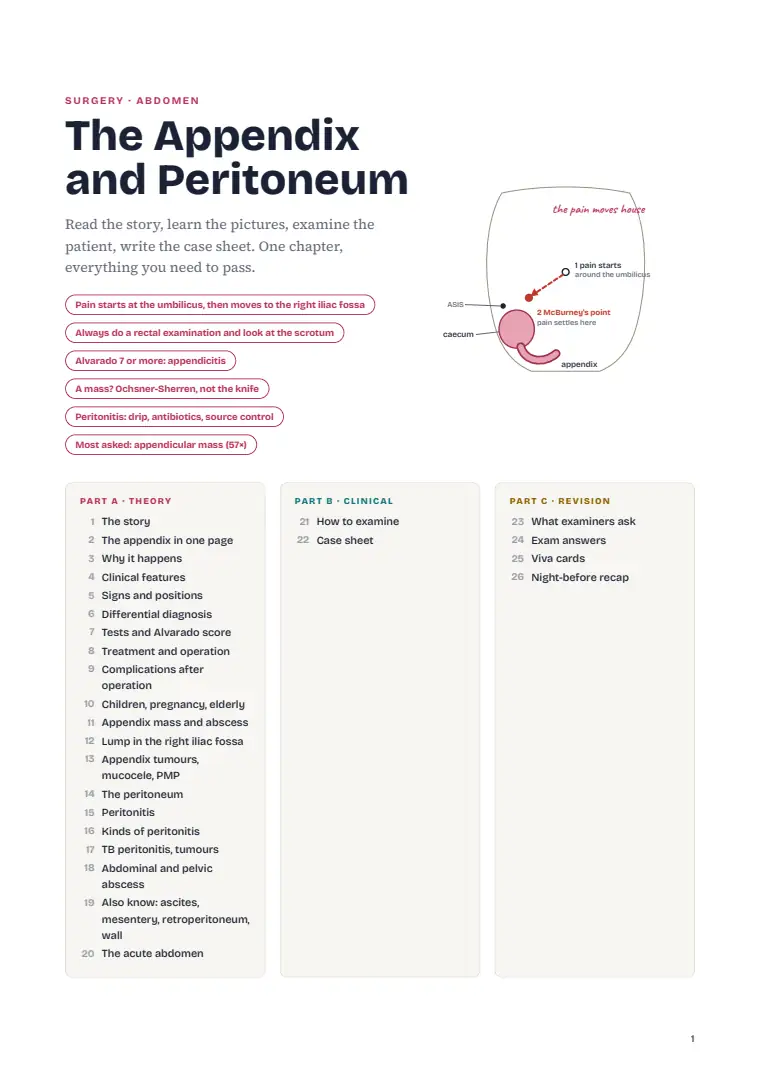
p. 1 · First page 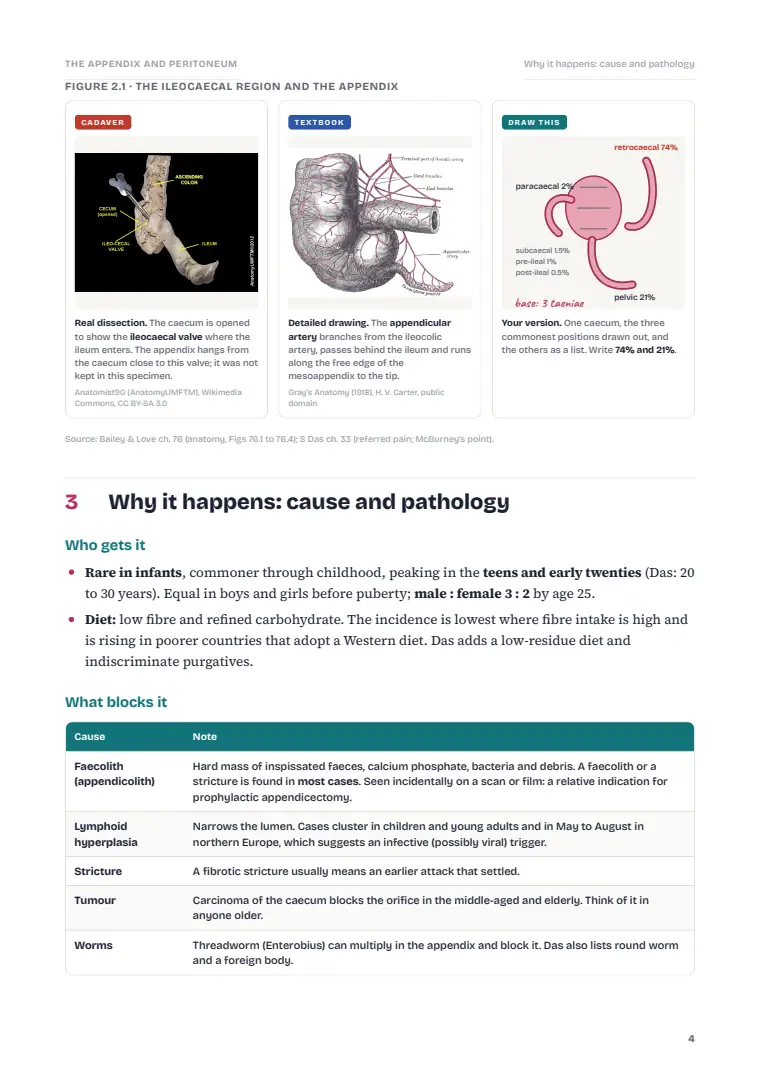
p. 4 · Inside the chapter 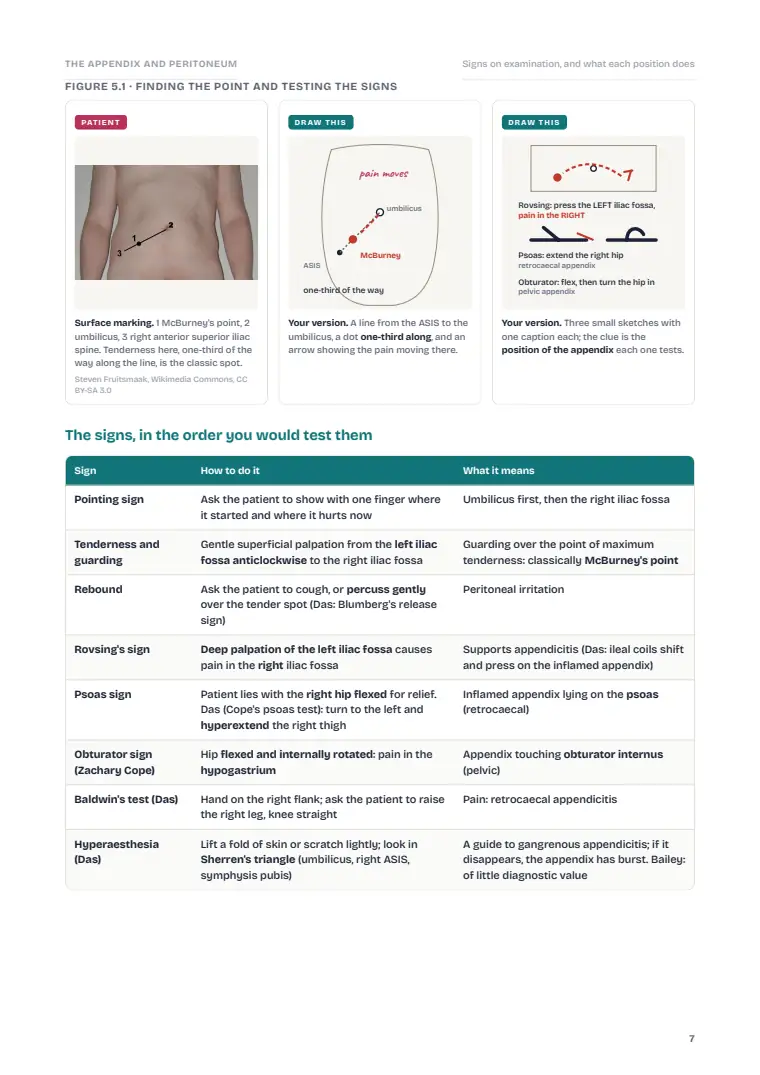
p. 7 · Inside the chapter 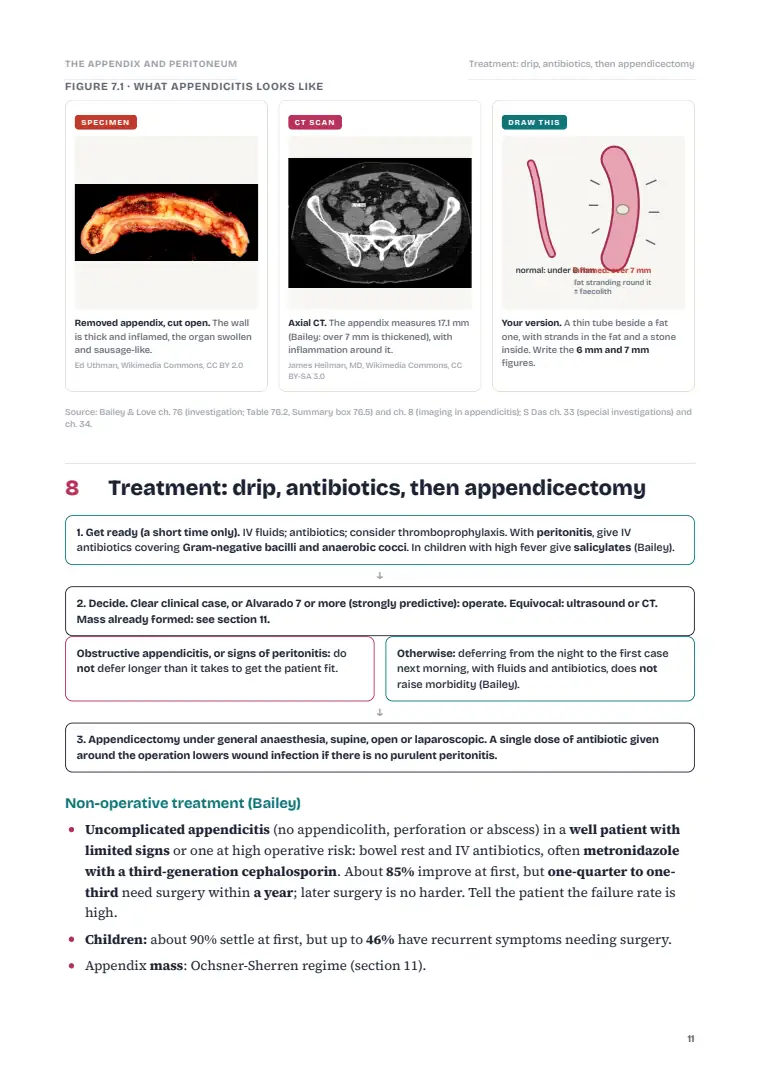
p. 11 · Inside the chapter 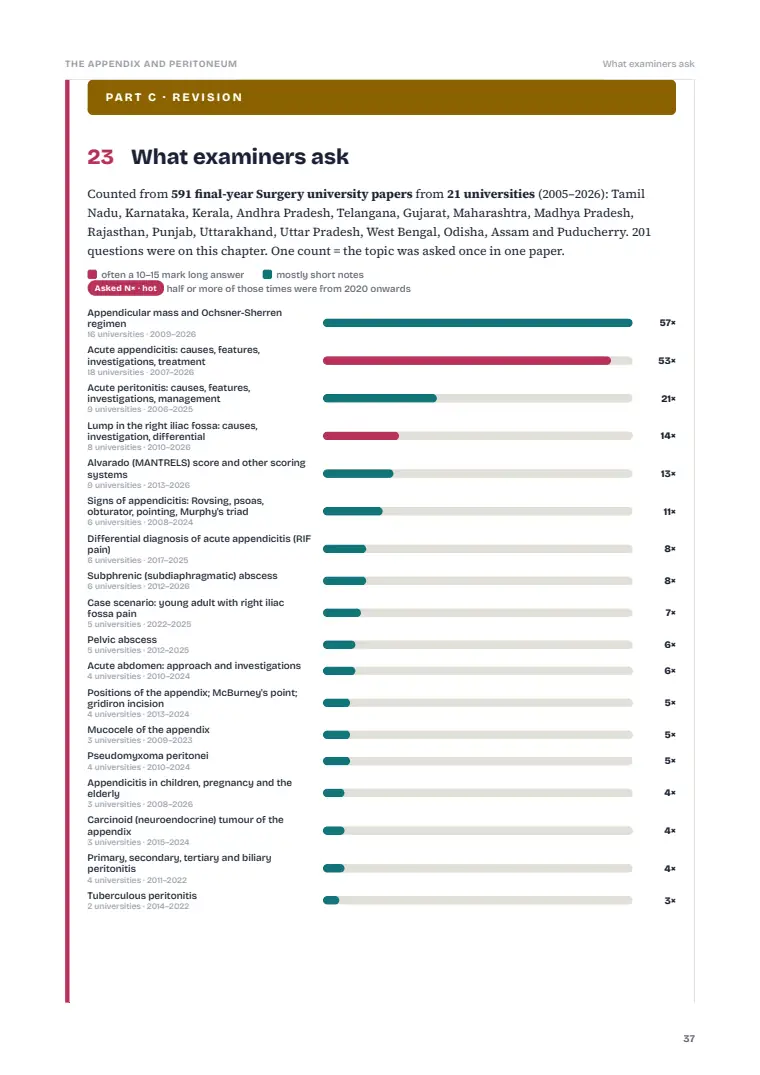
p. 37 · What examiners ask: previous years' questions - The Large Intestine and Rectum
Preview and contents
What you get (48 pages)- Change in bowel habit after 50 means look for cancer
- Always do the rectal examination
- Blood, mucus and an early-morning stool: rectal cancer
- Right side rusts, left side locks
- Ulcerative colitis always begins in the rectum
- Most asked: carcinoma rectum (31×)
Asked most in previous papers31× Carcinoma of the rectum: pathology, features, investigations, treatment26× Colostomy: types, indications, complications22× Carcinoma of the colon: pathology, features, investigations, treatmentPart A · TheoryThe story · Anatomy, physiology · Looking at the bowel: scopes and tests · Bleeding per rectum · Polyps and polyposis · Cancer: causes, pathology, spread · Cancer: features, investigations · Staging · Cancer: the operations · Ulcerative colitis · Other colitis and rare tumours · Diverticular disease · StomasPart B · ClinicalHow to examine · Case sheetPart C · RevisionWhat examiners ask · Exam answers · Viva cards · Night-before recap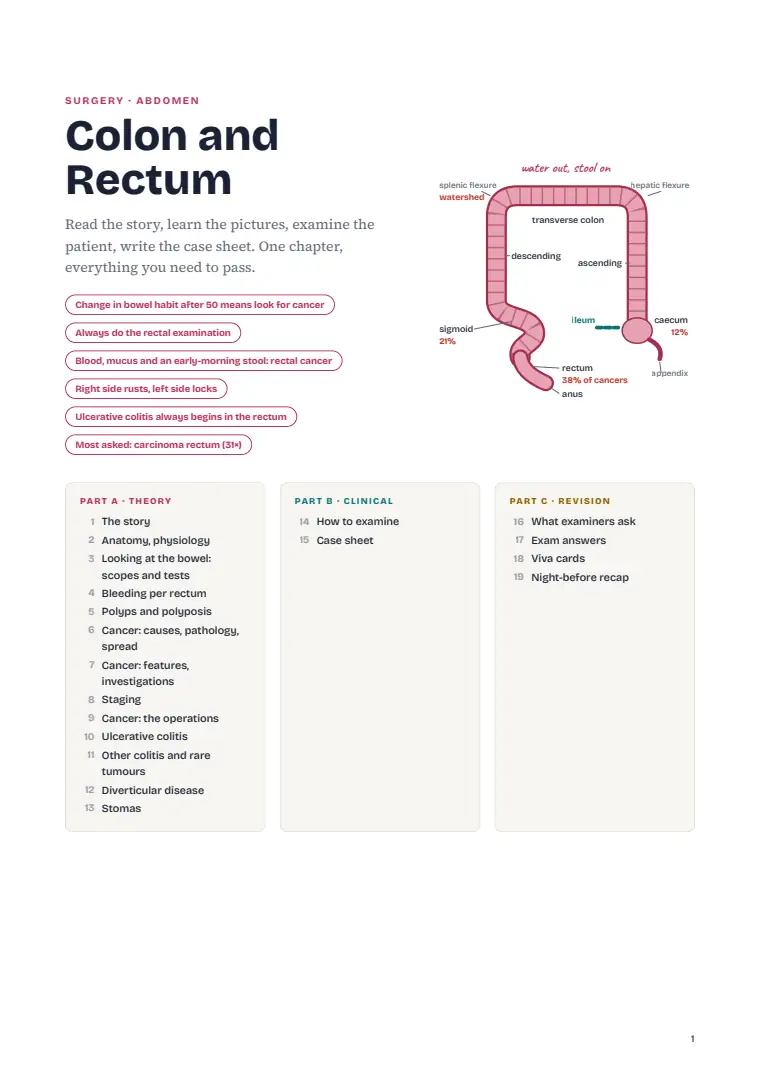
p. 1 · First page 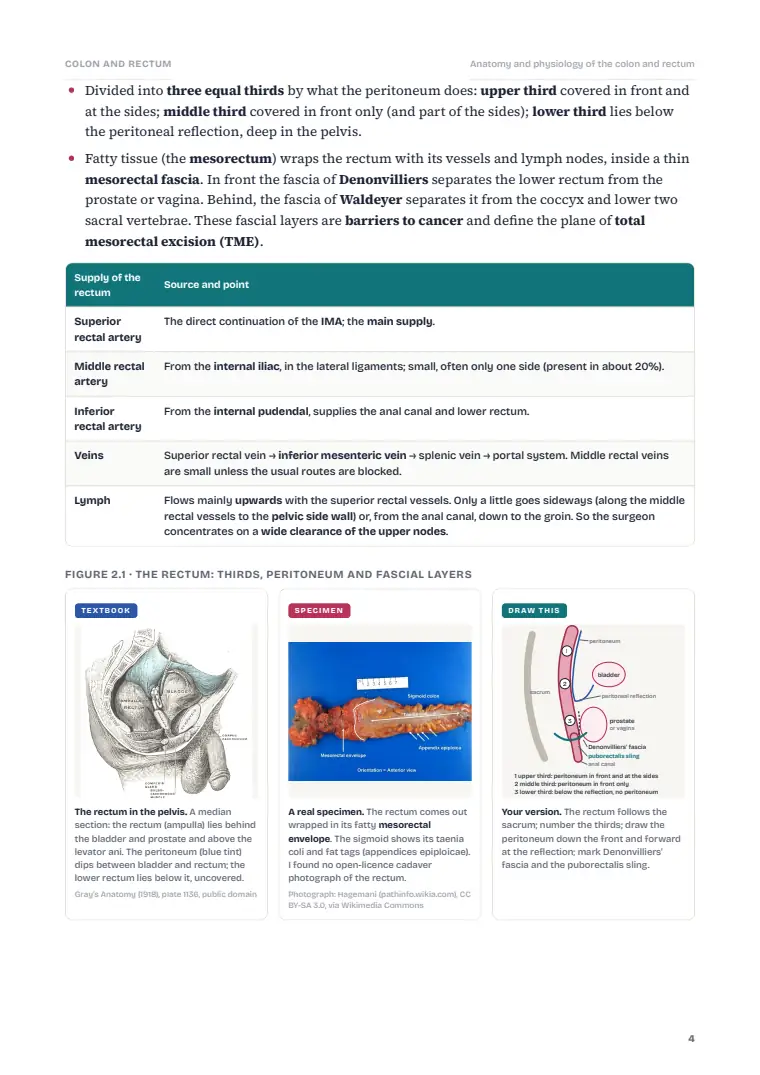
p. 4 · Inside the chapter 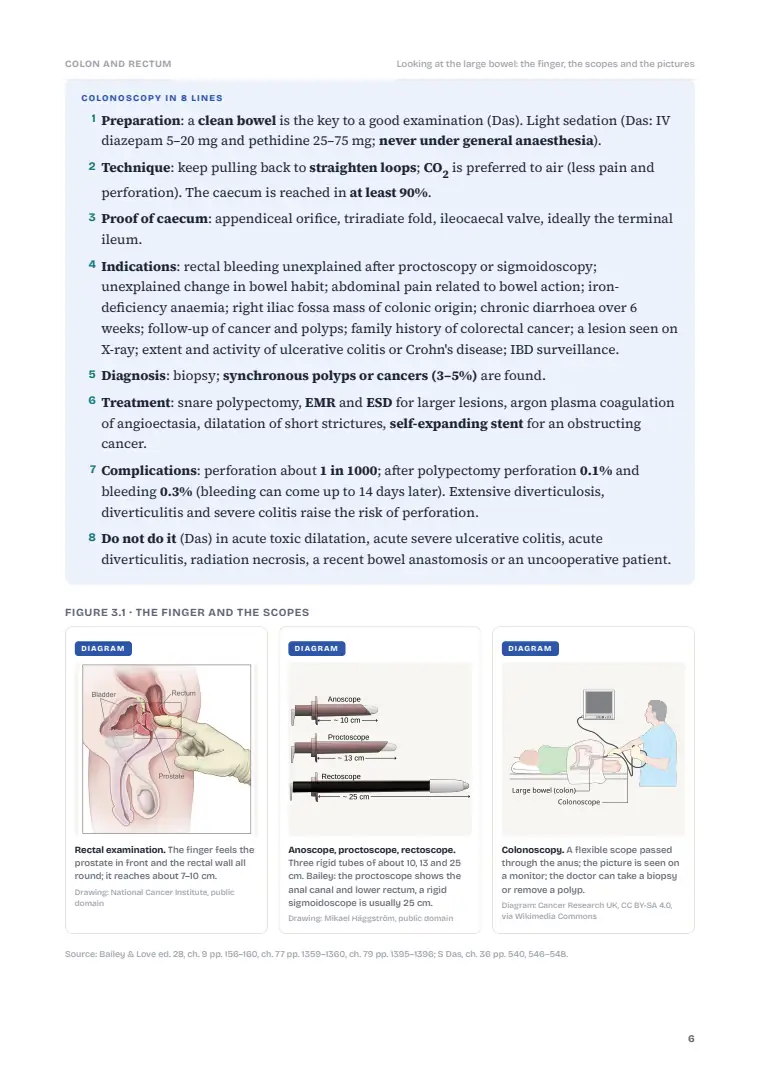
p. 6 · Inside the chapter 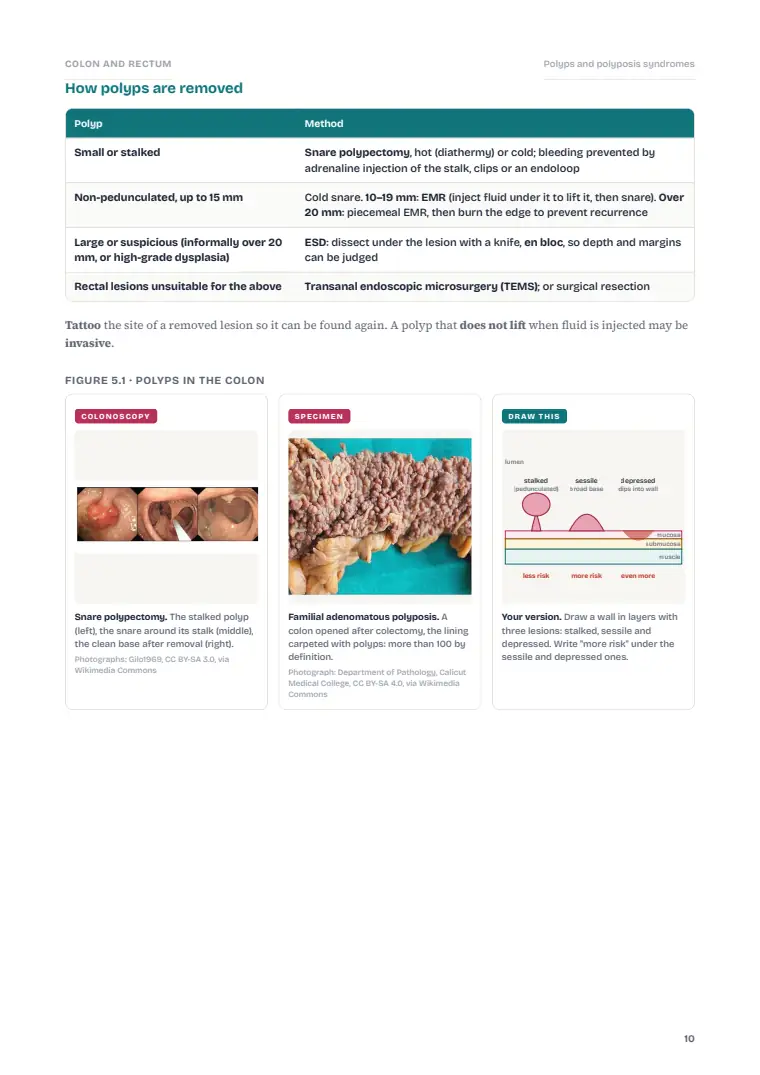
p. 10 · Inside the chapter 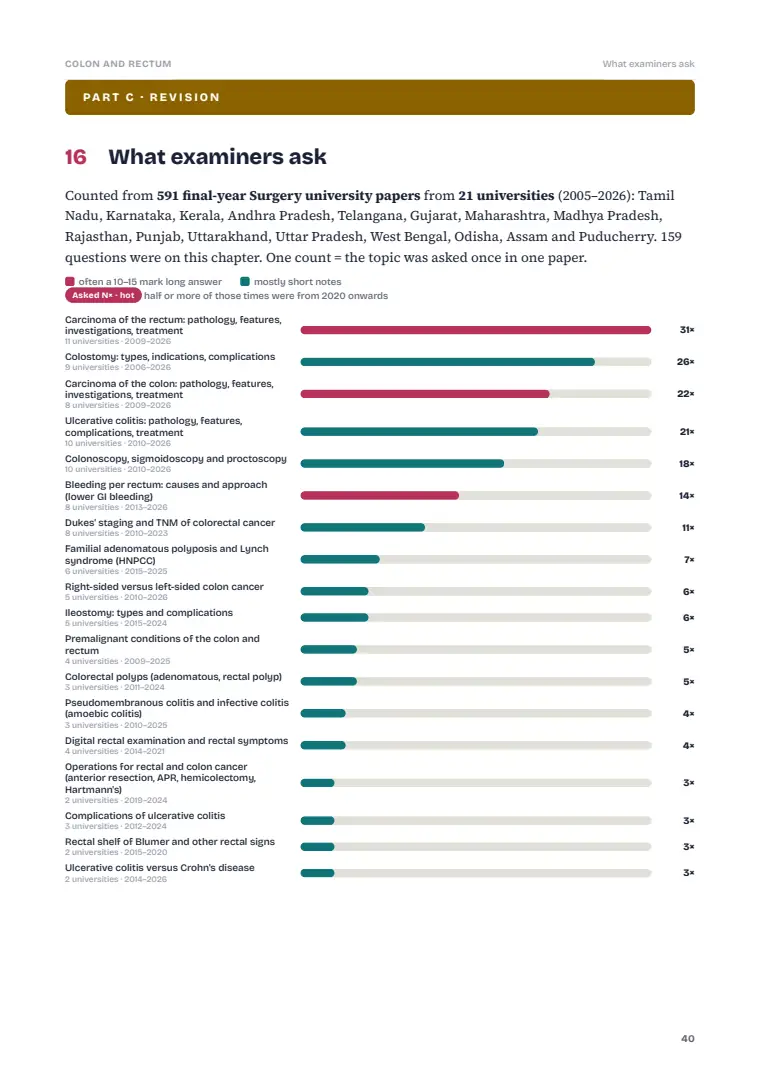
p. 40 · What examiners ask: previous years' questions - The Anus and Anal Canal
Preview and contents
What you get (49 pages)- Above the dentate line: painless. Below: painful
- Piles: bright blood, no pain, 3 · 7 · 11 o'clock
- Fissure: pain, posterior midline, sentinel pile
- Goodsall's rule for every fistula
- Never call it piles without a finger and a proctoscope
- Most asked: haemorrhoids (43×)
Asked most in previous papers43× Haemorrhoids (piles)43× Fistula in ano32× Pilonidal sinusPart A · TheoryThe story · Anatomy and physiology · Haemorrhoids · Treating haemorrhoids · Anal fissure · Anorectal abscess · Fistula-in-ano · Pilonidal sinus · Rectal prolapse · Itch, pain and small conditions · Warts, AIN and anal cancer · Incontinence and stricturesPart B · ClinicalHow to examine · Case sheetPart C · RevisionWhat examiners ask · Exam answers · Viva cards · Night-before recap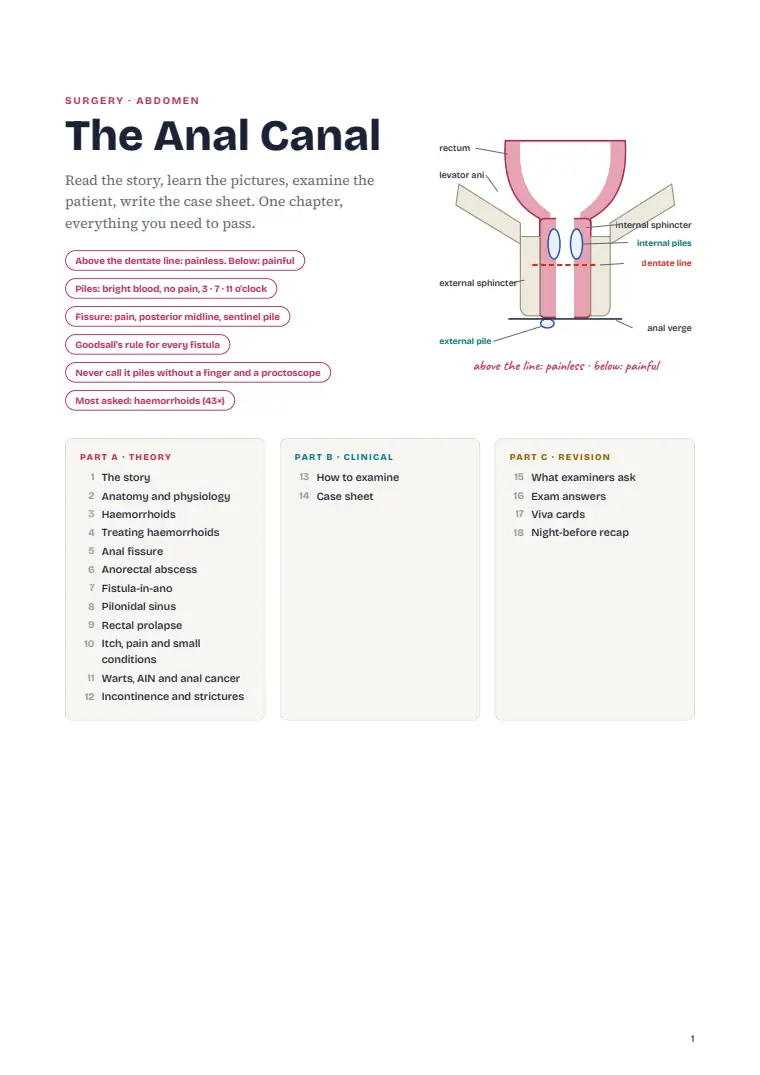
p. 1 · First page 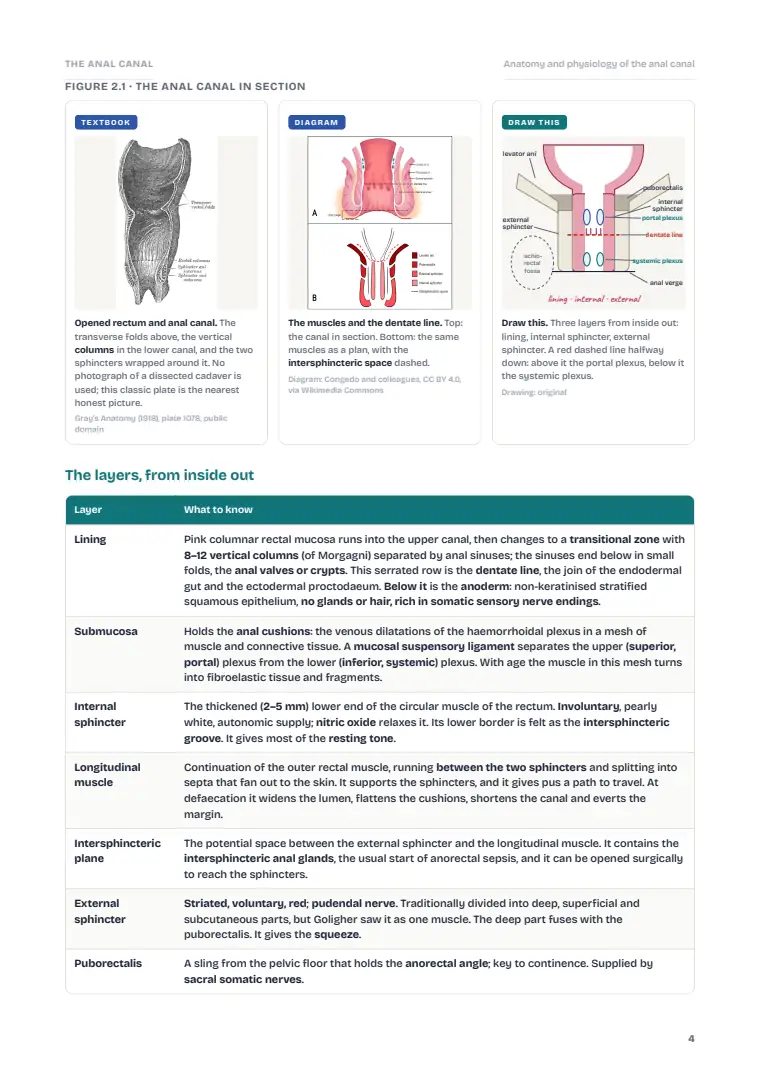
p. 4 · Inside the chapter 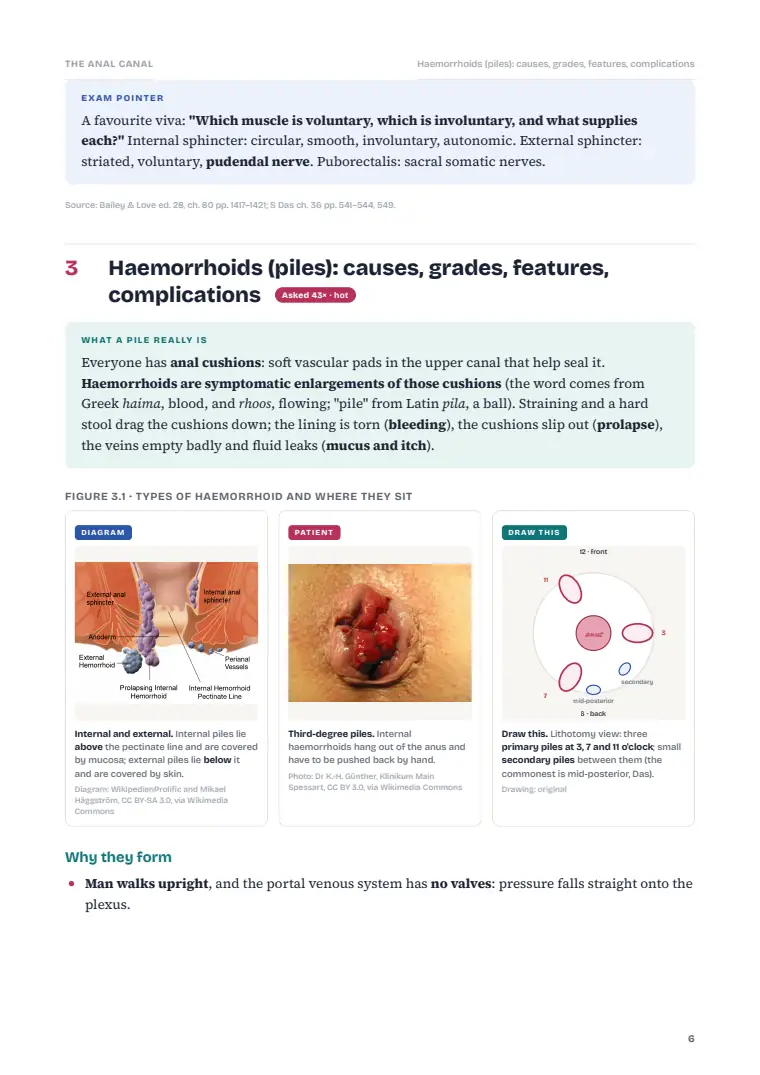
p. 6 · Inside the chapter 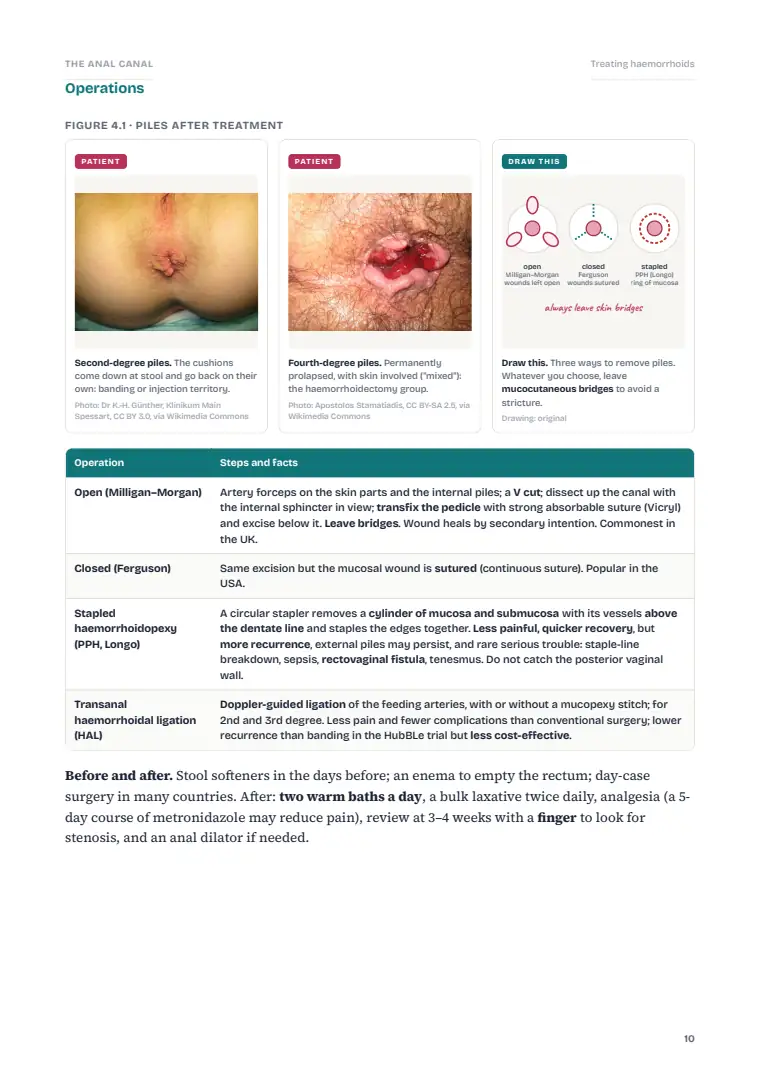
p. 10 · Inside the chapter 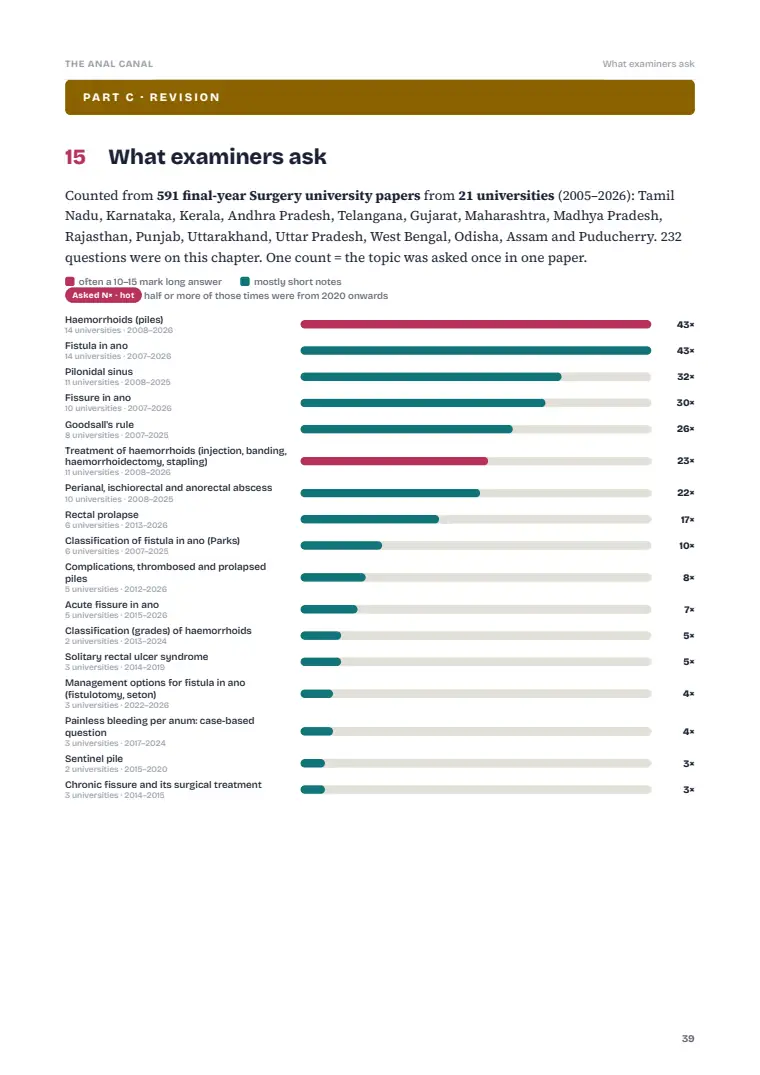
p. 39 · What examiners ask: previous years' questions - The Abdominal Wall, Hernia and Umbilicus
Preview and contents
What you get (46 pages)- Cough impulse + reducible
- Inferior epigastric vessels split indirect from direct
- Femoral: always repair
- Strangulation is an emergency
- Most asked: inguinal hernia (58×)
Asked most in previous papers58× Inguinal hernia: aetiology, clinical features, management37× Femoral hernia and femoral canal30× Strangulated / obstructed / incarcerated herniaPart A · TheoryThe story · Inguinal and femoral anatomy · What is a hernia · Inguinal hernia · Obstruction, strangulation · Femoral hernia · Umbilical, epigastric, incisional · Rare hernias · Hernia in children · Principles of repair, mesh · Operations · After repairPart B · ClinicalHow to examine · Case sheetPart C · RevisionWhat examiners ask · Exam answers · Viva cards · Night-before recap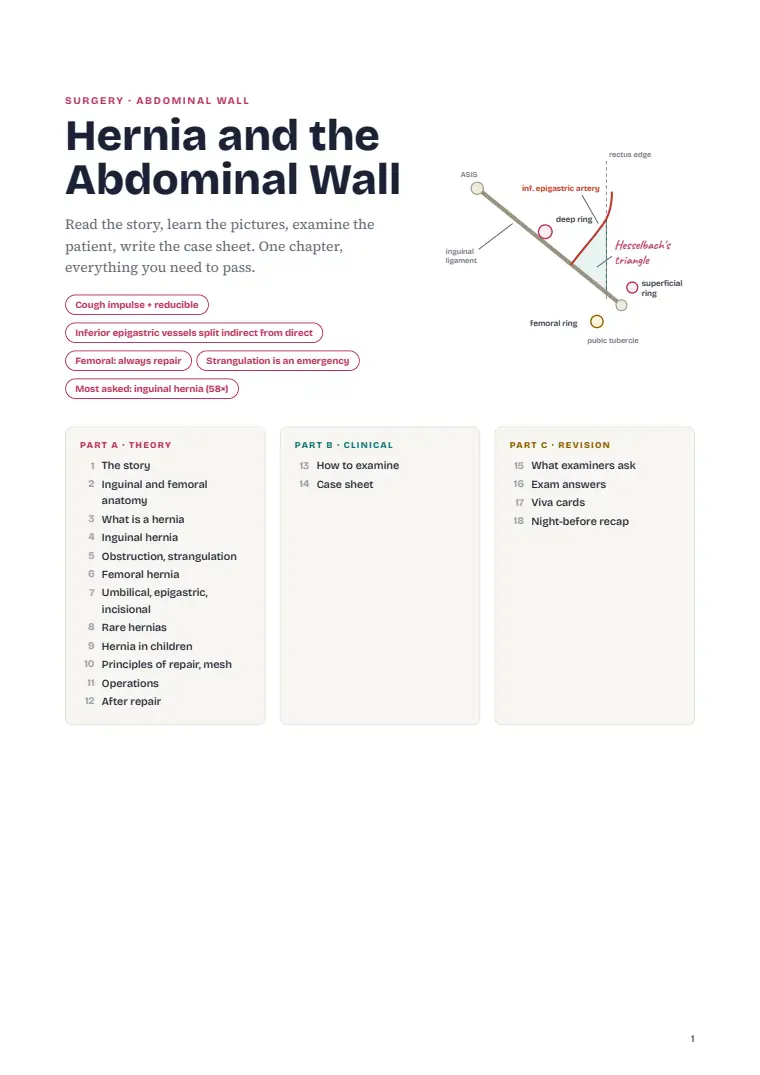
p. 1 · First page 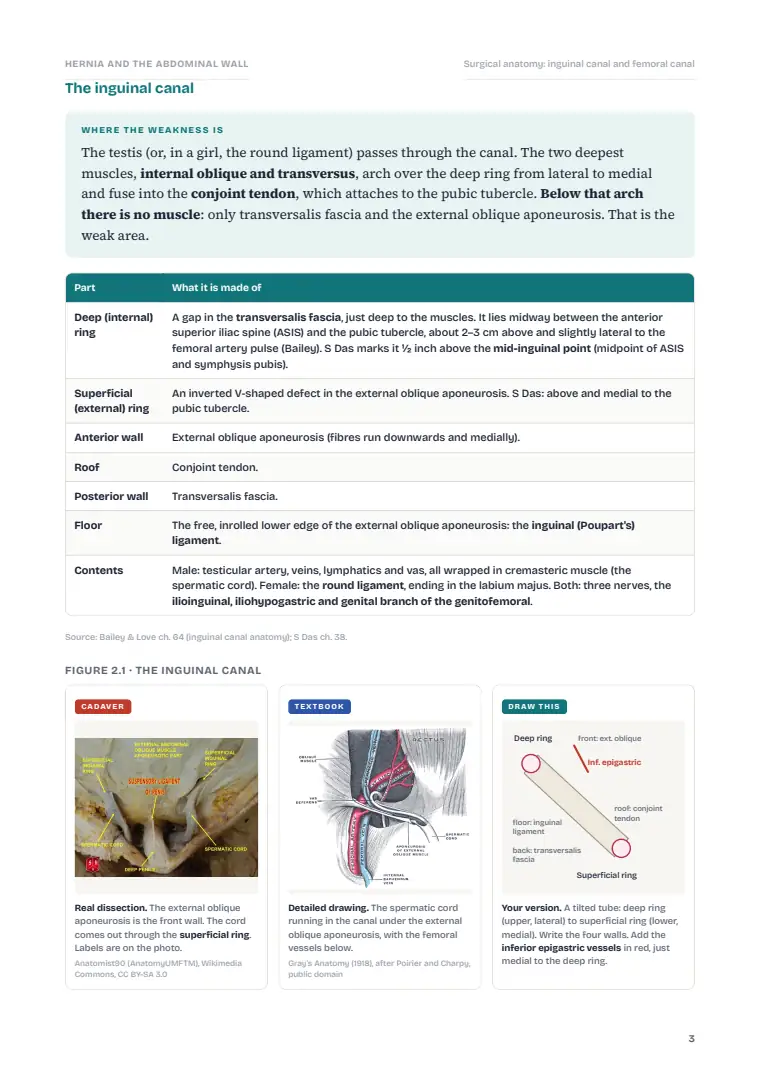
p. 3 · Inside the chapter 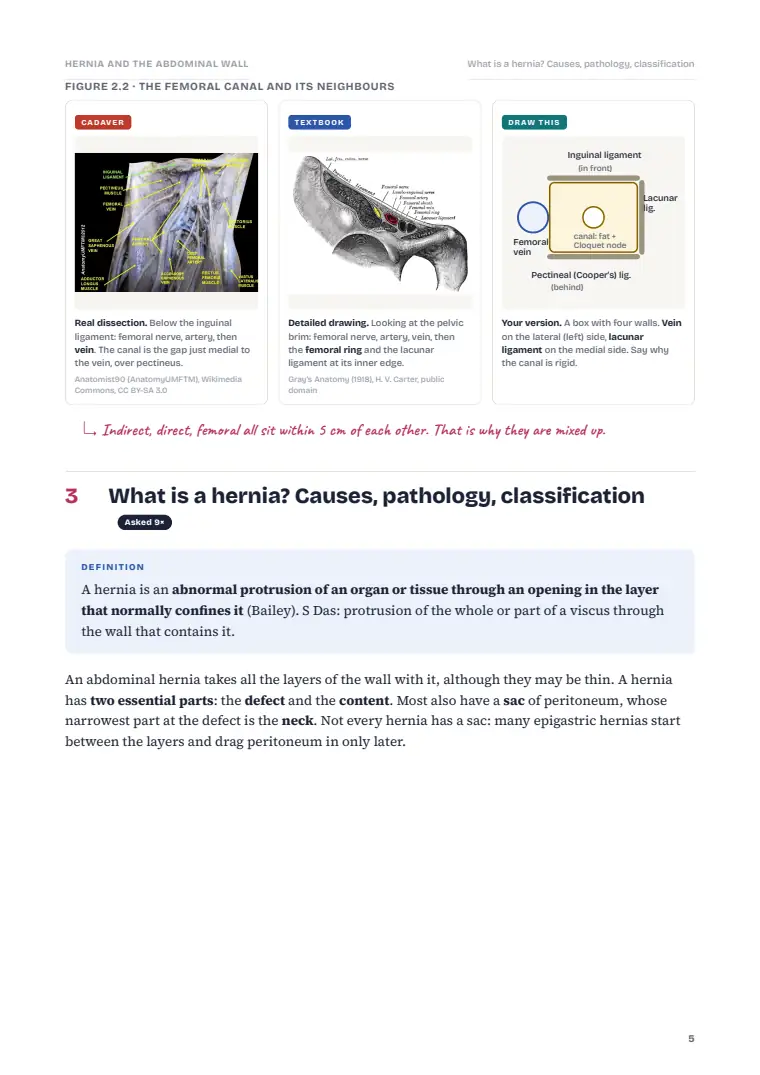
p. 5 · Inside the chapter 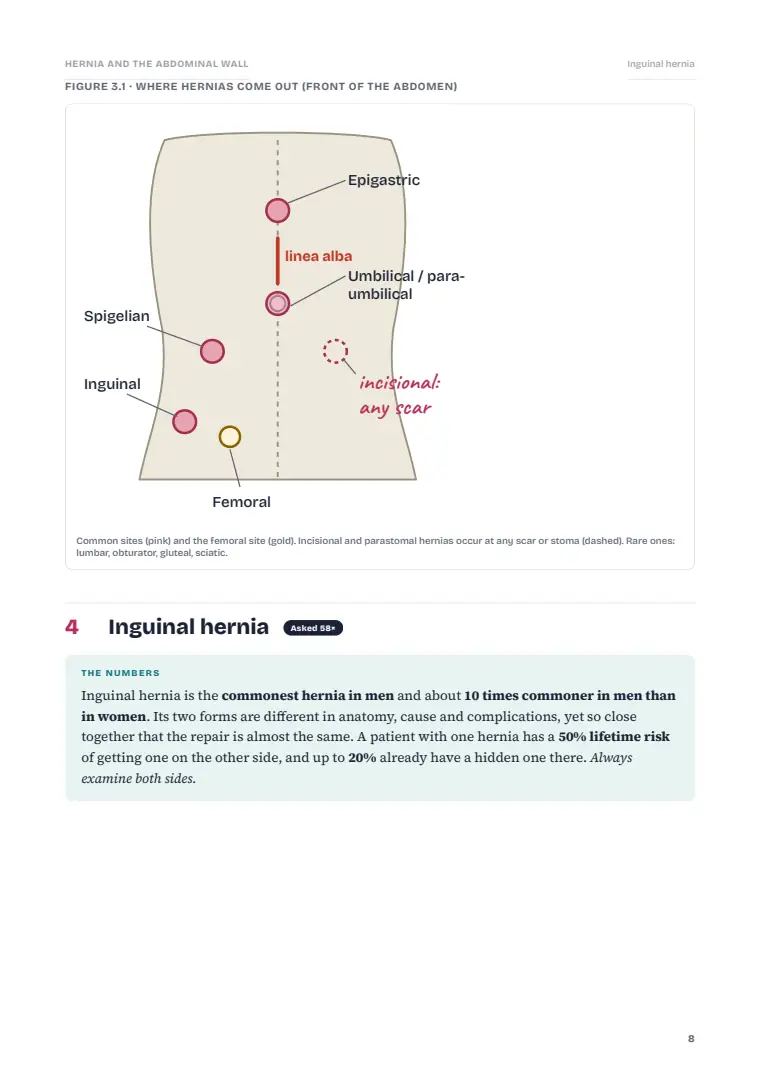
p. 8 · Inside the chapter 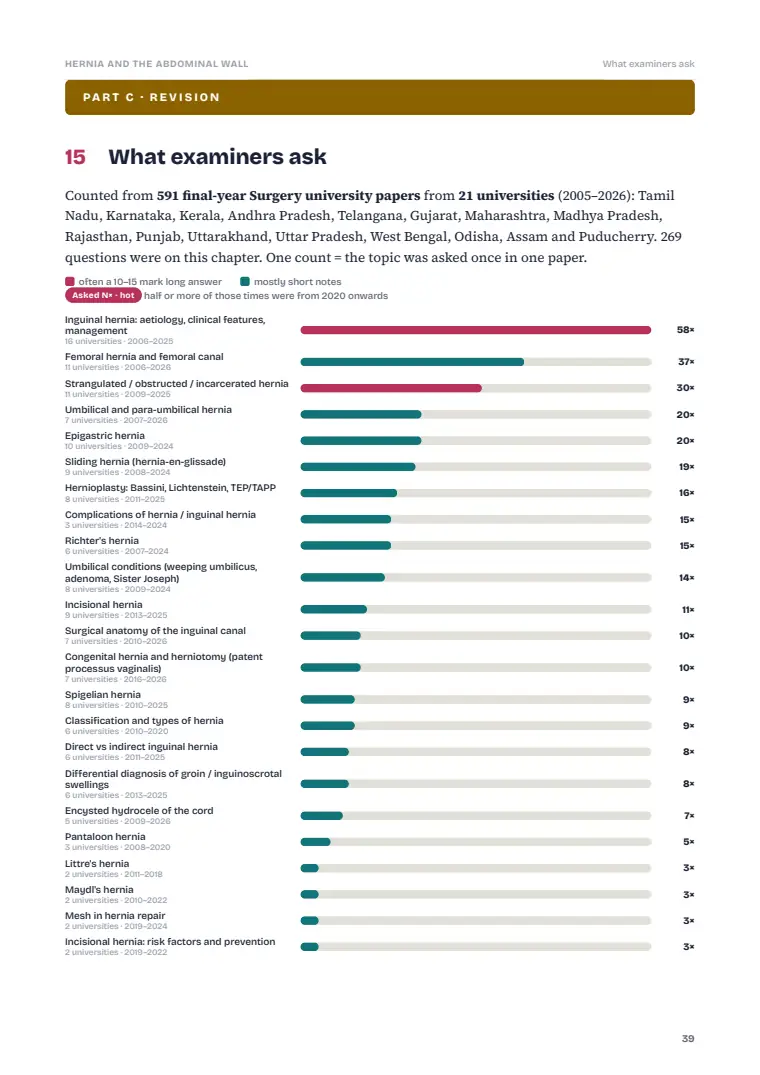
p. 39 · What examiners ask: previous years' questions
Urology
- The Kidney and Ureter
Preview and contents
What you get (45 pages)- Painless haematuria: look at the whole tract
- Ureteric colic: non-contrast CT
- Hydronephrosis: PUJ obstruction first
- Renal cell carcinoma: nephrectomy, CT staging
- Kidney lump: ballottable, bimanual
- Most asked: haematuria (49×)
Asked most in previous papers49× Haematuria: causes and approach48× Renal cell carcinoma (hypernephroma): features, staging, treatment47× Renal stones: types, aetiology, clinical features, managementPart A · TheoryThe story · Anatomy · Investigations · Congenital anomalies · Hydronephrosis, PUJ · Haematuria · Infection, pyonephrosis · Renal TB · Stones: causes, types · Renal, staghorn stones · Ureteric stone, colic · Treating stones · Cysts, polycystic kidney · Tumours · The loin lump · Injuries · Kidney transplantPart B · ClinicalHow to examine · Case sheetPart C · RevisionWhat examiners ask · Exam answers · Viva cards · Night-before recap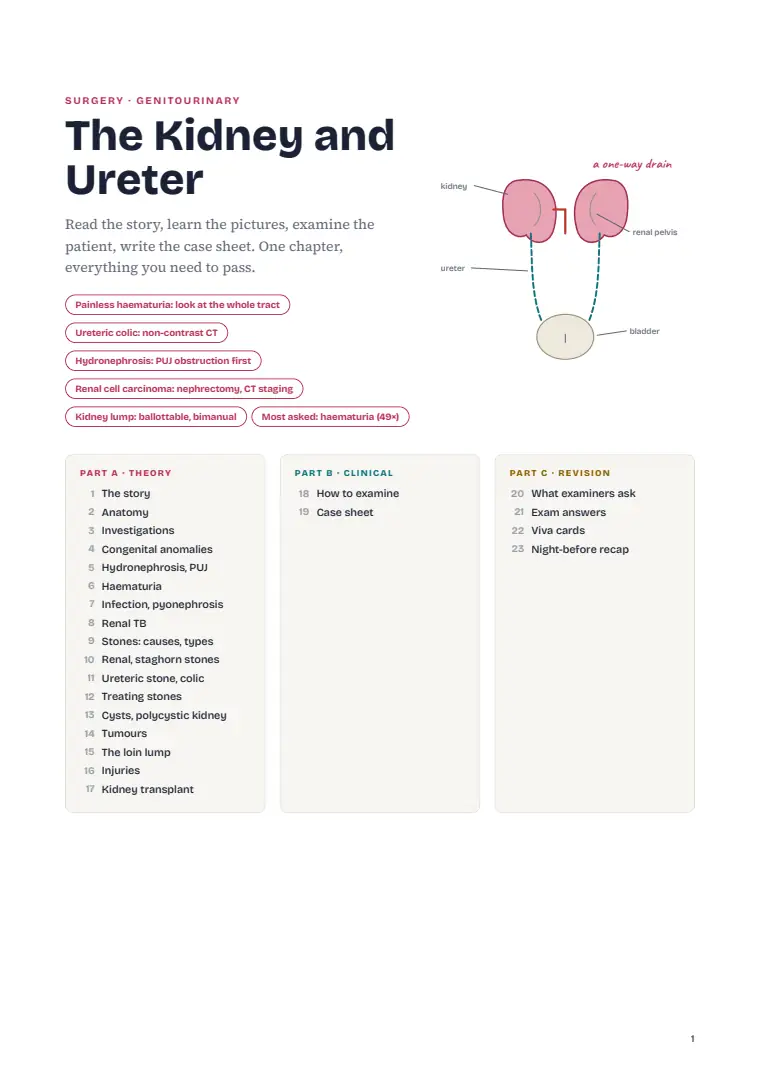
p. 1 · First page 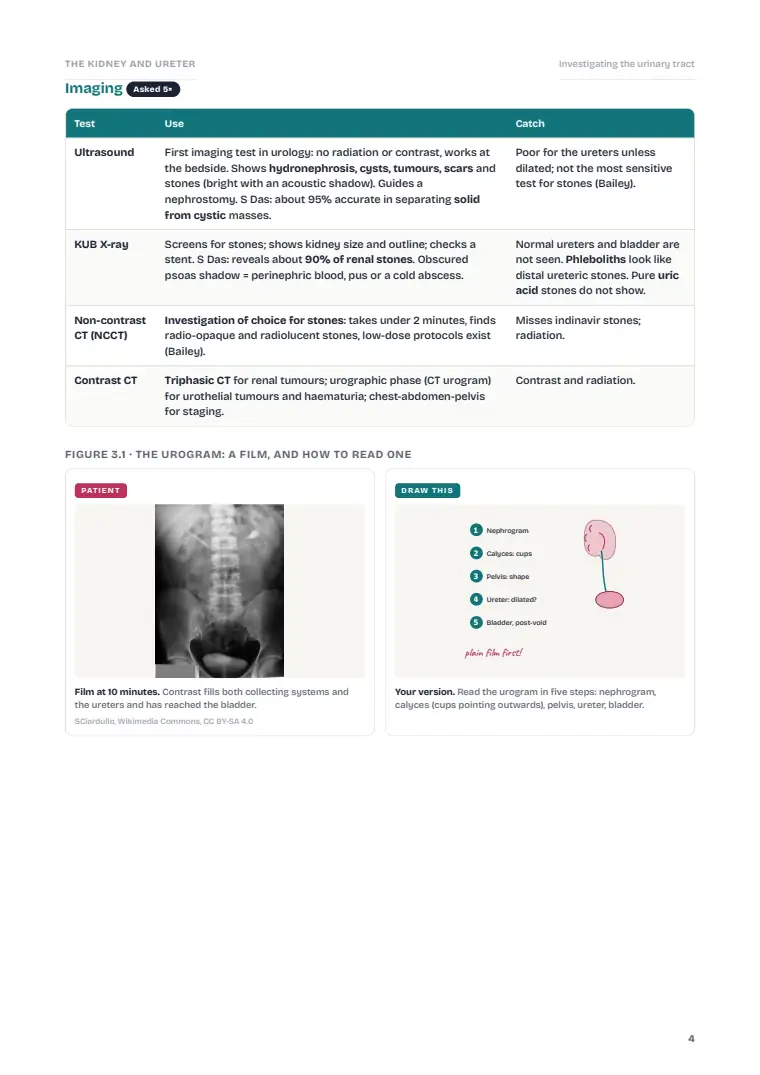
p. 4 · Inside the chapter 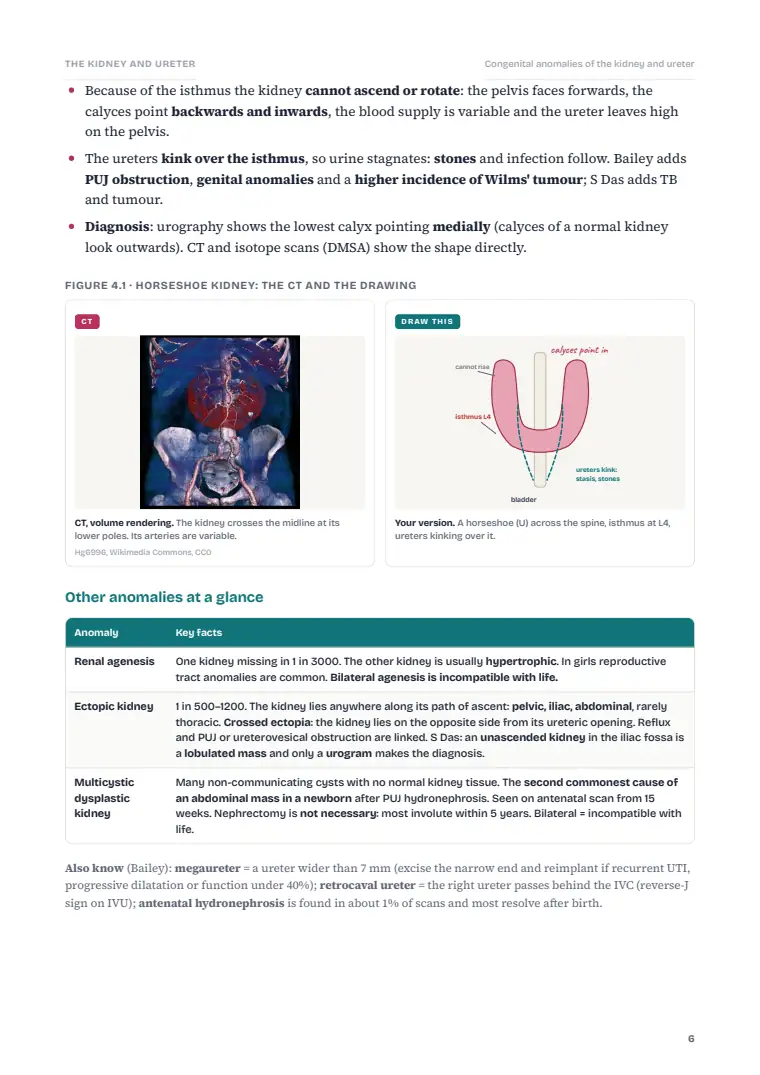
p. 6 · Inside the chapter 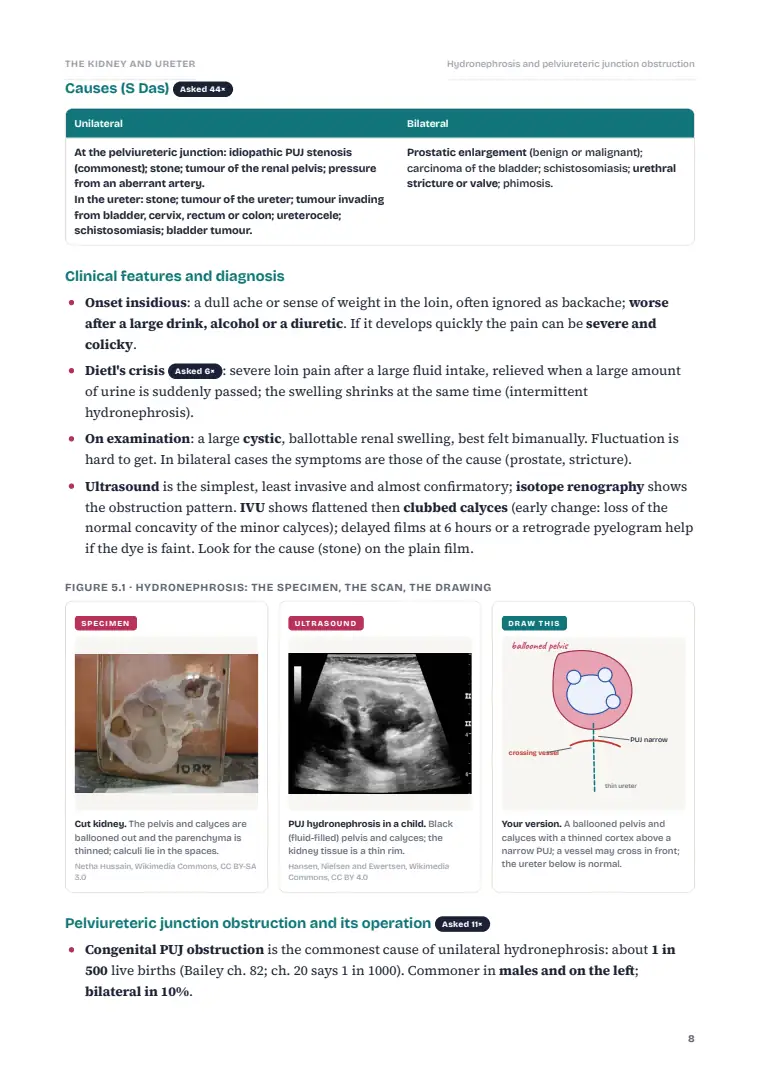
p. 8 · Inside the chapter 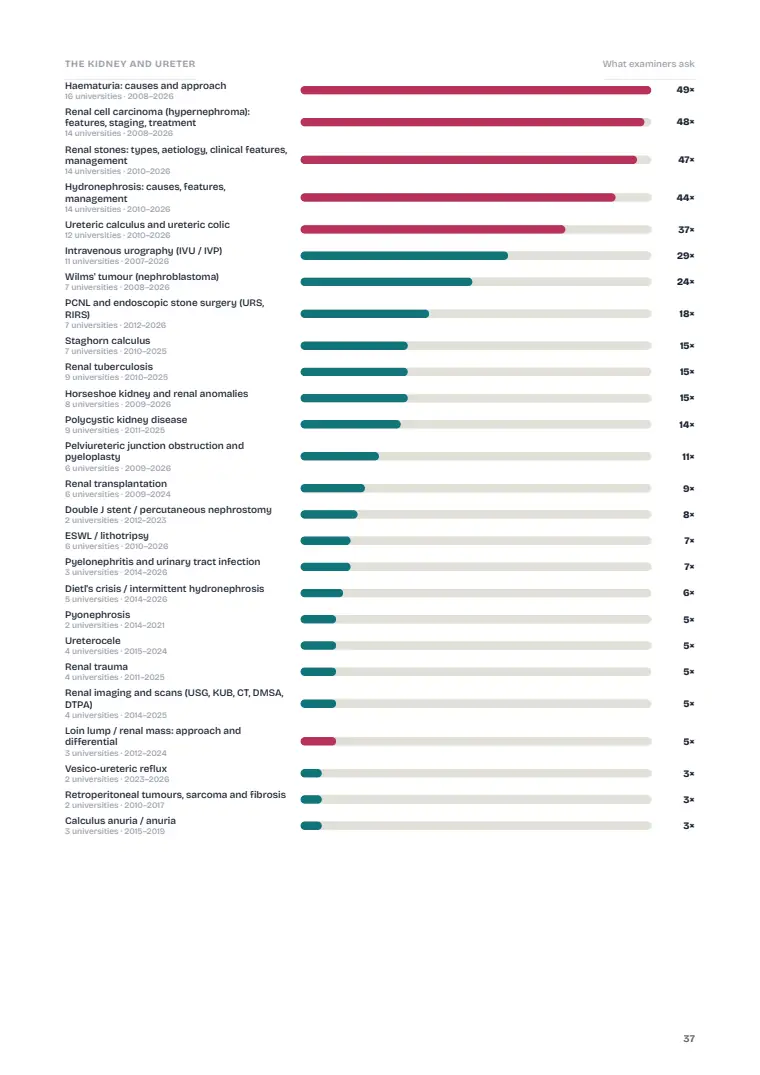
p. 37 · What examiners ask: previous years' questions - The Urinary Bladder, Prostate and Urethra
Preview and contents
What you get (45 pages)- Empty the bladder before you examine
- Acute retention hurts, chronic retention does not
- Painless haematuria: think tumour
- Smooth with a sulcus = BPH; stony, no sulcus = cancer
- Blood at the meatus: no blind catheter
- Most asked: BPH (69×)
Asked most in previous papers69× Benign prostatic hyperplasia: pathology, features, investigations, treatment25× Vesical calculus (bladder stone)22× Retention of urine: causes and managementPart A · TheoryThe story · Anatomy, micturition · Symptoms and tests · Retention of urine · Catheters, cystostomy · Benign prostatic hyperplasia · Cancer of the prostate · Prostatitis and bladder neck · Cystitis, TB, bilharzia · Bladder stones, diverticulum · Cancer of the bladder · Bladder injuries · Urethral injuries · Urethral stricture and other urethral disease · Congenital: valves, exstrophy · Incontinence, neurogenic bladder, fistula, diversionPart B · ClinicalHow to examine · Case sheetPart C · RevisionWhat examiners ask · Exam answers · Viva cards · Night-before recap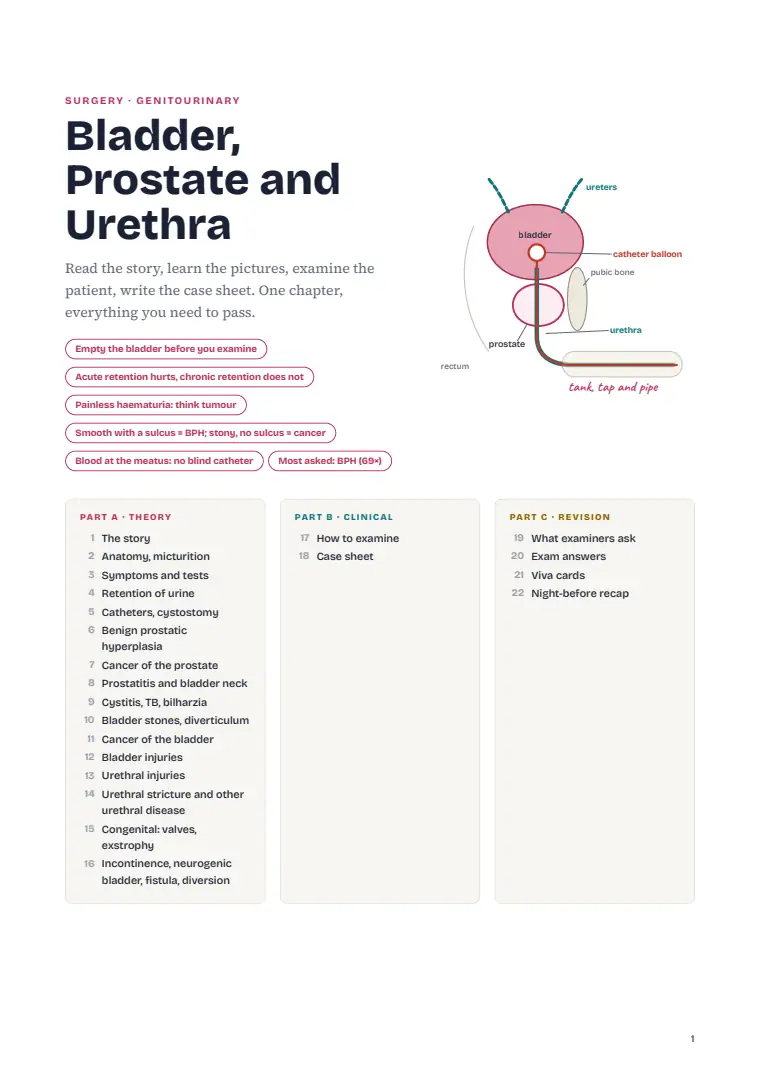
p. 1 · First page 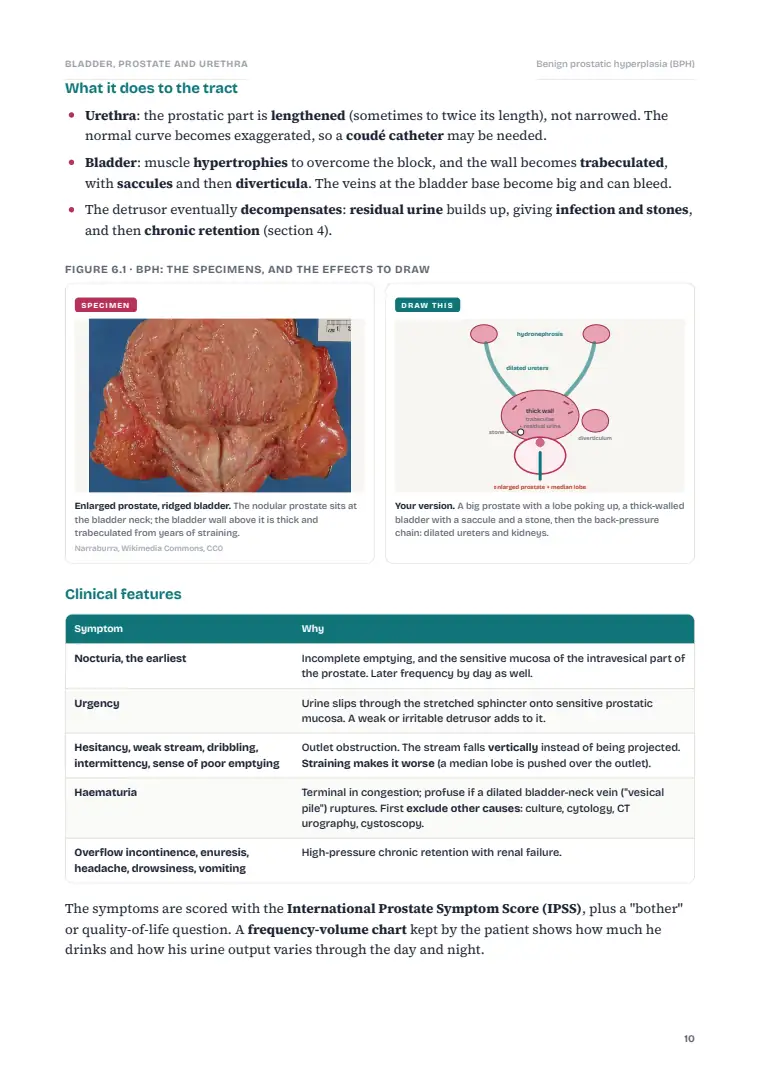
p. 10 · Inside the chapter 
p. 20 · Inside the chapter 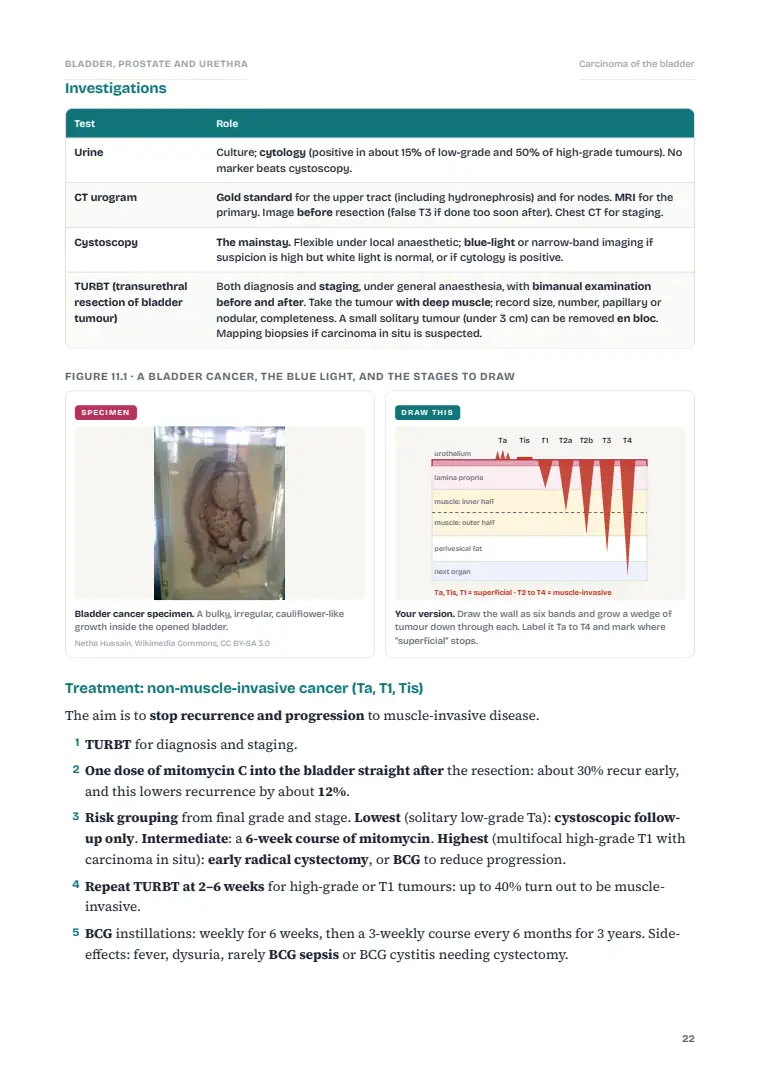
p. 22 · Inside the chapter 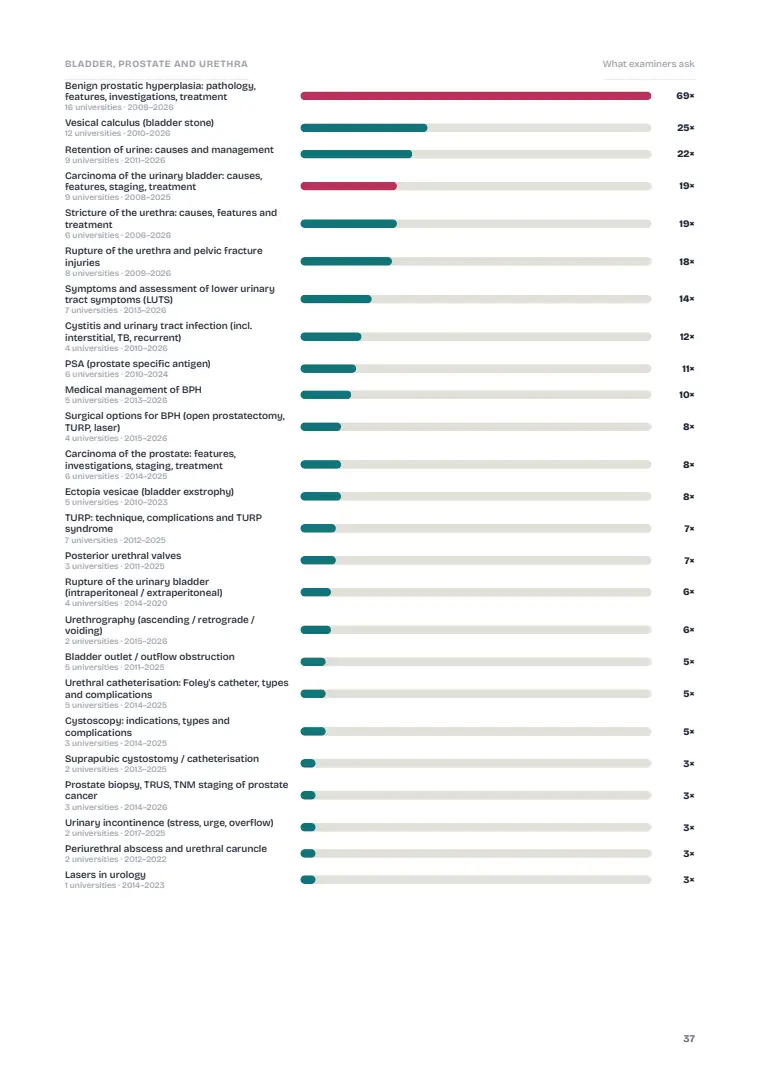
p. 37 · What examiners ask: previous years' questions - The Testis, Scrotum and Penis
Preview and contents
What you get (47 pages)- Get above the swelling
- Torsion: operate within 6 hours
- Hydrocele: fluctuant and translucent
- Left varicocele 90%
- Seminoma spreads by lymphatics
- Most asked: hydrocele (58×)
Asked most in previous papers58× Hydrocele: types, features, treatment53× Torsion of the testis (cause, diagnosis, treatment)43× Undescended testis (cryptorchidism): features, complications, orchidopexyPart A · TheoryThe story · Anatomy, descent · Scrotal swellings · Hydrocele · Haematocele, cysts · Varicocele · Epididymo-orchitis, TB · Torsion, acute scrotum · Undescended testis · Testicular tumours · Scrotal skin · Foreskin, circumcision · Penile cancer, ulcers · Peyronie, priapism, injury · Hypospadias, epispadias · VasectomyPart B · ClinicalHow to examine · Case sheetPart C · RevisionWhat examiners ask · Exam answers · Viva cards · Night-before recap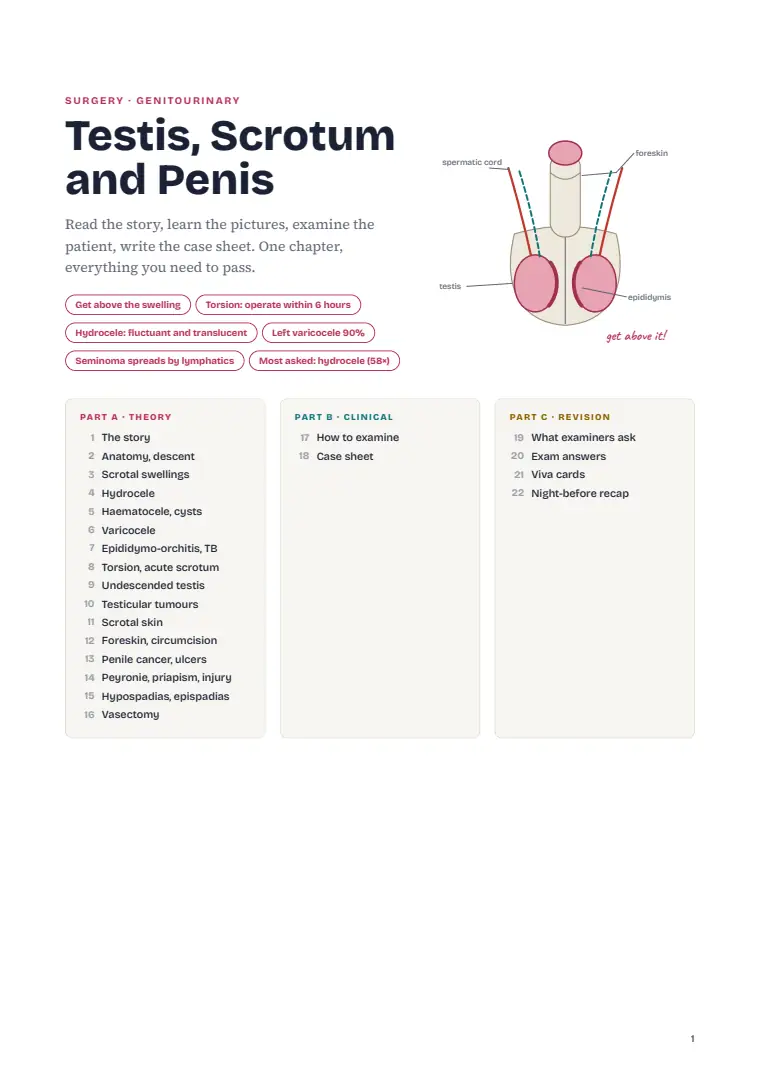
p. 1 · First page 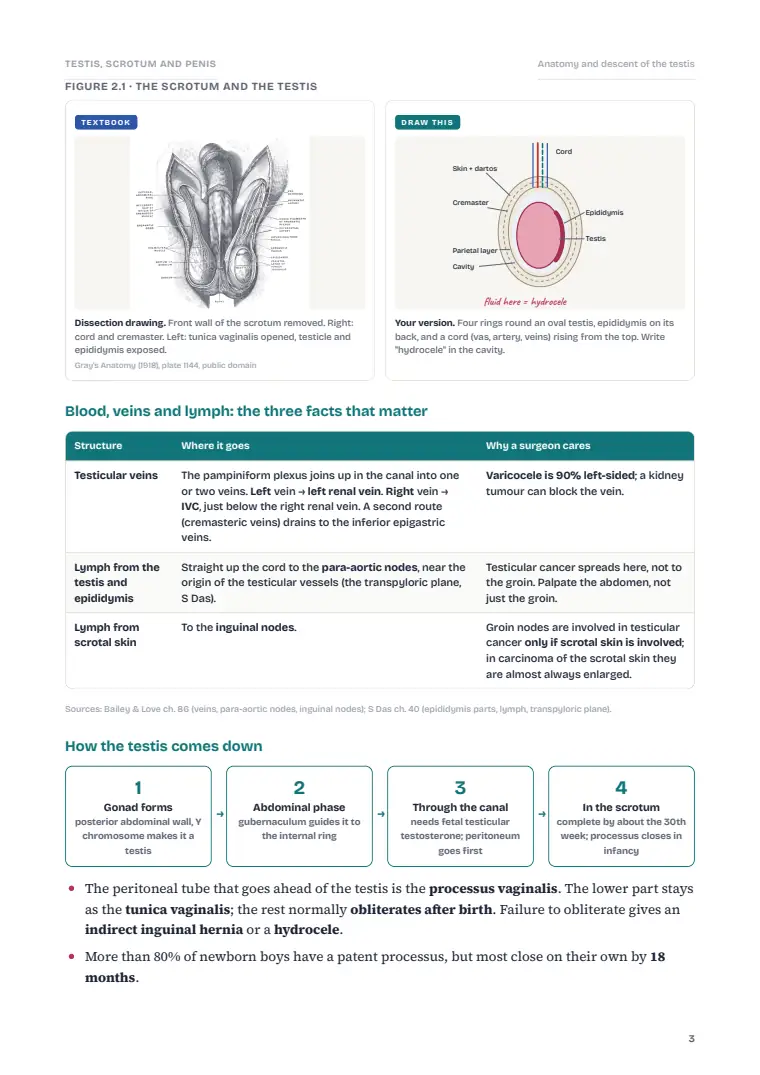
p. 3 · Inside the chapter 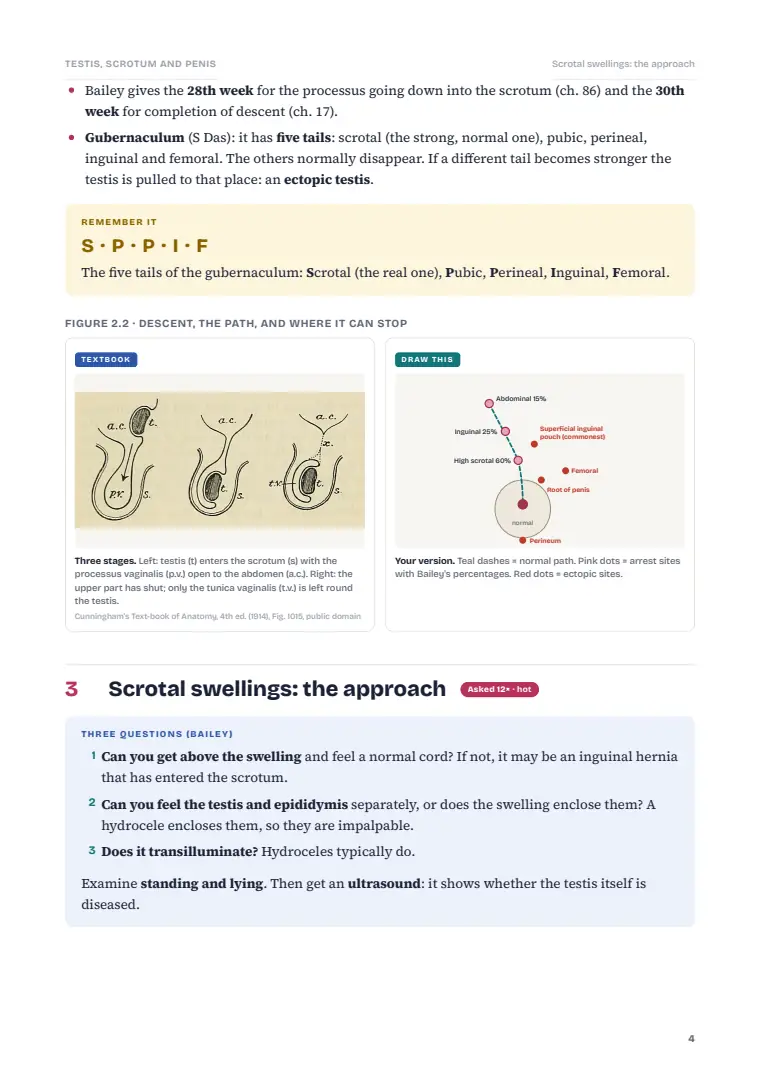
p. 4 · Inside the chapter 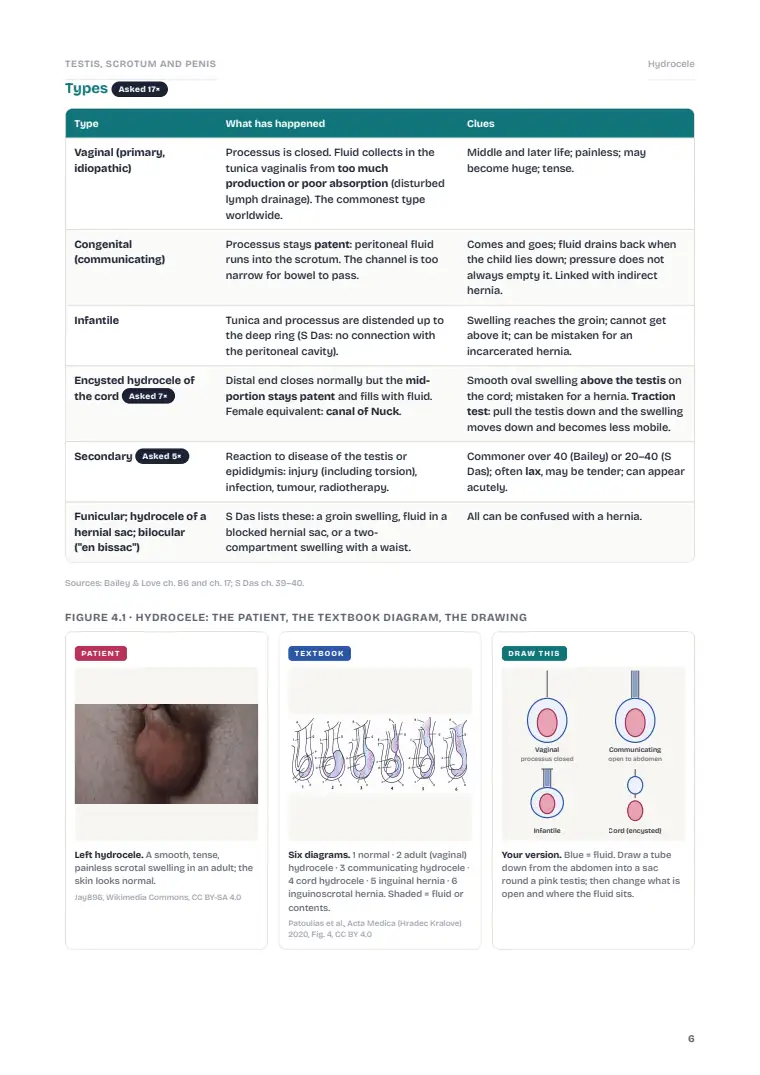
p. 6 · Inside the chapter 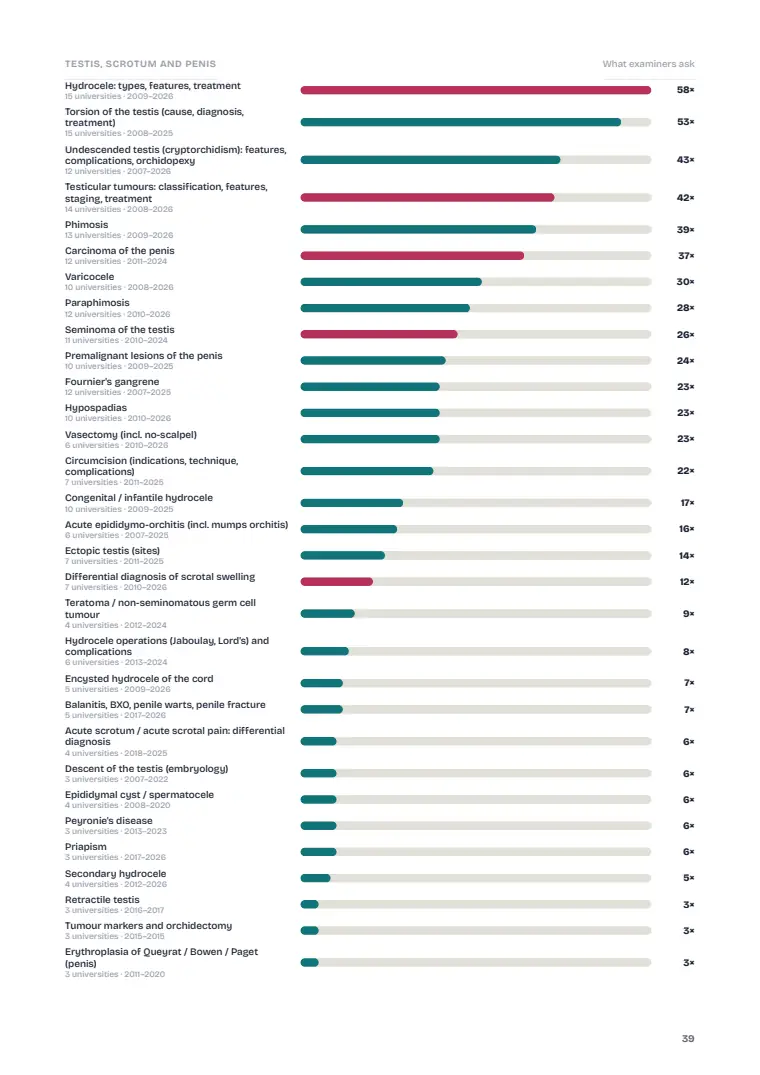
p. 39 · What examiners ask: previous years' questions
Paediatric surgery
- Paediatric and Neonatal Surgery
Preview and contents
What you get (46 pages)- Vomiting baby: bile or no bile?
- Projectile, no bile, hungry: pyloric stenosis
- Screaming, redcurrant jelly: intussusception
- No meconium: Hirschsprung or anorectal
- Drooling and cyanosis: oesophageal atresia
- Most asked: intussusception (55×)
Asked most in previous papers55× Intussusception: types, features, diagnosis, treatment46× Infantile hypertrophic pyloric stenosis: features, diagnosis, Ramstedt's pyloromyotomy38× Branchial cyst, fistula and sinusPart A · TheoryThe story · Not small adults · The vomiting newborn · Oesophageal atresia, TOF · Pyloric stenosis · Atresia, malrotation, meconium ileus · Necrotising enterocolitis · Hirschsprung's disease · Anorectal malformations · Intussusception · Exomphalos, gastroschisis · Diaphragmatic hernia · Other tummy problems · Tumours of childhood · Cleft lip and palate · Mouth and neck · Injury, foreign bodiesPart B · ClinicalHow to examine · Case sheetPart C · RevisionWhat examiners ask · Exam answers · Viva cards · Night-before recap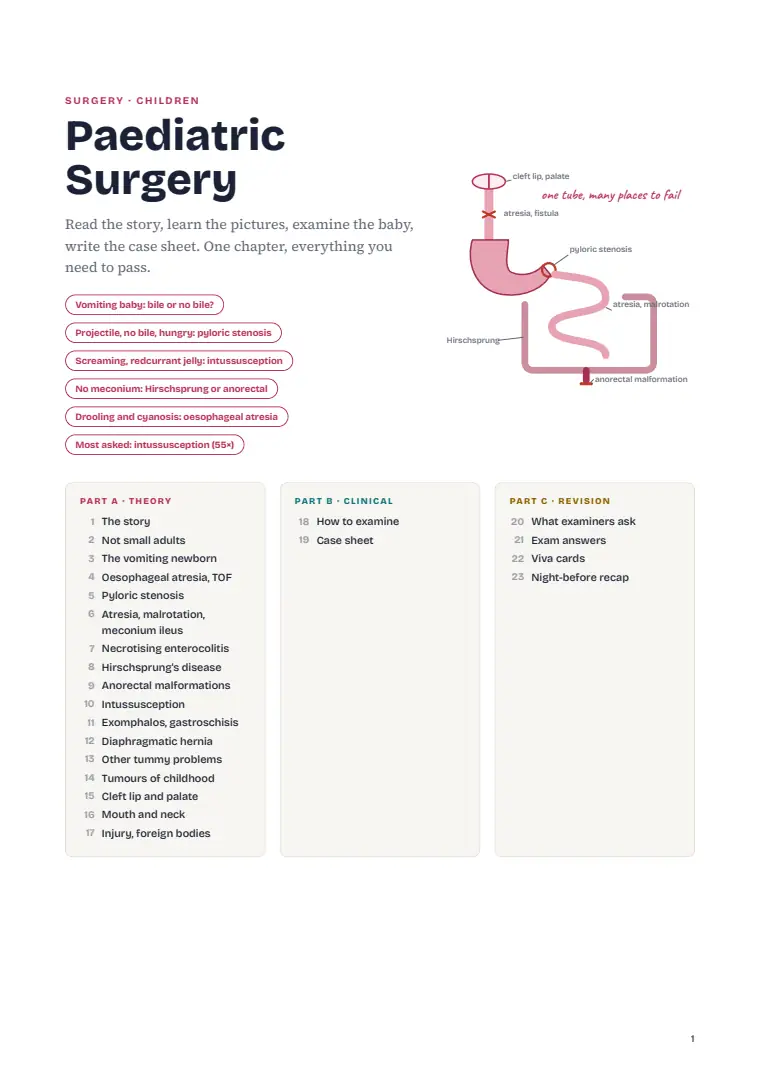
p. 1 · First page 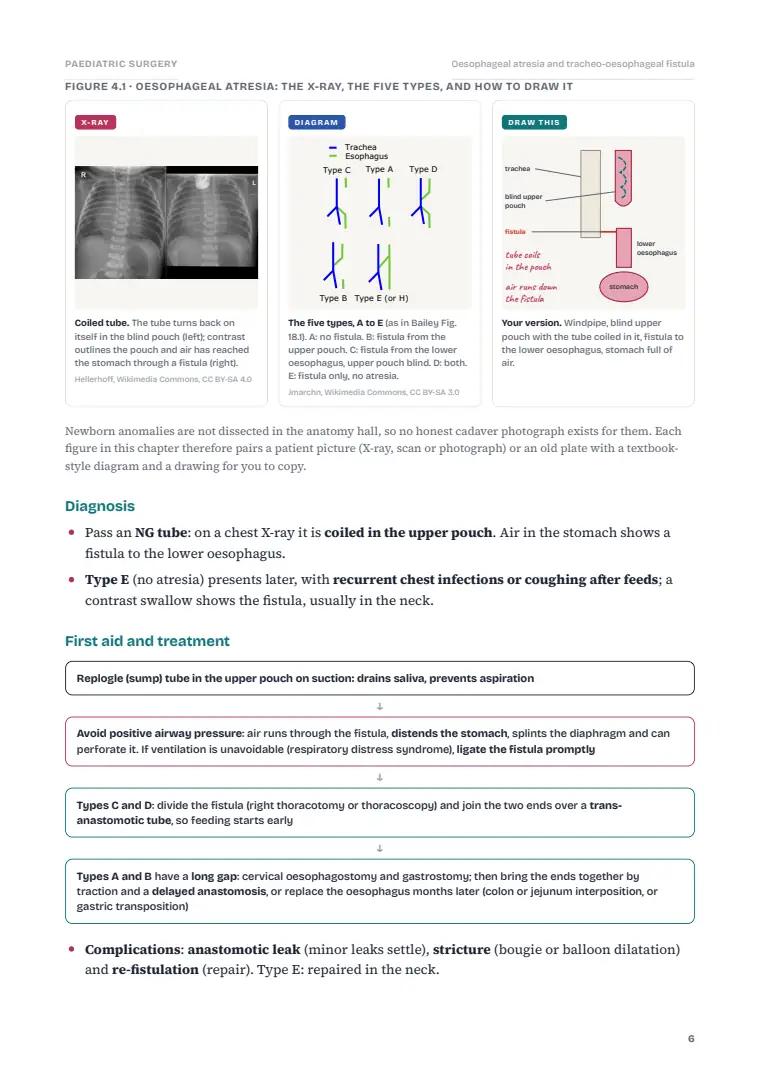
p. 6 · Inside the chapter 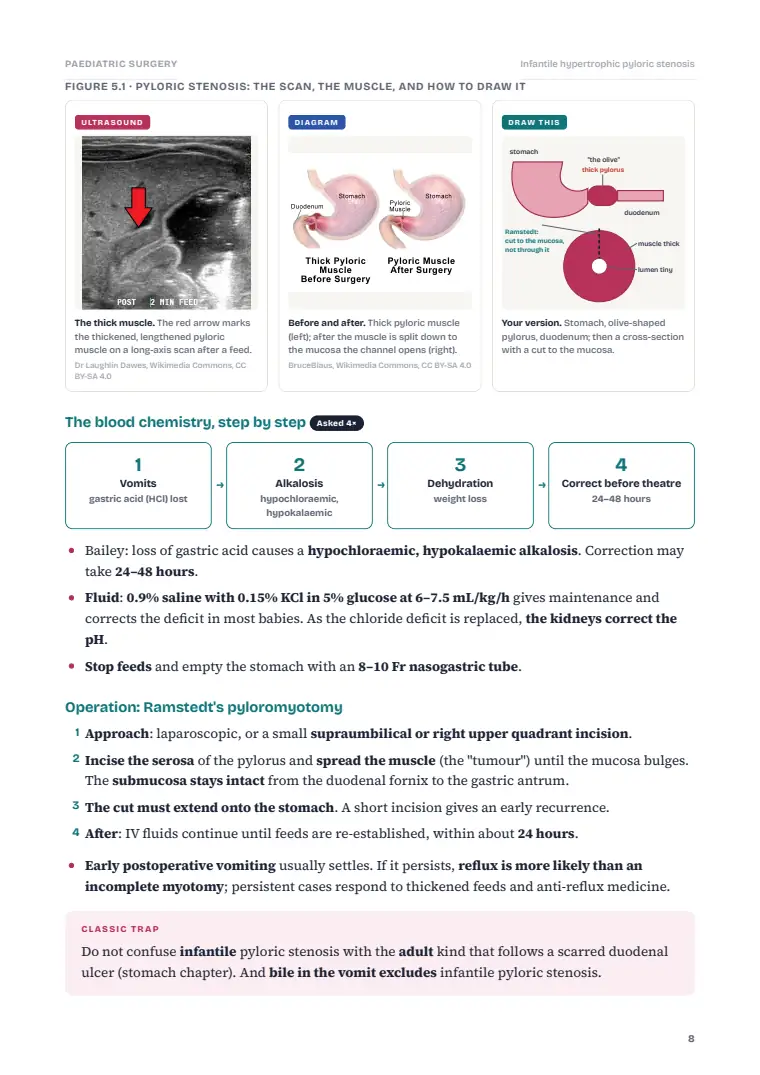
p. 8 · Inside the chapter 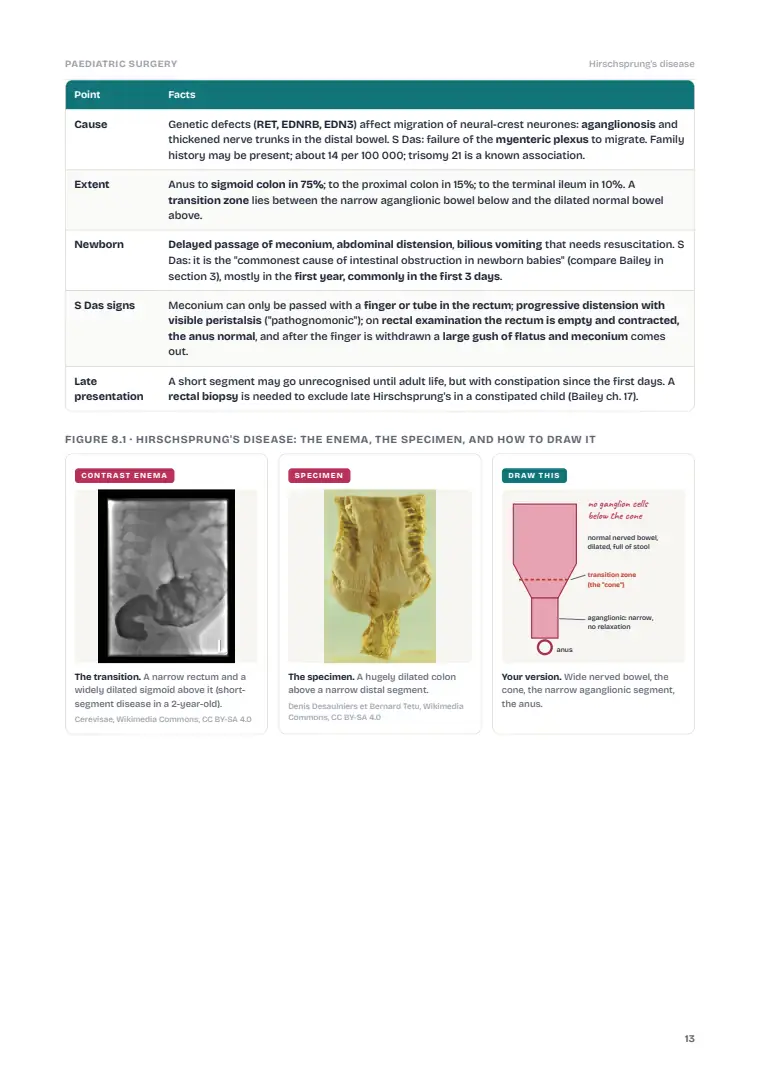
p. 13 · Inside the chapter 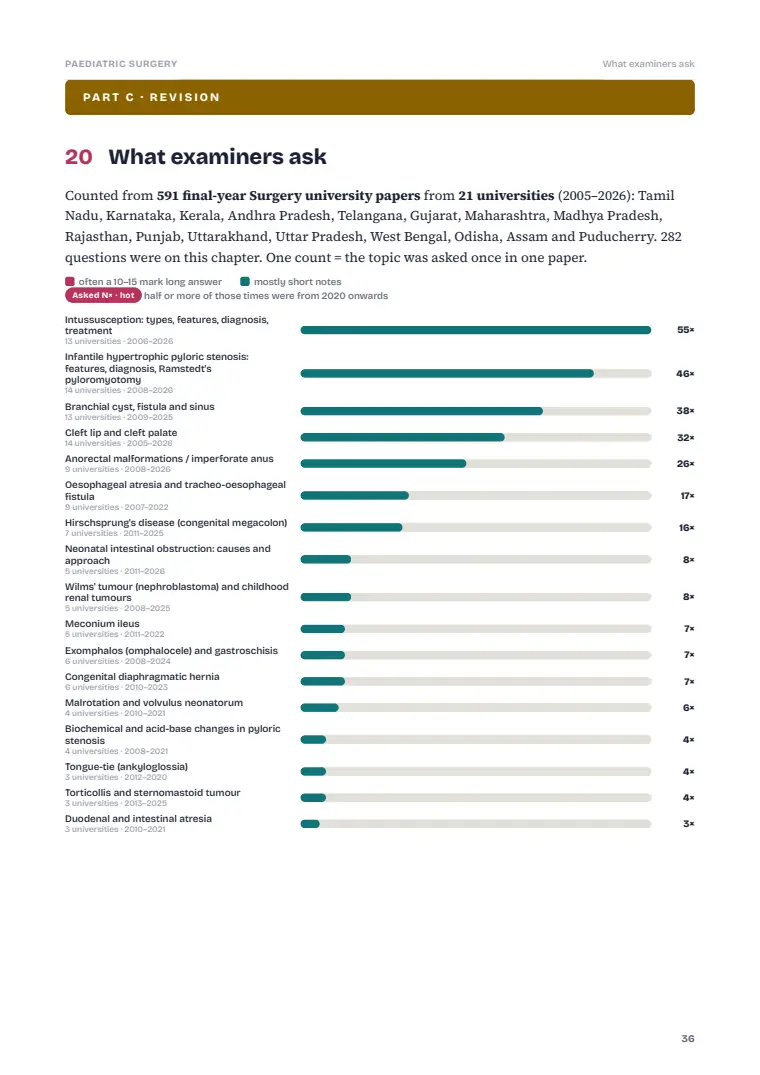
p. 36 · What examiners ask: previous years' questions
Only with the full book
- Signs, Triads and Eponyms
Preview and contents
What you get (23 pages)- Goodsall's rule (33×)
- Charcot's triad (26×)
- Calot's triangle (22×)
- Courvoisier's law (20×)
- Murphy's sign (12×)
Asked most in previous papers51× Glasgow Coma Scale33× Goodsall's rule26× Charcot's triadPart A · Signs by systemThe story in 1 minute · Triads at a glance · Right iliac fossa, acute abdomen · Gall bladder, bile ducts, pancreas, liver · Gut, anus, cancer spread · Hernia, groin, testis, urine · Neck, thyroid, chest-wall · Arteries, veins, limbs · Skin, breast, lumps · Trauma, head, ICUPart B · Look-up tablesScores and classifications · Named diseases, operations, tubes · Asked but not in the booksPart C · RevisionWhat examiners ask · Viva cards · Night-before recap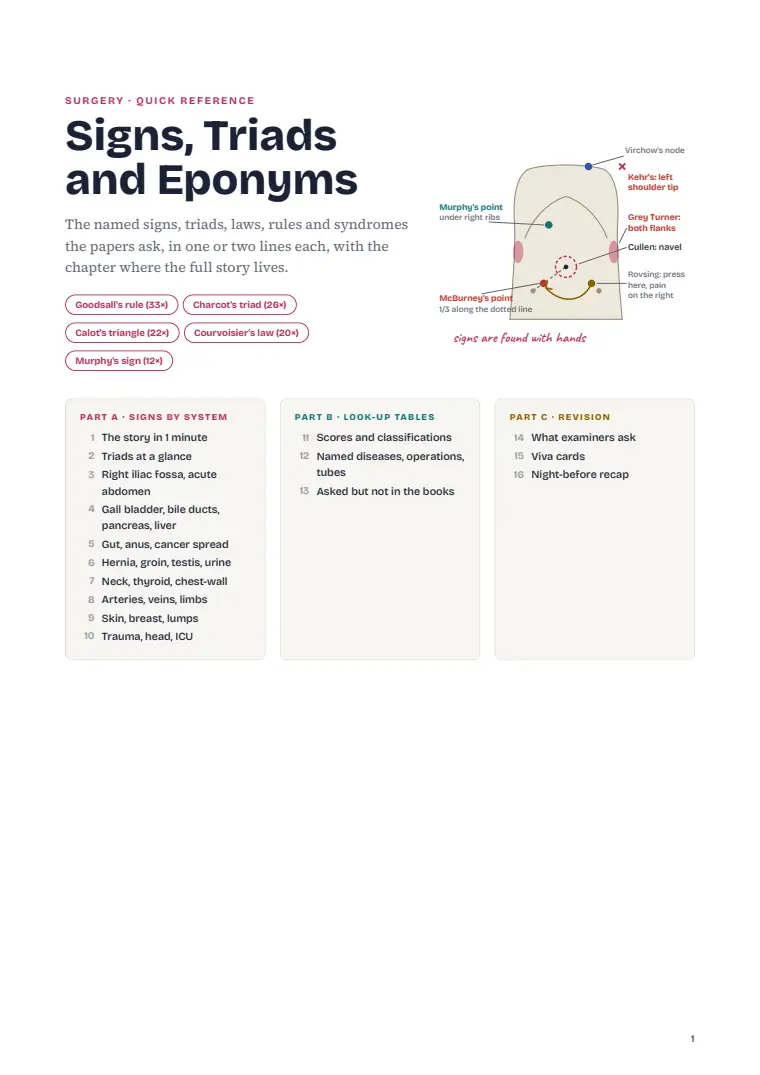
p. 1 · First page 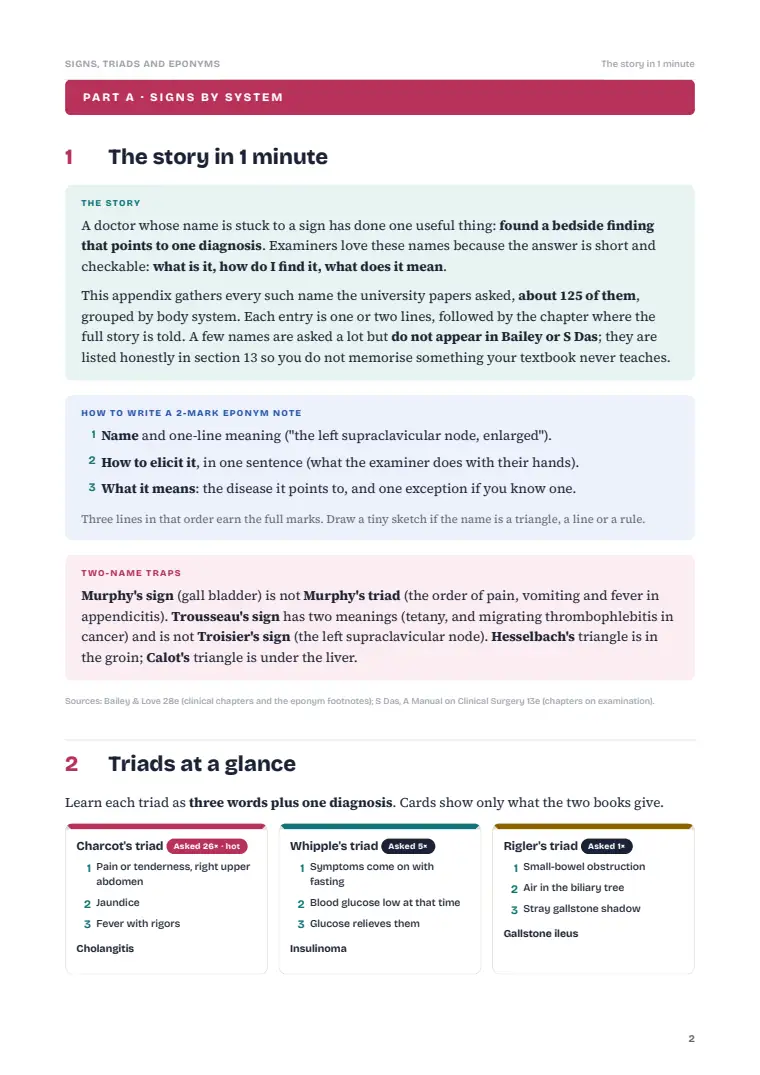
p. 2 · Inside the chapter 
p. 3 · Inside the chapter 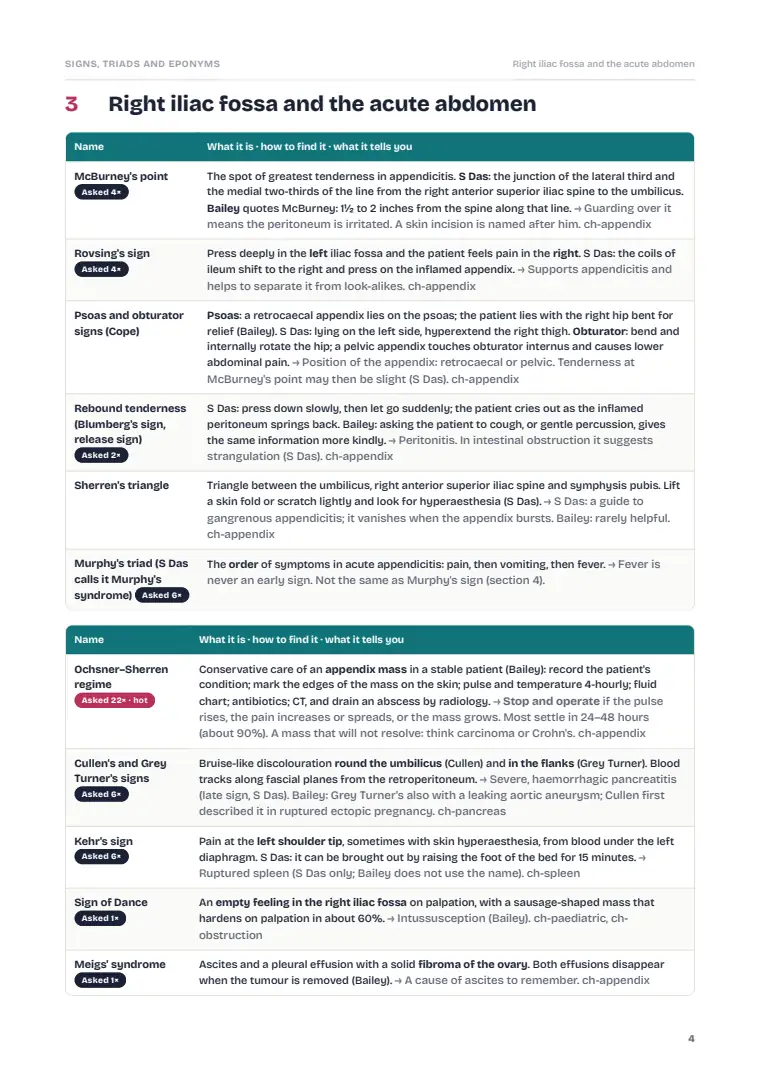
p. 4 · Inside the chapter 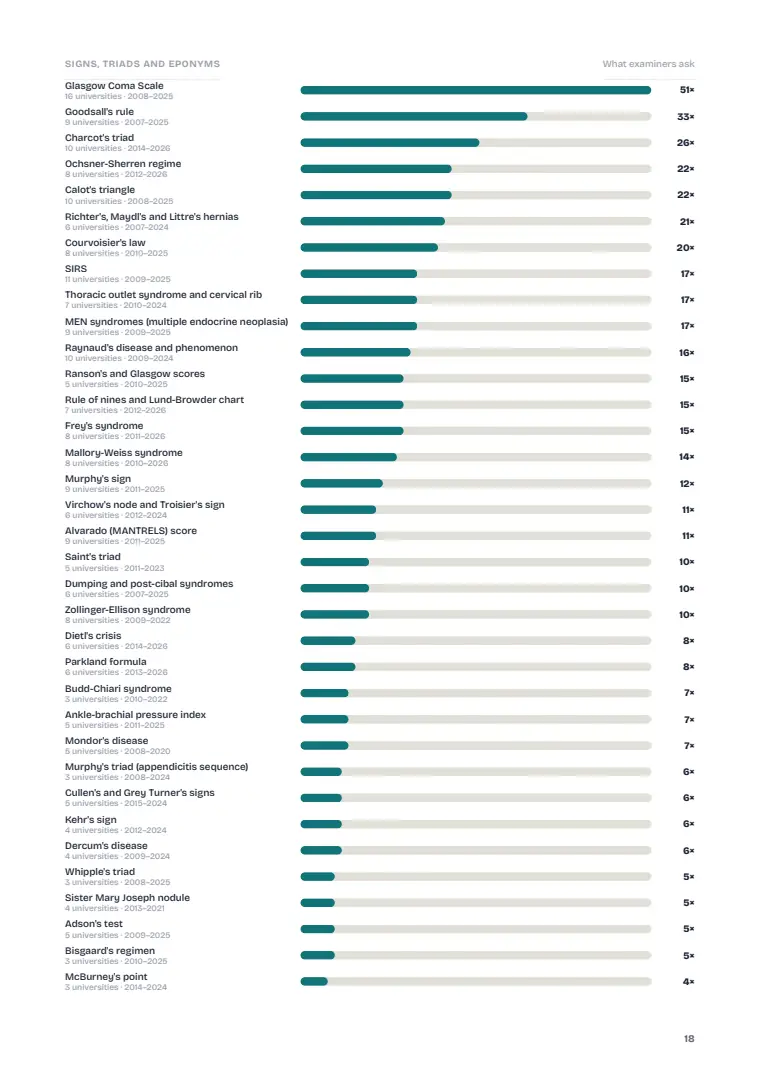
p. 18 · What examiners ask: previous years' questions - Night-before Surgery
Preview and contents
What you get (315 pages)- All 33 chapters in one PDF
- Read it the night before the exam
For every chapterWhat examiners ask, ranked · Ready exam answers · Viva cards · One-page recap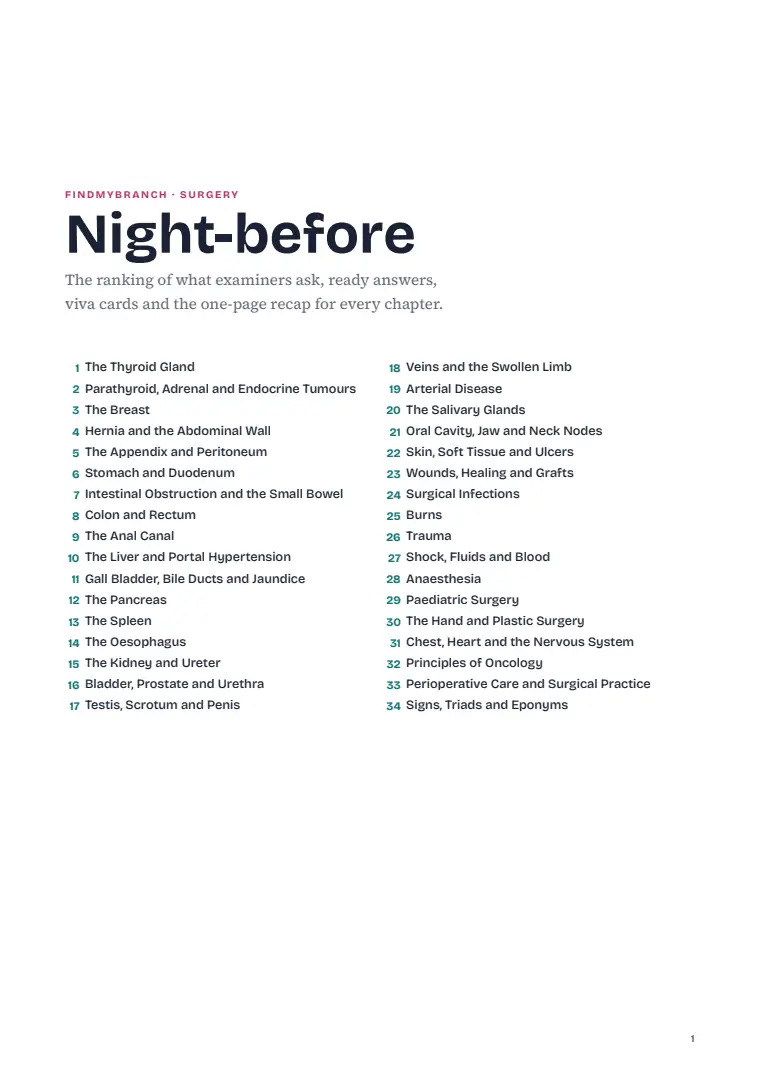
p. 1 · First page 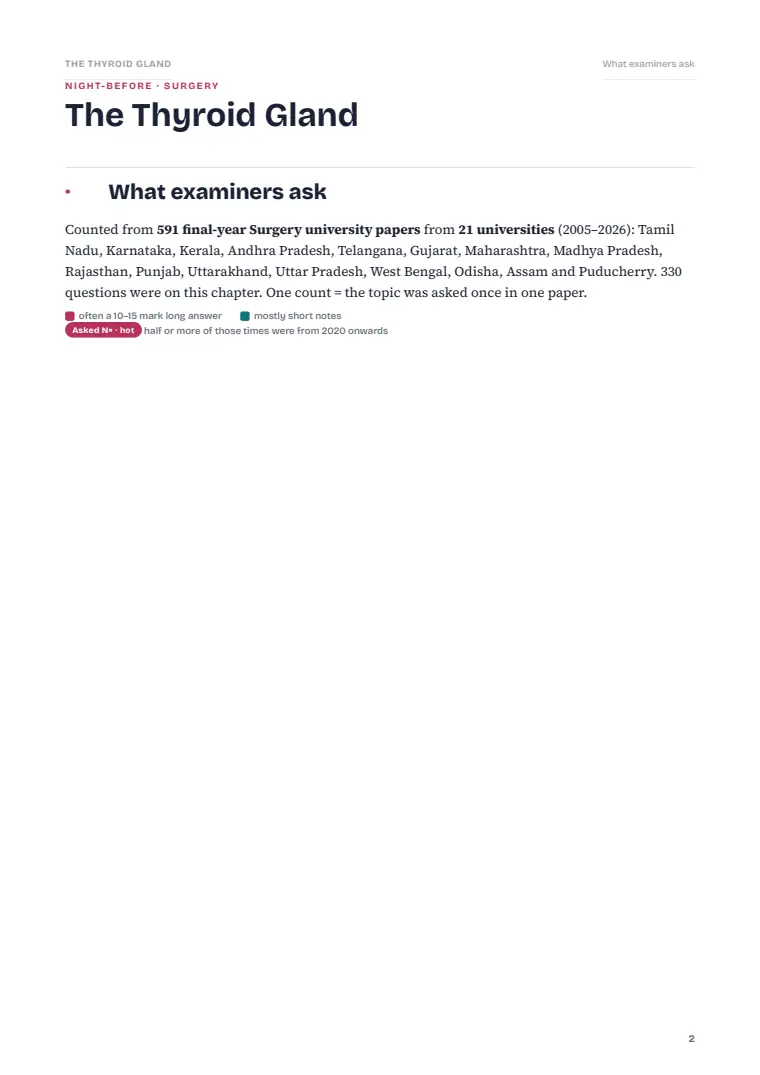
p. 2 · Inside 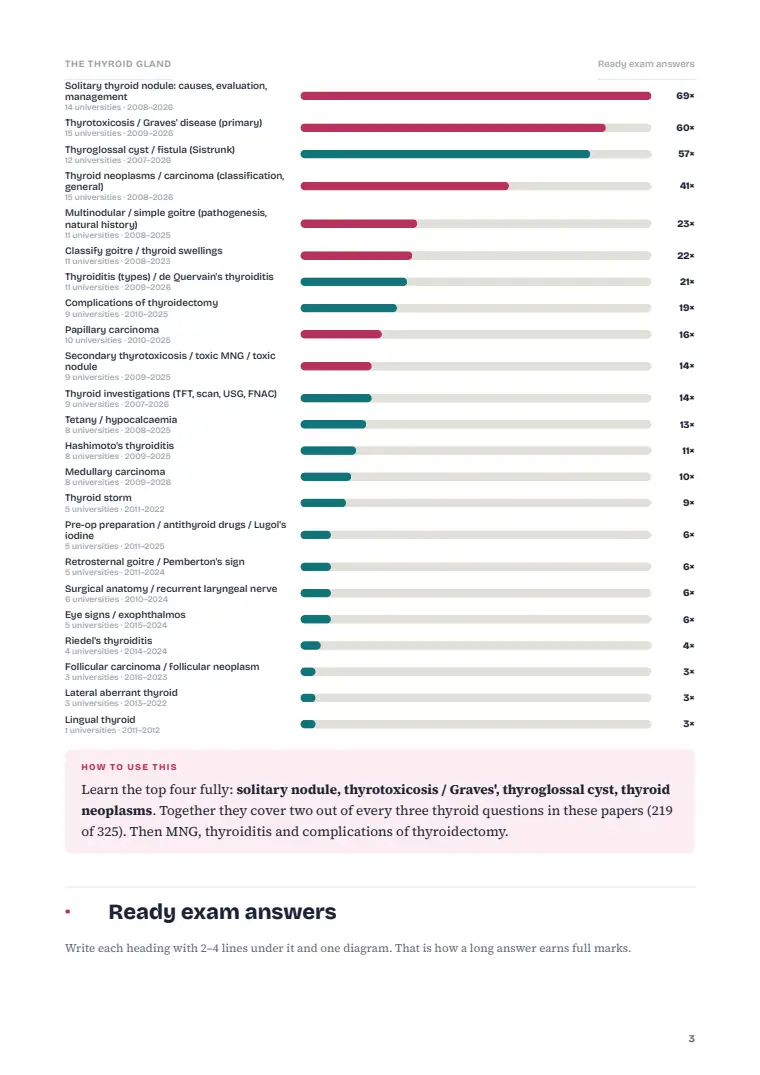
p. 3 · Inside 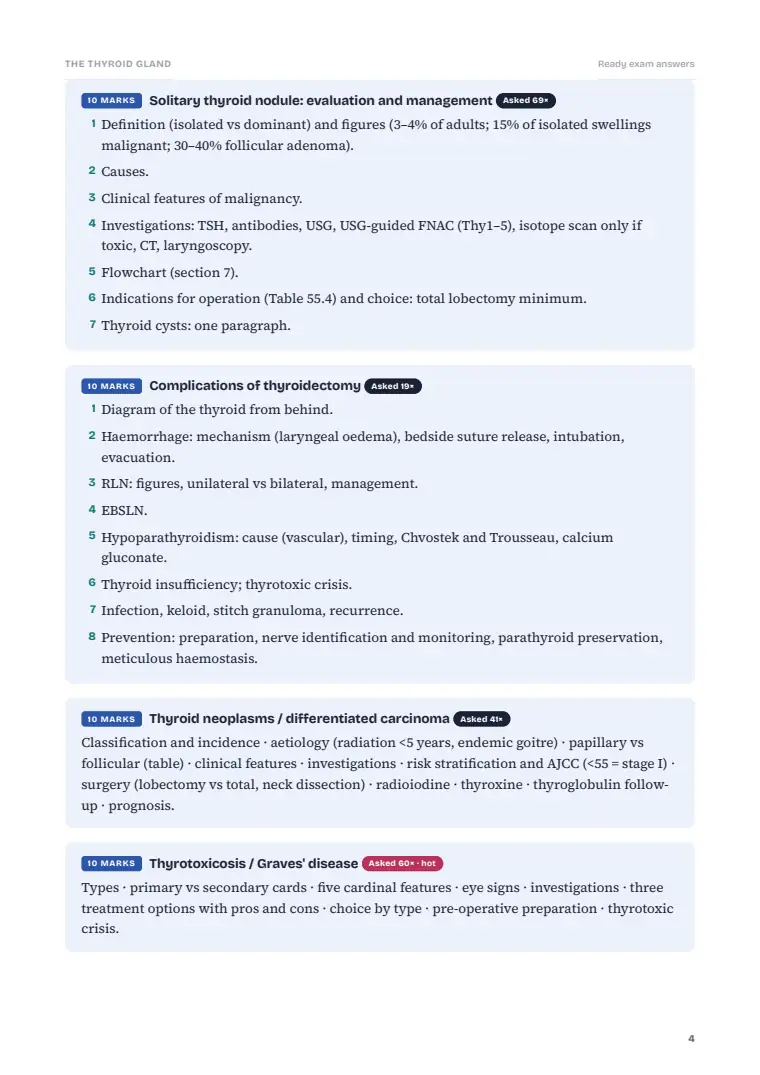
p. 4 · Inside
Already bought? Open your library.